The Anatomy of a Claude 5 Prompt
About This Cheat Sheet
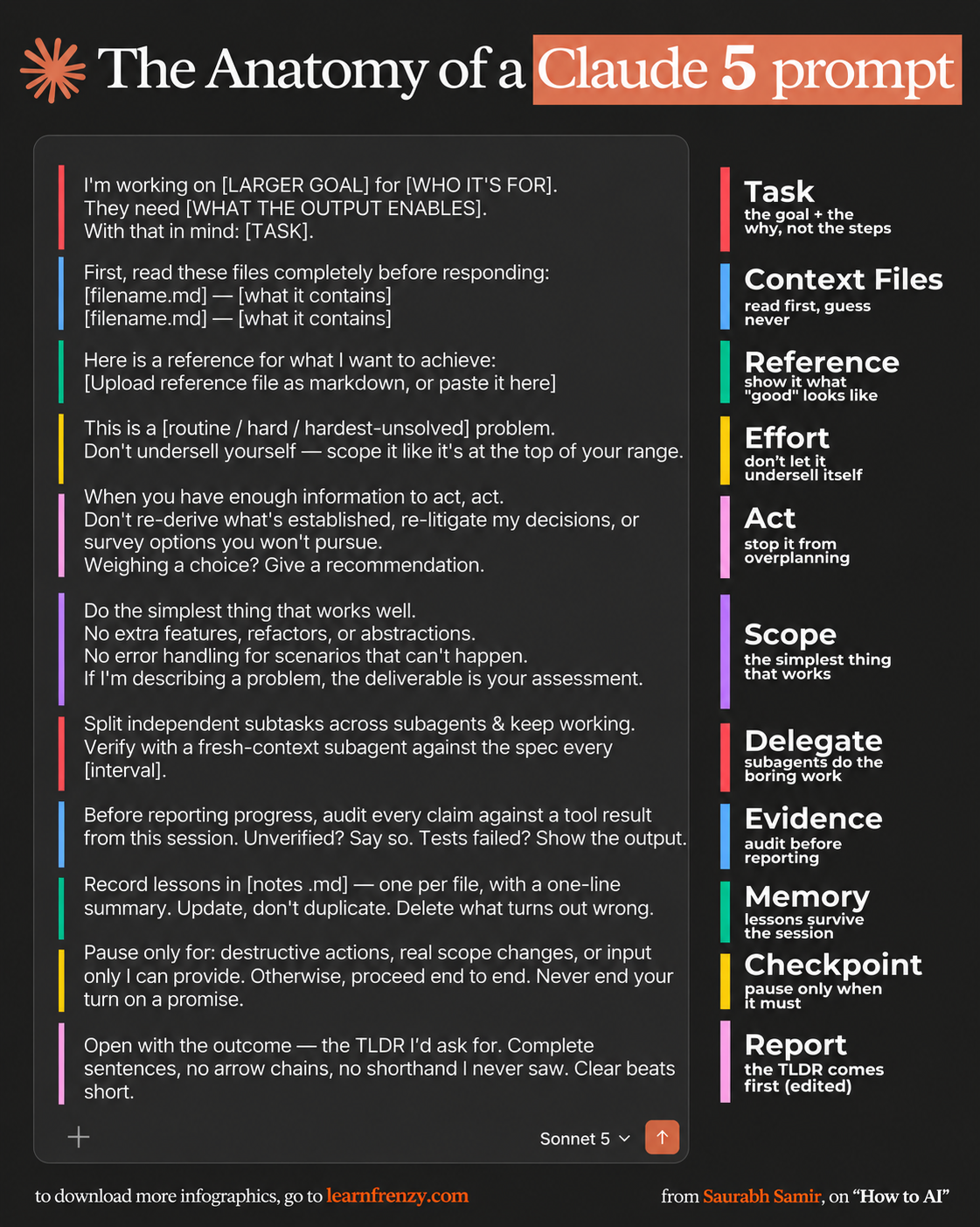
Hey! I'm Saurabh Samir, and this is my cheat sheet for the anatomy of a Claude 5 prompt — the proven framework that gets you perfect outputs every time. I've been refining this prompt structure for years, and it's the secret to getting Claude to deliver exactly what you need. This guide covers Core Structure (LARGER GOAL, WHO IT'S FOR, WHAT OUTPUT ENABLES, TASK), File Instructions (Read files completely before responding), Reference Material (Upload or paste reference), Problem Scoping (routine/hard/hardest-unsolved), Action Protocol (Act when ready, don't re-derive/re-litigate/survey), Simplicity Principle (Simplest that works, no extras), Subagent Strategy (Split tasks, verify every interval), Verification Protocol (Audit claims, show failures), Documentation (Record lessons in notes.md), Pause Conditions (Only for destructive actions/scope changes), and Output Format (TLDR first, complete sentences, clear beats short). Whether you're working on complex projects or simple tasks, this anatomy will transform your prompting.
🎯 Core Structure
- LARGER GOAL - What you're working on
- WHO IT'S FOR - Target audience
- WHAT OUTPUT ENABLES - Value/outcome
- TASK - Specific deliverable
- Define the mission
- Be specific
- Set clear expectations
📁 File Instructions
- Read files completely - Before responding
- filename.md - Name of the file
- What it contains - Brief description
- Sets full context
- Ensures accuracy
- No missing info
📎 Reference Material
- Upload reference - As markdown
- Or paste directly
- Provides examples
- Shows desired quality
- Sets style
- Gives Claude a model
📊 Problem Scoping
- routine - Standard task
- hard - Challenging task
- hardest-unsolved - Complex task
- Don't undersell yourself
- Scope at top of range
- Set difficulty level
⚡ Action Protocol
- Act when ready - Just execute
- Don't re-derive - What's established
- Don't re-litigate - My decisions
- Don't survey options - You won't pursue
- Give recommendation - Always
- Streamline decisions
📤 Output Format
- Open with outcome - TLDR first
- Complete sentences - Fully written
- No arrow chains - Avoid → → →
- No shorthand - Spell it out
- Clear beats short - Clarity first
- Professional delivery
🎯 4 Core
Goal, Audience, Output, Task
Define the mission📁 Files
Read completely
Full context📊 3 Scopes
routine, hard, hardest
Set difficulty⚡ Protocol
Act, Don't re-derive
Streamline📋 Key Topics Covered — Claude 5 Prompt Anatomy
| Section | Component | Purpose |
|---|---|---|
| Core Structure | LARGER GOAL, WHO IT'S FOR, WHAT OUTPUT ENABLES, TASK | Define the mission |
| File Instructions | Read files completely, filename.md with contents | Set context |
| Reference Material | Upload or paste reference | Provide examples |
| Problem Scoping | routine/hard/hardest-unsolved | Set difficulty level |
| Action Protocol | Act when ready, don't re-derive/re-litigate | Streamline decisions |
| Simplicity Principle | Simplest that works, no extras | Avoid over-engineering |
| Subagent Strategy | Split tasks, verify every interval | Scale work |
| Verification Protocol | Audit claims, show failures | Ensure accuracy |
| Documentation | Record lessons in notes.md | Learn and improve |
| Pause Conditions | Only for destructive actions, scope changes | Keep momentum |
| Output Format | TLDR, complete sentences, clear beats short | Perfect delivery |
📝 The Complete Claude 5 Prompt Template
🎯 Core Structure Breakdown
| Element | What to Include | Example |
|---|---|---|
| LARGER GOAL | The big-picture objective | "I'm working on launching a new product" |
| WHO IT'S FOR | Target audience or stakeholder | "for our enterprise sales team" |
| WHAT OUTPUT ENABLES | Value/outcome of the work | "They need the competitive analysis to win deals" |
| TASK | Specific deliverable | "With that in mind: create a competitive battle card" |
📁 File Instructions Breakdown
| Element | What to Include | Purpose |
|---|---|---|
| Read files completely | Command to ingest all files | Ensures full context |
| [filename.md] | Name of the file | Identifies the source |
| [what it contains] | Brief description | Explains file's purpose |
📝 Example File Instructions
📊 Problem Scoping Breakdown
| Level | What It Means | When to Use |
|---|---|---|
| routine | Standard, well-understood task | Everyday work |
| hard | Challenging, requires thought | Non-trivial problems |
| hardest-unsolved | Complex, unresolved | Breakthrough work |
💡 The Key Instruction
⚡ Action Protocol Breakdown
| Rule | What It Means | Benefit |
|---|---|---|
| Act when ready | Don't wait, just execute | Speed |
| Don't re-derive | Don't re-prove what's already known | Efficiency |
| Don't re-litigate | Don't re-argue decisions | Progress |
| Don't survey options | Don't explore dead ends | Focus |
| Give recommendation | Always suggest the best path | Clarity |
🚫 What NOT to Do
❌ Don't re-litigate my decisions
❌ Don't survey options you won't pursue
✅ Do: Weigh choices and give a recommendation
🧹 Simplicity Principle Breakdown
| Rule | What It Means | Why |
|---|---|---|
| Simplest that works | Minimal viable solution | Speed, clarity |
| No extra features | Only what's needed | Efficiency |
| No refactors | Don't restructure unnecessarily | Keep moving |
| No abstractions | Keep it concrete | Clarity |
| No error handling for impossible scenarios | Don't plan for what can't happen | Avoid waste |
🤝 Subagent Strategy Breakdown
| Rule | What It Means | Why |
|---|---|---|
| Split subtasks | Break work into pieces | Parallel processing |
| Across subagents | Use multiple AI agents | Scale productivity |
| Keep working | Maintain momentum | Efficiency |
| Verify every [interval] | Check against spec regularly | Quality assurance |
📝 Subagent Protocol
Verify with a fresh-context subagent against the spec every [interval].
🔍 Verification Protocol Breakdown
| Rule | What It Means | Why |
|---|---|---|
| Audit every claim | Check all statements | Accuracy |
| Against tool results | Use actual data | Truth |
| Unverified? Say so | Be honest about uncertainties | Transparency |
| Tests failed? Show output | Share failures directly | Accountability |
📝 Documentation Protocol Breakdown
| Rule | What It Means | Why |
|---|---|---|
| Record lessons | Save what you learn | Improvement |
| One per file | Separate learnings | Organization |
| One-line summary | Keep it concise | Usability |
| Update, don't duplicate | Add to existing | Avoid clutter |
| Delete wrong info | Remove bad lessons | Accuracy |
⏸️ Pause Conditions Breakdown
| Condition | When to Stop | Why |
|---|---|---|
| Destructive actions | Deleting data, big changes | Safety |
| Real scope changes | When the task fundamentally changes | Alignment |
| Input only you can provide | When only the user has info | Data |
| Otherwise | Don't pause for anything else | Momentum |
🚫 The Key Rule
📤 Output Format Breakdown
| Rule | What It Means | Why |
|---|---|---|
| Open with outcome | TLDR first | Immediately useful |
| Complete sentences | Fully written out | Clarity |
| No arrow chains | Avoid → → → | Readability |
| No shorthand | Spell it out | Professionalism |
| Clear beats short | Clarity over conciseness | Understanding |
🚫 What NOT to Use
❌ Shorthand you never saw
❌ Incomplete thoughts
📝 Template Fill-in Guide
| Variable | What to Put | Example |
|---|---|---|
| [LARGER GOAL] | The big objective | "launching a new product" |
| [WHO IT'S FOR] | Target audience | "for our enterprise sales team" |
| [WHAT OUTPUT ENABLES] | Value delivered | "to win competitive deals" |
| [TASK] | Specific deliverable | "create a competitive battle card" |
| [filename.md] | File name | "product-spec.md" |
| [what it contains] | File description | "detailed product requirements" |
| [routine/hard/hardest-unsolved] | Difficulty level | "hard" |
| [interval] | Check frequency | "every 5 minutes" |
| [notes .md] | Notes filename | "lessons-learned.md" |
🎯 When to Use This Prompt
| Scenario | How to Use |
|---|---|
| Complex project | Full template with all sections |
| Medium task | Use core structure + action protocol |
| Simple task | Only need core structure + output format |
| Team work | Add subagent strategy |
| Critical work | Add full verification protocol |
| Learning task | Add documentation protocol |
🚫 Common Mistakes to Avoid
| Mistake | Problem | Solution |
|---|---|---|
| Leaving brackets unfilled | Prompt doesn't work | Fill ALL variables |
| Too vague | Unclear outcome | Be specific in each section |
| Missing file context | Claude lacks info | Always upload files |
| Not scoping difficulty | Wrong effort level | Set routine/hard/hardest |
| Ending with promise | No follow-through | Never end on promise |
| No TLDR | Output buried | Open with outcome |
| No verification | Wrong outputs | Add verification protocol |
| Skipping subagents | Slower work | Use subagents for complex |
✅ Quick Implementation Checklist
| Step | Action | Status |
|---|---|---|
| 1 | Define LARGER GOAL | ⬜ |
| 2 | Define WHO IT'S FOR | ⬜ |
| 3 | Define WHAT OUTPUT ENABLES | ⬜ |
| 4 | Define TASK | ⬜ |
| 5 | List files with descriptions | ⬜ |
| 6 | Upload reference material | ⬜ |
| 7 | Set difficulty level | ⬜ |
| 8 | Add action protocol | ⬜ |
| 9 | Add simplicity principle | ⬜ |
| 10 | Add subagent strategy if needed | ⬜ |
| 11 | Add verification protocol | ⬜ |
| 12 | Add documentation protocol | ⬜ |
| 13 | Add pause conditions | ⬜ |
| 14 | Add output format instructions | ⬜ |
📊 Anatomy of a Claude 5 Prompt — Visual Summary
🎯 The Anatomy of a Claude 5 Prompt — Quick Revision
The Golden Rule: Every Claude 5 prompt should follow this anatomy: Core Structure → File Instructions → Reference → Problem Scoping → Action Protocol → Simplicity → Subagent Strategy → Verification → Documentation → Pause Conditions → Output Format. Fill every bracket, be specific, and never end on a promise.
Quick Memory Tricks:
- 📌 Core Structure: "Goal → Audience → Output → Task"
- 📌 Problem Scoping: "routine → hard → hardest-unsolved"
- 📌 Action Protocol: "Act → Don't re-derive → Don't re-litigate → Give recommendation"
- 📌 Simplicity: "Simplest that works, no extras"
- 📌 Output: "TLDR first → Complete sentences → Clear beats short"
Key Rules to Remember:
- ✅ Never end on a promise — Always deliver
- ✅ Don't undersell yourself — Scope at top of your range
- ✅ Don't re-derive/re-litigate/survey — Just execute
- ✅ Open with outcome — TLDR first, every time
- ✅ Clear beats short — Clarity always wins
💡 Pro Tips for Claude 5 Prompts
✅ Fill Every Bracket
Every [bracket] in the template must be filled. Vague prompts = vague outputs. Be specific in every section.
✅ Always Add Files
Claude needs context. Always upload files and describe what each contains. This ensures accurate, informed outputs.
✅ Never End on a Promise
If Claude says "I'll do that next," it's a red flag. Always demand complete, finished output in one response.
✅ Open with TLDR
Every response should start with the outcome. What would you want to know first? Put that at the top.
✅ Scope Up, Not Down
Set difficulty at the top of your range. Don't undersell what you need. Claude can handle it.
✅ Use Verification for Critical Work
For important tasks, add the verification protocol. Claude audits claims against tool results, ensuring accuracy.
from Saurabh Samir, on "How to AI"
Download Cheat Sheet
Click the button below to download this high-resolution PNG cheat sheet.
Download PNG (1.5 MB)Preview
Still have questions?
We're here to help! Reach out to our support team for any queries.