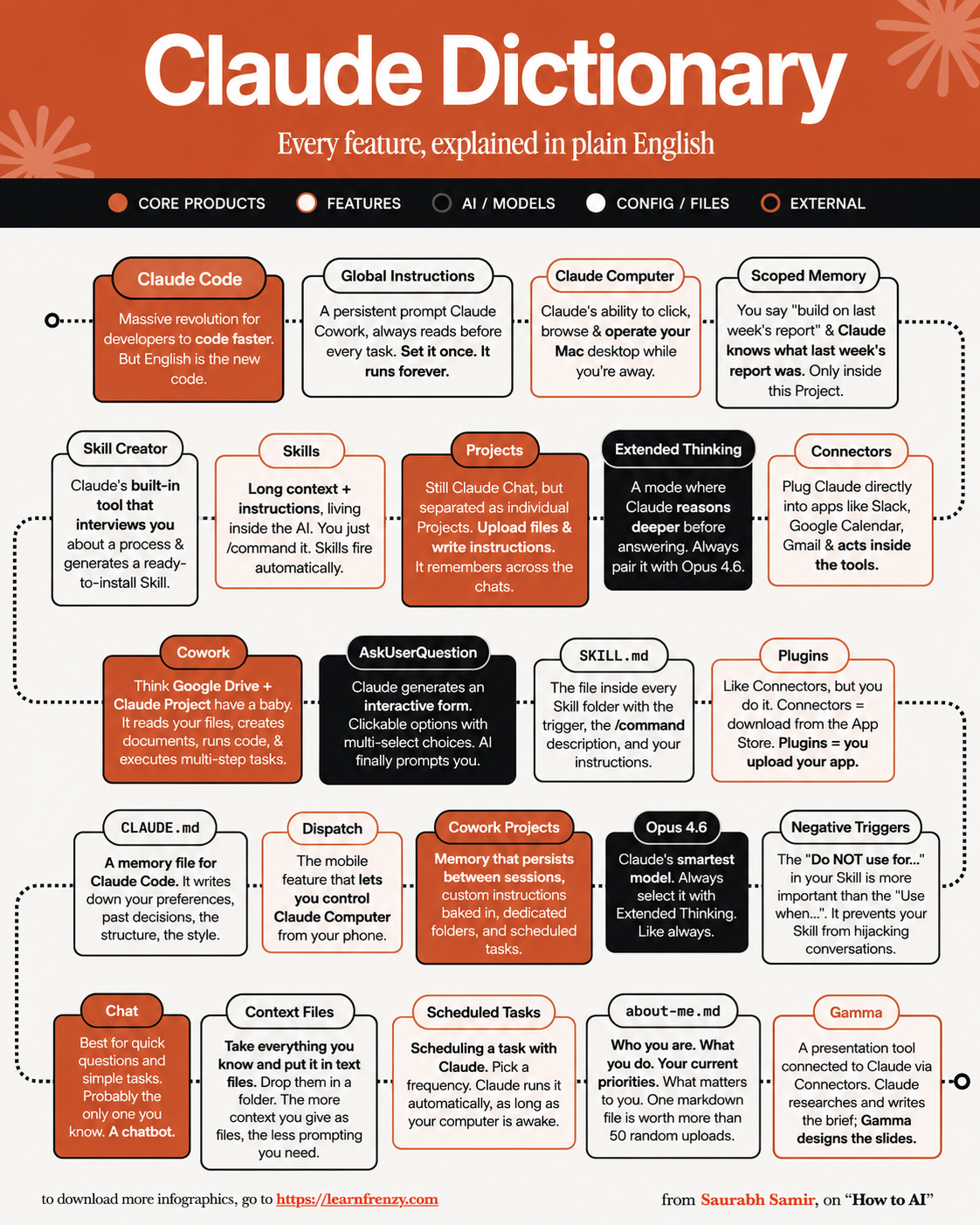
Claude Dictionary
About This Cheat Sheet
Hi! I'm Saurabh Samir, and this is my Claude Dictionary — a handy reference guide to understand all the key terms, concepts, and features of Claude AI. Whether you're new to Claude or a seasoned user, this cheat sheet will help you speak the language of AI with confidence. This guide covers essential Claude terminology (Artifacts, Projects, Context Window, Vision, Multimodal, Sonnet, Opus, Haiku, Prompt Engineering, Chain of Thought, Temperature, Top-P, System Prompts, Fine-tuning, Embeddings, Tokenization, API, Rate Limits, Streaming, Moderation, Safety Filters, Hallucination, Grounding, RAG, Agents, Tools, Function Calling, JSON Mode, Structured Outputs, and more), common AI terms explained simply, and practical definitions for everything you need to navigate the Claude ecosystem. Whether you're a developer, content creator, or just curious about AI, this cheat sheet will help you understand and use Claude like a pro.
🤖 Claude Models
- Claude 3.5 Sonnet - Best overall
- Claude 3 Opus - Most powerful
- Claude 3 Haiku - Fastest
- Anthropic - Creator of Claude
- 200K Context Window
- Multimodal Capabilities
✨ Core Features
- Artifacts - Code/documents panel
- Projects - Organized conversations
- Vision - Image analysis
- Context Window - 200K tokens
- Multimodal - Text + Images
- Streaming - Real-time responses
📝 Prompting Terms
- Prompt Engineering - Crafting prompts
- Chain of Thought - Step-by-step thinking
- System Prompt - Initial instructions
- Temperature - Randomness control
- Top-P - Vocabulary diversity
- Structured Outputs - Organized data
🔧 Technical Terms
- Token - Smallest text unit
- Tokenization - Breaking text into tokens
- API - Application interface
- Rate Limits - Request restrictions
- JSON Mode - Structured responses
- Function Calling - External tools
🧠 AI Concepts
- Hallucination - False information
- Grounding - Fact-based responses
- RAG - Retrieval-Augmented Generation
- Agents - Action-taking AI
- Tools - External functions
- Fine-tuning - Custom training
🛡️ Safety & More
- Safety Filters - Content moderation
- Moderation - Checking harmful content
- Embeddings - Text as numbers
- System Prompts - Core instructions
- Temperature - 0 = precise, 1 = creative
- Top-P - Diversity control
🤖 3 Models
Sonnet · Opus · Haiku
Choose your AI📄 200K Tokens
Context Window
Entire books📝 Prompting
Engineering + CoT
Better results🛡️ Safety
Filters + Moderation
Responsible AI🤖 Claude Models Dictionary
⚡ Claude 3.5 Sonnet
- Type: Best overall model
- Speed: Fast
- Intelligence: Very High
- Best For: Everyday tasks, coding, content creation
- Access: Free & Pro
- My Note: My go-to model for everything
🏆 Claude 3 Opus
- Type: Most powerful model
- Speed: Slower
- Intelligence: Highest
- Best For: Complex reasoning, research, advanced analysis
- Access: Pro only
- My Note: Use for critical, complex tasks
💨 Claude 3 Haiku
- Type: Fastest, most affordable
- Speed: Very Fast
- Intelligence: Good
- Best For: Quick tasks, high volume, simple requests
- Access: Free & Pro
- My Note: Perfect for simple, quick answers
✨ Core Features Dictionary
📝 Prompting Terms Dictionary
🔧 Technical Terms Dictionary
💻 API & Integration
- API: Application Programming Interface - allows developers to integrate Claude into their applications.
- Rate Limits: Maximum number of API requests allowed per minute or day.
- Function Calling: Claude's ability to use external tools and functions to perform tasks.
📊 Data & Output
- JSON Mode: Getting responses in JSON format for easy parsing and integration.
- Structured Outputs: Organized data formats like tables, lists, or custom schemas.
- Embeddings: Converting text into numerical representations that computers can process.
📝 Tokenization
- Token: The smallest unit of text that Claude processes. Approximately 4 characters or 0.75 words.
- Tokenization: The process of breaking text into tokens for processing.
- 200K Context: Claude can process 200,000 tokens in a single conversation.
🧠 AI Concepts Dictionary
🔍 Understanding AI Behavior
- Hallucination: When AI generates false or made-up information that sounds plausible but is incorrect.
- Grounding: Connecting AI responses to factual, verifiable information to ensure accuracy.
- RAG (Retrieval-Augmented Generation): A technique that retrieves relevant information from a database before generating a response.
🤖 Advanced AI Capabilities
- Agents: AI systems that can take actions and perform tasks autonomously.
- Tools: External functions and integrations that Claude can use to extend its capabilities.
- Fine-tuning: Training Claude on specific data to specialize it for particular tasks or domains.
📚 Model Knowledge
- Training Data: The vast amount of text used to train Claude.
- Parameters: The internal settings that determine how Claude processes information.
- Inference: The process of Claude generating responses based on learned patterns.
🛡️ Safety & Moderation Dictionary
🛡️ Safety Features
- Safety Filters: Built-in content moderation systems that prevent harmful or inappropriate responses.
- Moderation: The process of checking and filtering content for safety and compliance.
- Ethical Guidelines: The principles that guide Claude's behavior, designed by Anthropic.
- Responsible AI: The commitment to developing AI that is safe, ethical, and beneficial to society.
⚖️ Compliance & Privacy
- Privacy: How Claude handles user data and conversations.
- Security: Measures to protect user information and prevent unauthorized access.
- Compliance: Following regulations like GDPR and other data protection laws.
- Transparency: Being open about how Claude works and its limitations.
📋 Claude Dictionary: Complete Key Terms Table
🤖 Models & Basics
- Claude: AI assistant created by Anthropic
- Anthropic: Company that created Claude
- Sonnet: Fastest Claude model (3.5 Sonnet)
- Opus: Most powerful Claude model
- Haiku: Fastest, most affordable Claude model
- Context Window: 200,000 tokens of text Claude can process
✨ Features & Capabilities
- Artifacts: Separate window for code, documents, designs
- Projects: Organize conversations and files by project
- Vision: Claude's ability to analyze images
- Multimodal: Ability to process text and images
- Streaming: Real-time word-by-word responses
- Files: Upload PDF, DOCX, XLSX, images, and more
📋 More Claude Dictionary Terms
📝 Prompting & Output
- Prompt Engineering: Crafting effective prompts for better results
- Chain of Thought: Asking AI to think step by step
- System Prompt: Instructions given at the start of conversation
- Temperature: Controls randomness (0 = precise, 1 = creative)
- Top-P: Controls vocabulary diversity
- JSON Mode: Getting structured JSON responses
🔧 Technical & Advanced
- Token: Smallest unit of text (approx 4 characters)
- Tokenization: Breaking text into tokens
- API: Application Programming Interface
- Rate Limits: Maximum API requests per minute
- Function Calling: Claude using external tools
- Structured Outputs: Organized data formats
📋 Even More Claude Dictionary Terms
🧠 AI Concepts
- Hallucination: AI making up false information
- Grounding: Connecting AI responses to facts
- RAG: Retrieval-Augmented Generation
- Agents: AI systems that take actions
- Tools: Functions Claude can call
- Fine-tuning: Training on specific data
🛡️ Safety & More
- Safety Filters: Content moderation systems
- Moderation: Checking for harmful content
- Embeddings: Text as numerical representations
- Inference: Generating responses
- Parameters: Internal model settings
- Training Data: Data used to train Claude
🎯 Claude Dictionary: Quick Reference Guide
The Golden Rule: Understanding these terms will help you communicate better with Claude and get more out of your AI interactions. Master the language of AI to become a power user.
My Top 10 Essential Terms to Know:
- 1. Claude 3.5 Sonnet: The best overall model for most tasks
- 2. Context Window: 200K tokens = process entire books
- 3. Artifacts: Separate panel for code and long content
- 4. Prompt Engineering: The art of getting better responses
- 5. Chain of Thought: "Think step by step" for better answers
- 6. Temperature: Control randomness (0 = factual, 1 = creative)
- 7. Vision: Claude can analyze images and charts
- 8. Hallucination: When AI makes up false information
- 9. RAG: Retrieving facts before generating responses
- 10. System Prompt: Setting Claude's behavior from the start
Common Confusions Clarified:
- Sonnet vs Opus vs Haiku: Sonnet = best overall, Opus = most powerful, Haiku = fastest
- Temperature vs Top-P: Temperature controls randomness, Top-P controls vocabulary diversity
- Grounding vs RAG: Grounding = connecting to facts, RAG = retrieving facts from a database
- Tokens vs Words: 1 token ≈ 4 characters or 0.75 words
My Memory Trick: Remember the 5 Categories of Claude Terminology:
- 🤖 Models: Sonnet, Opus, Haiku
- ✨ Features: Artifacts, Projects, Vision
- 📝 Prompting: Engineering, CoT, Temperature
- 🔧 Technical: API, Tokens, Rate Limits
- 🧠 Concepts: Hallucination, Grounding, RAG
💡 My Pro Tips for Using the Claude Dictionary
✅ Use the Right Term
Using correct terminology helps you get better results. For example, ask for "Chain of Thought" instead of "explain step by step" for more structured reasoning.
✅ Understand Temperature
Use lower temperature (0-0.3) for factual tasks, higher temperature (0.7-1.0) for creative writing and brainstorming.
✅ Master System Prompts
Set system prompts to define Claude's role and behavior. This ensures consistent responses across conversations.
✅ Learn About RAG
Understanding RAG helps you know why Claude sometimes asks for uploaded documents before answering complex questions.
✅ Watch for Hallucinations
Always fact-check Claude's responses, especially for technical, medical, or legal topics. Use grounding techniques when possible.
✅ Use Structured Outputs
Ask for JSON, tables, or bullet points for better organization and easier data extraction from Claude's responses.
📋 Quick Reference: Term Categories
🤖 Models
- Sonnet
- Opus
- Haiku
- Anthropic
✨ Features
- Artifacts
- Projects
- Vision
- Multimodal
📝 Prompting
- Prompt Engineering
- Chain of Thought
- System Prompt
- Temperature
🔧 Technical
- Tokens
- API
- Rate Limits
- JSON Mode
📋 Must-Know Terms for Every Claude User
🎯 Beginner Terms
- Claude: AI assistant
- Prompt: Your question
- Response: Claude's answer
- Chat: Conversation
- Upload: Add files
📊 Intermediate Terms
- Artifacts: Long content panel
- Projects: Organized chats
- Vision: Image analysis
- Context Window: 200K tokens
- Multimodal: Text + Images
🚀 Advanced Terms
- RAG: Retrieval-Augmented Generation
- Function Calling: External tools
- Agents: Action-taking AI
- Fine-tuning: Custom training
- Embeddings: Text as numbers
Download Cheat Sheet
Click the button below to download this high-resolution PNG cheat sheet.
Download PNG (1.5 MB)Preview
Still have questions?
We're here to help! Reach out to our support team for any queries.