Completion of Figures - Expert Level
Practice and master this topic with our carefully crafted questions.
In each of the following questions, select a figure from amongst the four alternatives, which when placed in the blank space of fig. (X) would complete the pattern.
In each of the following questions, select a figure from amongst the four alternatives, which when placed in the blank space of fig. (X) would complete the pattern.
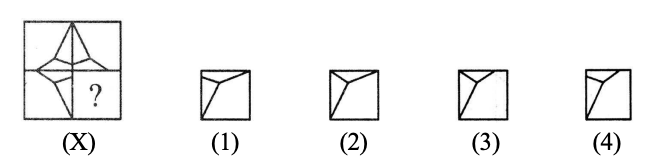
🔍 Analyze the Pattern
The missing part is the lower-right quadrant of the large square.
Observe the lines entering the blank region:
- A diagonal line enters from the centre and must continue towards the lower-right corner.
- A slanting line enters from the upper boundary of the missing quadrant.
- These lines must meet at exactly the same points as the adjoining quadrants.
Now compare the options carefully.
- Fig. (1) does not align the upper junction correctly.
- Fig. (2) shifts the top V-shaped meeting point slightly to the left.
- Fig. (3) does not continue the incoming lines accurately.
- Fig. (4) perfectly matches all boundary points and completes the figure without any break.
Therefore, the missing quadrant is represented by Fig. (4).
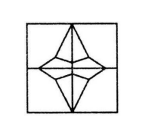
Correct Answer: (D)
⚡ Quick Exam Shortcut
Ignore the overall shape and focus only on the boundary connections.
The correct option must:
- Continue the diagonal from the centre.
- Match the upper slanting line exactly.
- Align all meeting points on the borders.
Only Figure (4) satisfies all these conditions.
Shortcut Answer: Match all boundary junctions exactly → Option (D).
In each of the following questions, select a figure from amongst the four alternatives, which when placed in the blank space of fig. (X) would complete the pattern.
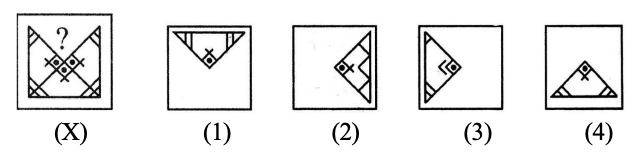
🔍 Analyze the Figure
Search for the exact arrangement consisting of:
- A triangular outline.
- A small diamond near the top.
- Diagonal connecting lines.
- Striped corner portions.
Only Fig. (4) appears in the given figure with the same orientation and proportions.
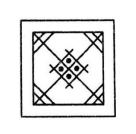
Correct Answer: (D)
⚡ Quick Exam Shortcut
Focus on the small diamond first.
Then trace the surrounding triangle and striped portions.
The exact combination appears only in Fig. (4).
Shortcut Answer: Diamond + triangle + matching stripes → Option (D).
In each of the following questions, select a figure from amongst the four alternatives, which when placed in the blank space of fig. (X) would complete the pattern.
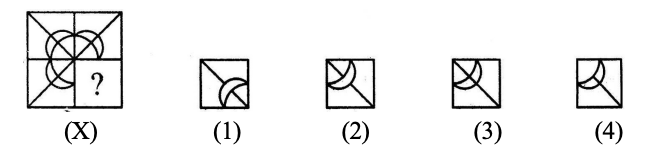
🔍 Analyze the Pattern
The missing quadrant must continue both the diagonal line and the circular arcs coming from the centre.
- The diagonal must run from the upper-left corner to the lower-right corner.
- Two circular arcs must intersect near the upper-left portion of the quadrant.
- The arcs must align exactly with the neighbouring quadrants.
Among the answer figures, only Fig. (3) correctly continues all the lines and curves.
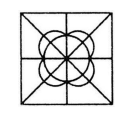
Correct Answer: (C)
⚡ Quick Exam Shortcut
Trace the arcs entering the blank space from the centre.
The correct option must continue both arcs and the diagonal without any break.
Shortcut Answer: Match the incoming arcs exactly → Option (C).
In each of the following questions, select a figure from amongst the four alternatives, which when placed in the blank space of fig. (X) would complete the pattern.
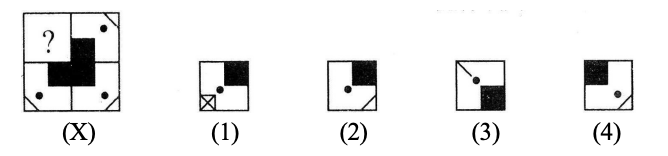
🔍 Analyze the Pattern
Focus on the central black shape rather than the corner markings.
- The black region is formed by contributions from all four quadrants.
- The missing quadrant must provide the upper-left portion of the central black block.
- The dot arrangement must remain consistent with the other quadrants.
Among all options, only Fig. (4) correctly completes the central black pattern and maintains the overall symmetry.
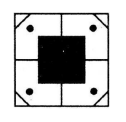
Correct Answer: (D)
⚡ Quick Exam Shortcut
In figure completion questions, first check whether any shaded region continues across quadrants.
Here the central black shape is incomplete and the missing piece must complete it.
Shortcut Answer: Complete the central black block → Option (D).
In each of the following questions, select a figure from amongst the four alternatives, which when placed in the blank space of fig. (X) would complete the pattern.
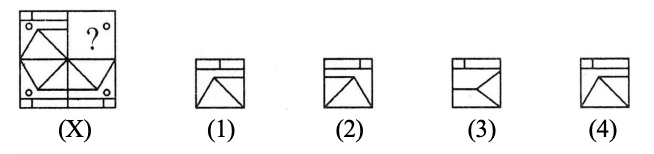
🔍 Analyze the Pattern
The missing quadrant must complete both the upper strip pattern and the central triangular design.
- The top rectangular block shifts to the right side.
- The triangular shape must continue symmetrically across the vertical centre line.
- The diagonal must align perfectly with the existing lines.
Among the answer figures, only Fig. (2) satisfies all these conditions.
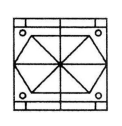
Correct Answer: (B)
⚡ Quick Exam Shortcut
Check the vertical mirror symmetry.
The missing piece must mirror the top-left quadrant while continuing the central triangle.
Shortcut Answer: Mirror the left side and continue the triangle → Option (B).
In each of the following questions, select a figure from amongst the four alternatives, which when placed in the blank space of fig. (X) would complete the pattern.
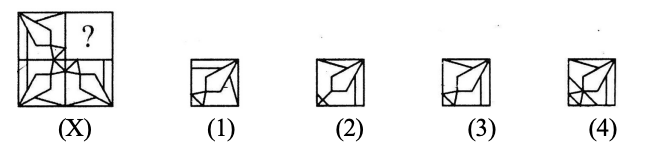
🔍 Analyze the Pattern
The missing part is the upper-right quadrant of the figure.
Step 1: Match the Central Diagonal
A diagonal line starts from the central meeting point and continues towards the upper-right corner. The missing piece must continue this line exactly.
Step 2: Match the Zig-Zag Shape
The irregular zig-zag figure entering from the left boundary must continue smoothly into the blank region.
Step 3: Match the Right Border
The vertical strip near the right border must align perfectly with the strip visible in the lower-right quadrant.
Step 4: Check the Small Corner Section
The small triangular section near the lower-left corner of the missing quadrant must align exactly with the central junction.
Among all the options:
- Fig.1 (1) misplaces the diagonal.
- Fig. (2) does not align the lower-left section correctly.
- Fig. (4) introduces extra lines that do not continue from the main figure.
- Fig. (3) matches every incoming line and boundary perfectly.
Clearly fig. (3) when placed in the blank in fig. (X) will complete the pattern, as shown below :
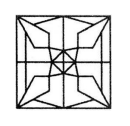
Correct Answer: (C)
⚡ Quick Exam Shortcut
For figure completion questions:
- Match the central junction first.
- Follow all lines entering the blank space.
- Check border alignment.
- Reject options with extra or missing line segments.
Only Fig. (3) satisfies all these conditions.
Shortcut Answer: Exact continuation of all boundary lines → Option (C).
In each of the following questions, select a figure from amongst the four alternatives, which when placed in the blank space of fig. (X) would complete the pattern.
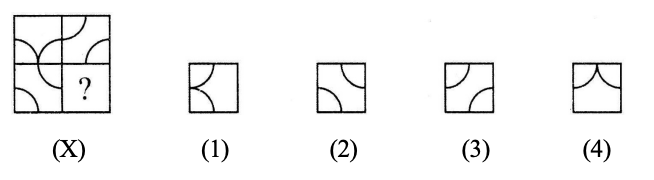
🔍 Analyze the Pattern
The missing portion is the lower-right quadrant of the figure.
Step 1: Follow the Central Circle
The circle in the centre extends into the missing quadrant. Therefore, one arc must begin from the middle of the left boundary of the missing square.
Step 2: Follow the Right-Side Curve
The curve visible in the upper-right quadrant continues downward across the right side of the figure. The missing piece must contain the continuation of this curve.
Step 3: Match Boundary Contact Points
The important point is where the arcs touch the edges of the missing square.
- The central circular arc enters from the left side.
- The outer curve continues along the right side.
- Both arcs must meet the boundaries at exactly the same locations as the surrounding figure.
Among the answer figures:
- Fig. (2) places the upper arc at the wrong boundary position.
- Fig. (3) reverses the curve arrangement.
- Fig. (4) introduces a different curved pattern.
- Fig. (1) correctly continues both incoming curves and matches all boundary points.
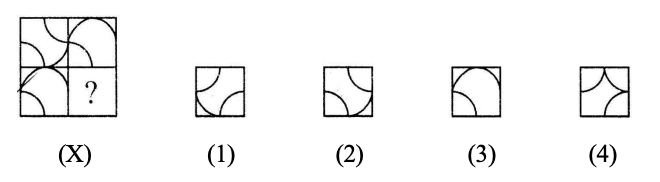
Clearly fig. (1) when placed in the blank in fig. (X) will complete the pattern, as shown below :
Correct Answer: (A)
⚡ Quick Exam Shortcut
Ignore the overall design and focus on the curve endpoints.
- Find where each arc enters the blank space.
- Match the exact boundary positions.
- Reject options with shifted arc locations.
Only Fig. (1) matches both incoming curves perfectly.
Shortcut Answer: Match the curve entry points exactly → Option (A).
In each of the following questions, select a figure from amongst the four alternatives, which when placed in the blank space of fig. (X) would complete the pattern.
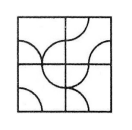
🔍 Analyze the Pattern
The missing quadrant must continue the curves entering from the adjacent quadrants.
- A curve enters from the upper boundary near the right side.
- Another curve enters from the left boundary near the bottom side.
- Both curves must continue smoothly without any break.
Among the answer figures, only Fig. (2) correctly continues both arcs.
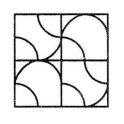
Correct Answer: (B)
⚡ Quick Exam Shortcut
Trace the arcs entering the blank space.
The correct option must have:
- One arc in the top-right corner.
- One arc in the bottom-left corner.
Shortcut Answer: Match both incoming arcs → Option (B).
In each of the following questions, select a figure from amongst the four alternatives, which when placed in the blank space of fig. (X) would complete the pattern.
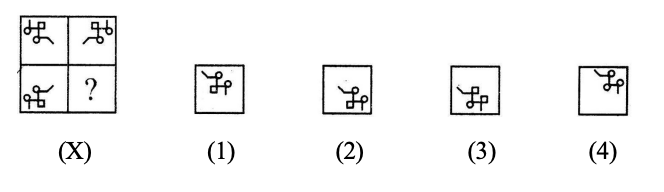
🔍 Analyze the Pattern
The relationship is based on mirror symmetry, not rotation.
In each row:
- The right figure is the mirror image of the left figure.
- The circle and square exchange positions.
- The bent arm reverses direction.
Applying the same rule to the second row, the missing figure must be the mirror image of the bottom-left figure.
Only Fig. (2) satisfies this condition.
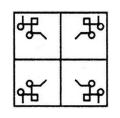
Correct Answer: (B)
⚡ Quick Exam Shortcut
Check whether the figures are rotating or mirroring.
Here, the top row clearly shows a left-right mirror image.
Apply the same mirror rule to the bottom row.
Shortcut Answer: Mirror image pattern → Option (B).
In each of the following questions, select a figure from amongst the four alternatives, which when placed in the blank space of fig. (X) would complete the pattern.
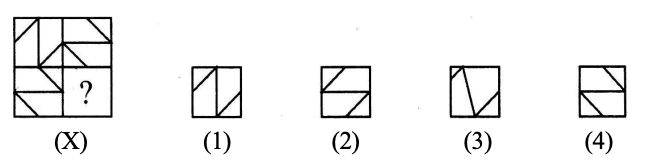
🔍 Analyze the Pattern
Observe the three visible quadrants carefully.
- The top-left quadrant contains a vertical strip and a diagonal corner cut.
- The top-right quadrant is obtained by rotating the pattern around the centre.
- The bottom-left quadrant continues the same rotational arrangement.
The missing bottom-right quadrant must therefore complete the rotational sequence.
Boundary Matching
The missing piece must:
- Continue the vertical line coming from the top boundary.
- Continue the horizontal line entering from the left boundary.
- Match the diagonal line touching the centre.
Among the options:
- Fig. (2) introduces an unnecessary horizontal division.
- Fig. (3) misaligns the diagonal with the centre.
- Fig. (4) places the diagonal cuts in incorrect positions.
- Fig. (1) matches all boundary lines and completes the rotational pattern perfectly.
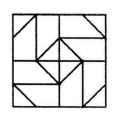
Correct Answer: (A)
⚡ Quick Exam Shortcut
In figure completion questions:
- Check the lines touching the centre first.
- Match the boundary continuations.
- Reject options that add extra lines.
Only Fig. (1) continues all existing lines without adding any extra pattern.
Shortcut Answer: Match the centre and boundary lines exactly → Option (A).