Completion of Figures
✏️ Practice with curated questions covering all difficulty levels. Detailed solutions and expert tips help you master each question type.
Sample Questions
Study MaterialSample Questions
The following sample questions demonstrate the most important concepts used in Completion of Figures, including rotational symmetry, diagonal similarity, mirror-image relationships, and design-based pattern completion.
Carefully observe the incomplete figure, identify the hidden relationship, and determine which answer figure correctly completes the pattern.
Sample Question 1
Complete the pattern in fig. (X) by selecting one of the figures from the four alternatives:
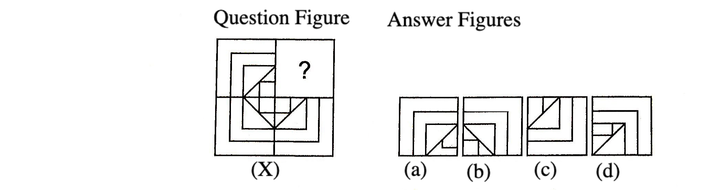
Pattern Identified: Rotational Symmetry Through 90°
🔍 Analysis
All three visible sections contain the same design. Each section is obtained by rotating the previous section through 90° clockwise.
Therefore, the missing section can be obtained by rotating the adjacent visible section by 90° clockwise.
Correct Answer: Option (b)
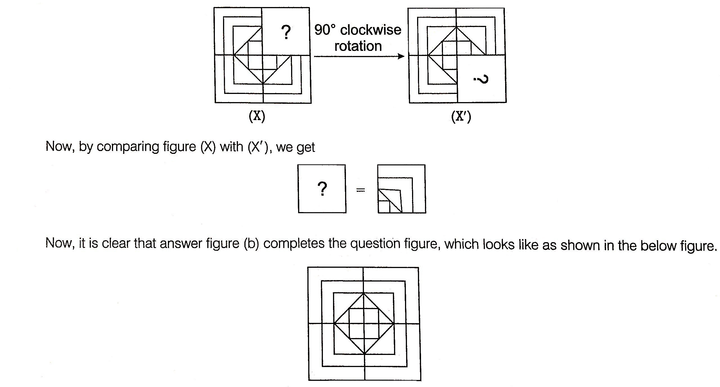
💡 Visual Explanation
The solution diagram shows how the missing section is obtained by rotating the existing design through 90° clockwise. Once the rotation is applied, the missing quadrant perfectly matches Option (b).
✓ Key Learning
Whenever all visible quadrants contain the same design in different orientations, check whether the figure follows a fixed rotational sequence.
Sample Question 2
Select a figure from the four alternatives, which when placed in the blank space of figure (X) would complete the pattern.
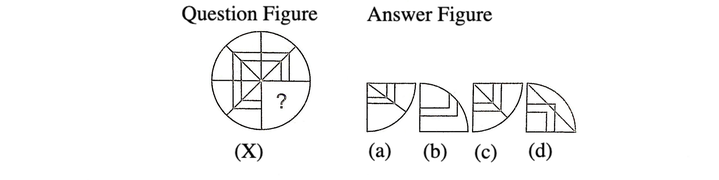
Pattern Identified: Rotational Symmetry Through 90°
🔍 Analysis
Observe the three visible sections of the figure carefully. Each section contains the same design, but its orientation changes systematically.
The design is obtained by rotating the previous section through 90° clockwise. Therefore, the missing portion must also follow the same rotational sequence.
If we rotate the adjacent visible section by 90° clockwise, we obtain the exact design required to complete the figure.
Correct Answer: Option (c)
✓ Key Learning
Whenever three sections of a figure contain identical designs in different orientations, check whether the pattern follows a fixed rotational movement. In most cases, the missing section can be obtained by rotating an existing section through the same angle.
Sample Question 3
Select a figure from the four alternatives, which when placed in the blank space of figure (X) would complete the pattern.

Pattern Identified: Rotational Symmetry Through 90°
🔍 Analysis
The figure is divided into four equal sections. The three visible sections contain the same design arranged in a rotational sequence.
By observing the pattern carefully, we find that each section is obtained by rotating the previous section through 90° clockwise.
To determine the missing portion, rotate the design in section (X) by 90° clockwise. The resulting figure matches one of the answer options exactly.
Hence, the figure represented by Option (b) correctly completes the pattern.
Correct Answer: Option (b)
✓ Key Learning
In rotational symmetry questions, focus on how one section transforms into the next. If the same design appears repeatedly in different orientations, identify the angle of rotation and apply the same rotation to obtain the missing figure.
Sample Question 4
Select a figure from the four alternatives, which when placed in the blank space of figure (X) would complete the pattern.

Pattern Identified: Rotational Symmetry Through 90°
🔍 Analysis
The figure consists of four equal sections arranged around a central point. Three sections are visible, while one section is missing.
On careful observation, the same design appears repeatedly in all visible sections. Each section is obtained by rotating the previous section through 90° clockwise.
To identify the missing part, mentally rotate the adjacent visible section by 90° clockwise. The resulting orientation perfectly matches one of the given answer figures.
Therefore, the figure represented by Option (c) correctly completes the overall pattern and preserves the rotational symmetry of the figure.
Correct Answer: Option (c)
✓ Key Learning
Whenever a figure is divided into equal parts and the same design appears repeatedly, check whether the pattern follows a rotational sequence. Identifying the angle of rotation is often the quickest way to determine the missing section.
Sample Question 5
Select a figure from the four alternatives, which when placed in the blank space of figure (X) would complete the pattern.
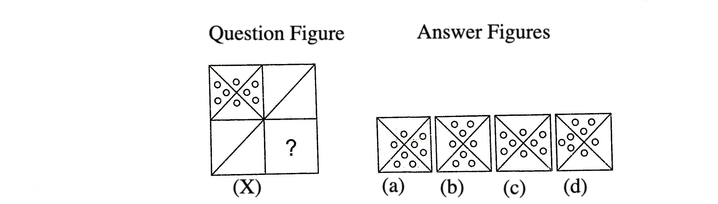
Pattern Identified: Diagonally Opposite Parts are Similar
🔍 Analysis
This figure follows the concept of diagonal symmetry. The diagonally opposite sections contain identical designs and maintain the same orientation relationship.
If the complete figure is rotated through 180°, the overall pattern remains unchanged. Therefore, the missing section must match the design present in its diagonally opposite part.
By examining the visible quadrants, we find that the missing portion should contain the same arrangement of lines and curves as its opposite section.
Among the given answer figures, Option (c) perfectly matches the required design and completes the figure without disturbing its symmetry.
Correct Answer: Option (c)
✓ Key Learning
In questions based on diagonally opposite similarity, always compare the missing section with the quadrant located diagonally opposite to it. If the figure remains unchanged after a 180° rotation, the missing part can usually be obtained directly from its opposite quadrant.
Sample Question 6
Select a figure from the four alternatives, which when placed in the blank space of figure (X) would complete the pattern.

Pattern Identified: Diagonally Opposite Parts are Similar (180° Rotational Symmetry)
🔍 Analysis
This question is based on the concept of diagonally opposite similarity. The figure is arranged in such a way that diagonally opposite sections contain identical designs.
If the complete figure is rotated through 180° clockwise or anti-clockwise, the overall pattern remains unchanged. Therefore, the missing section can be determined by examining the quadrant located diagonally opposite to it.
By comparing the visible sections carefully, we find that the missing portion must contain exactly the same arrangement of lines and shapes as its diagonally opposite counterpart.
Among the given answer figures, Option (a) matches the required design perfectly and completes the figure without disturbing the symmetry.
Correct Answer: Option (a)
✓ Key Learning
Whenever a figure exhibits 180° rotational symmetry, diagonally opposite sections generally contain identical designs. In such questions, the fastest approach is to compare the missing quadrant with its diagonally opposite section and identify the matching answer figure.
Sample Question 7
Select a figure from the four alternatives, which when placed in the blank space of figure (X) would complete the pattern.

Pattern Identified: Adjacent Parts are Laterally and Vertically Inverted Images
🔍 Analysis
This question is based on the concept of mirror-image relationships. The adjacent sections of the figure are related through lateral and vertical inversion.
The upper two sections contain designs that are laterally inverted (left-right mirror images) of each other. Similarly, the left-side sections are vertically inverted (top-bottom mirror images) of each other.
To determine the missing portion, observe the design present in section (3). The missing section (4) must be the lateral mirror image of section (3) so that the pattern remains consistent throughout the figure.
Among the given answer figures, Option (a) represents the correct laterally inverted form and perfectly completes the figure.
Correct Answer: Option (a)
✓ Key Learning
When adjacent sections appear similar but face opposite directions, always check for mirror-image relationships. In most such questions, the missing portion can be obtained by taking the lateral or vertical reflection of the neighboring section.
Sample Question 8
Select a figure from the four alternatives, which when placed in the blank space of figure (X) would complete the pattern.
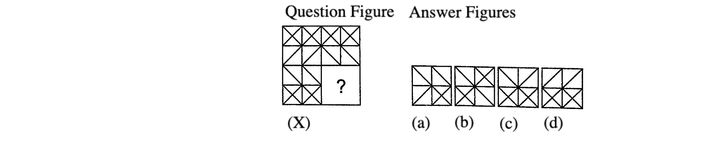
Pattern Identified: Lateral Inversion (Mirror Image Relationship)
🔍 Analysis
This figure follows the concept of lateral inversion, where adjacent sections are mirror images of each other along a vertical axis.
Observe the two upper sections carefully. The design in one section is the exact left-right mirror image of the design in the adjacent section. This relationship is consistently maintained throughout the figure.
To identify the missing portion, examine the design present in section (3). The required missing section (4) must be the laterally inverted form of section (3).
Among the given answer figures, Option (d) is the exact mirror image required to maintain the pattern and complete the figure correctly.
Correct Answer: Option (d)
✓ Key Learning
In lateral inversion questions, imagine a vertical mirror placed between adjacent sections. The missing part is usually obtained by reflecting the neighboring design across this mirror line. Always compare the direction of lines, curves, arrows, and symbols carefully before selecting the answer.
Sample Question 9
Select a figure from the four alternatives, which when placed in the blank space of figure (X) would complete the pattern.
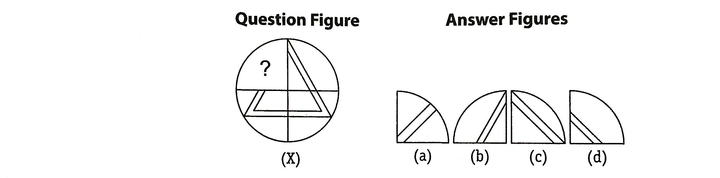
Pattern Identified: Based on Certain Design and Pattern
🔍 Analysis
This question does not follow rotational symmetry, diagonal similarity, or mirror-image relationships. Instead, it is based on completing an overall geometric design.
Observe the visible portions carefully. The figure represents a double-lined triangular pattern. The missing section must continue both the outer and inner triangular boundaries without disturbing the alignment of the lines.
By extending the visible line segments into the missing region, it becomes clear that only one answer figure correctly completes the triangular structure and maintains line continuity.
Among the given answer figures, Option (b) fits perfectly into the missing area and completes the overall design.
Correct Answer: Option (b)
✓ Key Learning
Whenever a question does not exhibit symmetry or reflection patterns, focus on the overall design. Follow the continuation of lines, curves, and shapes carefully. The correct answer is the one that completes the entire structure naturally without creating breaks or distortions in the pattern.
Sample Question 10
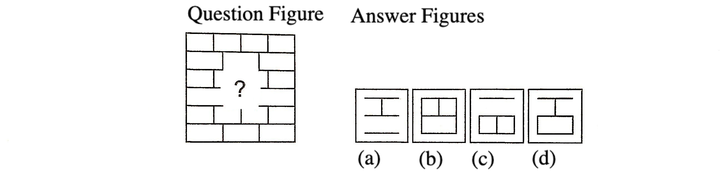
Pattern Identified: Pattern Repetition and Design Continuity
🔍 Analysis
This question is based on a repeating design pattern rather than rotational symmetry or mirror-image relationships.
On careful observation, we find that the design elements repeat themselves in alternate rows and columns. The arrangement follows a fixed sequence, and each visible section contributes to maintaining the overall pattern.
To identify the missing portion, examine the neighboring sections and determine how the design continues across the missing area. The required figure must preserve the repetition pattern while maintaining proper alignment with the surrounding elements.
Among the given answer figures, Option (d) is the only figure that correctly continues the repeating design and completes the overall pattern.
Correct Answer: Option (d)
✓ Key Learning
In design-based Completion of Figures questions, focus on how shapes, lines, or symbols repeat throughout the figure. Look for recurring structures, alternate arrangements, and visual continuity. The correct answer is the one that preserves the established pattern without disrupting the overall design.
Approach to Solve Sample Questions
- Locate the missing portion.
- Observe surrounding lines and shapes.
- Check for rotational symmetry.
- Compare diagonally opposite sections.
- Look for mirror-image relationships.
- Verify line and curve continuity.
- Apply pattern logic systematically.
- Select the option that completes the figure perfectly.
Important Concepts Covered in Sample Questions
| Concept | Application |
|---|---|
| Rotational Symmetry | 90° and 180° rotation patterns |
| Diagonal Similarity | Opposite sections contain identical designs |
| Mirror Images | Laterally and vertically inverted patterns |
| Line Continuity | Maintaining uninterrupted designs |
| Pattern Repetition | Repeating geometric structures |
| Design Completion | Completing overall visual structures |
Common Mistakes Students Make
- Ignoring rotational symmetry.
- Not checking diagonally opposite sections.
- Missing mirror-image relationships.
- Selecting visually similar options.
- Ignoring line continuity.
- Not verifying the completed figure.
Expert Tips for Solving Completion of Figures Questions
- Always check rotation first.
- Compare opposite quadrants carefully.
- Look for reflection patterns.
- Trace all lines entering the missing section.
- Use elimination to remove incorrect options.
- Visualize the complete figure before answering.
Quick Learning Framework
Identify Missing Part
↓
Check Rotation & Symmetry
↓
Analyze Pattern Relationship
↓
Verify Continuity
↓
Match Correct Option
↓
Complete the Figure
Final Takeaway
The Sample Questions in Completion of Figures demonstrate how rotational symmetry, diagonal similarity, mirror-image relationships, and design continuity are used to determine missing portions of figures.
Candidates who master these concepts can solve Completion of Figures questions quickly and accurately while improving their visual reasoning and pattern recognition skills.