Completion of Figures - Expert Level
Practice and master this topic with our carefully crafted questions.
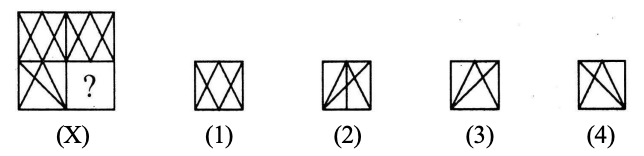
In each of the following questions, select a figure from amongst the four alternatives, which when placed in the blank space of fig. (X) would complete the pattern.
In each of the following questions, select a figure from amongst the four alternatives, which when placed in the blank space of fig. (X) would complete the pattern.
🔍 Analyze the Pattern
Focus on the lines touching the boundaries of the missing quadrant.
Step 1: Check the Top Boundary
From the upper-right quadrant, only one diagonal enters the missing square.
Step 2: Check the Left Boundary
From the lower-left quadrant, a diagonal reaches the central intersection and continues into the blank region.
Step 3: Complete the Figure
The missing quadrant therefore requires only a single crossing diagonal arrangement that continues the existing triangular pattern.
Among the options:
- Fig. (1) repeats the full X-pattern unnecessarily.
- Fig. (2) adds an extra internal line not required by the figure.
- Fig. (4) introduces an additional diagonal continuation that does not match the incoming boundaries.
- Fig. (3) exactly continues the lines entering the blank space and completes the pattern.
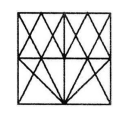
Correct Answer: (C)
⚡ Quick Exam Shortcut
For figure completion questions:
- Ignore the overall design.
- Trace only the lines entering the blank square.
- Select the option that continues those lines exactly.
Only Fig. (3) matches the incoming diagonal pattern without adding extra lines.
Shortcut Answer: Continue only the required diagonals → Option (C).
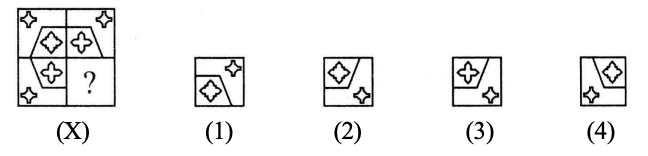
In each of the following questions, select a figure from amongst the four alternatives, which when placed in the blank space of fig. (X) would complete the pattern.
🔍 Analyze the Pattern
The figure follows diagonal symmetry.
- All outer corners contain a small star.
- The inner symbols form the pattern:
Diamond → Plus
Plus → Diamond
- The slanting line must continue into the missing quadrant.
Only Fig. (2) satisfies all these conditions.
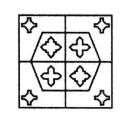
Correct Answer: (B)
⚡ Quick Exam Shortcut
Check the diagonal symmetry:
Diamond ↔ Diamond
Plus ↔ Plus
Then verify the corner star and slanting line.
Shortcut Answer: Diagonal symmetry + line continuation → Option (B).
In each of the following questions, select a figure from amongst the four alternatives, which when placed in the blank space of fig. (X) would complete the pattern.
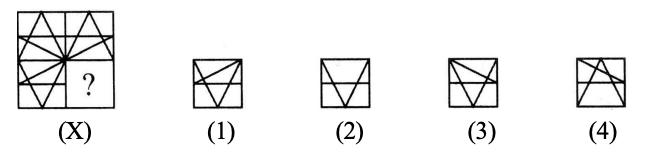
🔍 Analyze the Pattern
The missing part is the lower-right quadrant.
Step 1: Follow the Horizontal Line
The horizontal line passing through the centre must continue straight across the missing quadrant.
Step 2: Follow the Diagonal Rays
Several rays originate from the central junction and extend into the blank region.
The missing figure must preserve the same fan-like arrangement formed by these rays.
Step 3: Check Boundary Matching
Look at the points where the lines touch the upper and left borders of the blank square.
- One diagonal enters from the upper-left corner of the missing region.
- Another diagonal enters from the central junction.
- The lines must intersect in exactly the same positions as the surrounding pattern.
Among the options:
- Fig. (1) shifts one of the diagonals and does not align perfectly with the incoming rays.
- Fig. (2) lacks a required diagonal.
- Fig. (4) introduces an extra crossing line.
- Fig. (3) continues all incoming lines correctly and preserves the overall symmetry.
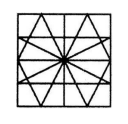
Correct Answer: (C)
⚡ Quick Exam Shortcut
Do not look at the whole figure.
- Trace only the lines entering the blank square.
- Match their exact entry points.
- Reject options that add or remove diagonals.
Only Fig. (3) matches every incoming line correctly.
Shortcut Answer: Exact continuation of all rays → Option (C).
In each of the following questions, select a figure from amongst the four alternatives, which when placed in the blank space of fig. (X) would complete the pattern.
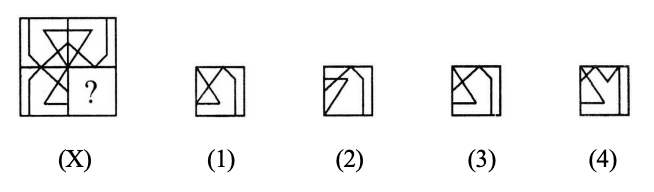
🔍 Analyze the Pattern
Follow the lines entering the blank quadrant from the top and left boundaries.
- The vertical border line must continue downward.
- The slanting polygon edge from above must continue into the blank space.
- The triangular figure from the lower-left quadrant must be completed.
- The central diagonal crossing must align perfectly.
Only Fig. (3) satisfies all these boundary conditions.
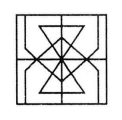
Correct Answer: (C)
⚡ Quick Exam Shortcut
Trace every line touching the blank square.
- Match the incoming diagonal.
- Match the vertical side.
- Complete the lower triangle.
Only Fig. (3) matches all incoming lines exactly.
Shortcut Answer: Exact continuation of all boundary lines → Option (C).
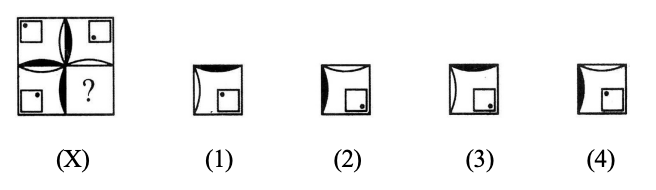
In each of the following questions, select a figure from amongst the four alternatives, which when placed in the blank space of fig. (X) would complete the pattern.
🔍 Analyze the Pattern
The missing quadrant must complete both the central petal design and the corner-dot sequence.
- The dot position follows a rotational pattern around the small square.
- The top curved petal must continue into the missing quadrant.
- The left curved petal must also continue into the missing quadrant.
Only Fig. (3) correctly completes both patterns.
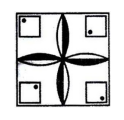
Correct Answer: Option (C)
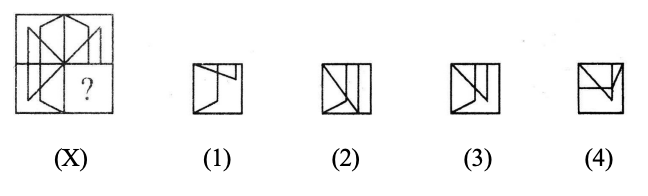
In each of the following questions, select a figure from amongst the four alternatives, which when placed in the blank space of fig. (X) would complete the pattern.
🔍 Analyze the Pattern
Trace the lines touching the boundaries of the missing quadrant.
- The diagonal from the upper boundary must continue downward.
- The horizontal centre line must continue across.
- The right-side vertical strip must extend into the missing quadrant.
Only Fig. (3) satisfies all three conditions without introducing extra lines.
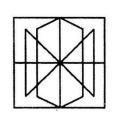
Correct Answer: (C)
⚡ Quick Exam Shortcut
For figure completion:
- Match the lines entering from the top.
- Match the lines entering from the left.
- Check continuation of border structures.
Only Fig. (3) matches all incoming lines exactly.
Shortcut Answer: Continue diagonal + horizontal + right strip → Option (C).
In each of the following questions, select a figure from amongst the four alternatives, which when placed in the blank space of fig. (X) would complete the pattern.
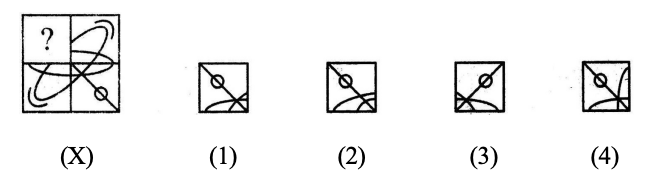
🔍 Analyze the Pattern
The missing part is the upper-left quadrant.
Step 1: Follow the Large Curved Loop
The large loop passes through all four quadrants. In the missing quadrant, the curve must enter from the lower boundary and bend toward the left side.
Step 2: Match the Diagonal
The diagonal running through the figure continues into the missing quadrant and must align exactly with the diagonal visible in the adjacent quadrants.
Step 3: Check the Oval Position
The oval lies on the diagonal. Its position must maintain the rotational symmetry of the complete figure.
Step 4: Compare the Options
- Fig. (2) has the same diagonal arrangement but the curve is shifted.
- Fig. (3) places the curved arc in the wrong corner.
- Fig. (4) introduces an extra curved extension not required.
- Fig. (1) correctly continues the loop, aligns the diagonal, and places the oval in the proper position.
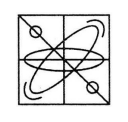
Correct Answer: (A)
⚡ Quick Exam Shortcut
For figure completion questions:
- Trace the curve entering the blank region.
- Match the diagonal exactly.
- Check the position of any enclosed symbol (oval, circle, square, etc.).
Only Fig. (1) satisfies all three conditions.
Shortcut Answer: Correct curve + diagonal + oval alignment → Option (A).