Completion of Figures
🔍 Master systematic approaches to break down complex problems. Learn pattern recognition, logical deduction, and strategic thinking frameworks.
Pattern Recognition
Study MaterialPattern Recognition
Pattern Recognition is the most important skill required to solve Completion of Figures questions accurately. In these questions, a figure is presented with one part missing, and candidates must identify the missing section by recognizing the underlying pattern, symmetry, design continuity, or visual relationship.
Unlike ordinary observation, pattern recognition requires candidates to identify hidden rules governing the arrangement of shapes, lines, curves, symbols, and designs within the figure.
Strong pattern recognition skills help candidates solve Completion of Figures questions quickly while minimizing errors in competitive examinations.
What is Pattern Recognition in Completion of Figures?
Pattern Recognition is the process of identifying the logical structure, symmetry, or visual relationship that exists within a figure and using that information to determine the missing part.
The missing section is not selected based on appearance alone. It must perfectly fit into the figure while maintaining the overall design and pattern.
Key Areas to Observe
- Shape continuity
- Line alignment
- Symmetry
- Rotation patterns
- Mirror-image relationships
- Design repetition
- Curved and straight line extensions
- Position of symbols and elements
Why Pattern Recognition is Important?
Visual Observation
Helps identify hidden relationships within incomplete figures.
Pattern Analysis
Improves the ability to recognize repeating structures and designs.
Spatial Intelligence
Enhances the ability to mentally visualize missing portions.
Exam Performance
Improves speed and accuracy in Non Verbal Reasoning questions.
Approach to Break Down Complex Problems
Complex Completion of Figures questions become much easier when analyzed systematically.
Step-by-Step Analysis Framework
- Observe the incomplete figure carefully.
- Identify the location of the missing part.
- Examine surrounding lines and shapes.
- Check whether the figure is symmetrical.
- Look for repetition or continuity.
- Analyze possible rotation patterns.
- Check mirror-image relationships.
- Select the option that perfectly completes the figure.
Most Common Patterns in Completion of Figures
| Pattern Type | Description |
|---|---|
| Rotational Symmetry | Figure repeats after rotation through a fixed angle |
| Diagonal Similarity | Diagonally opposite sections contain similar designs |
| Mirror Image | Parts are reflections of one another |
| Line Continuity | Lines continue smoothly through missing areas |
| Curve Continuity | Curves complete the overall design |
| Pattern Repetition | Designs repeat systematically |
| Shape Completion | Missing section completes a larger shape |
| Visual Balance | Elements maintain symmetry and proportion |
Pattern 1: Rotational Symmetry
One of the most common Completion of Figures patterns involves rotational symmetry.
In such questions, the figure looks identical when rotated through a specific angle, usually 90°, 180°, or 270°.
- 90° Clockwise Rotation
- 90° Anti-clockwise Rotation
- 180° Rotation
- 270° Rotation
- Complete Symmetry after Rotation
🔍 Recognition Tip
If the visible sections appear identical after rotation, the missing portion can usually be found by rotating an existing section appropriately.
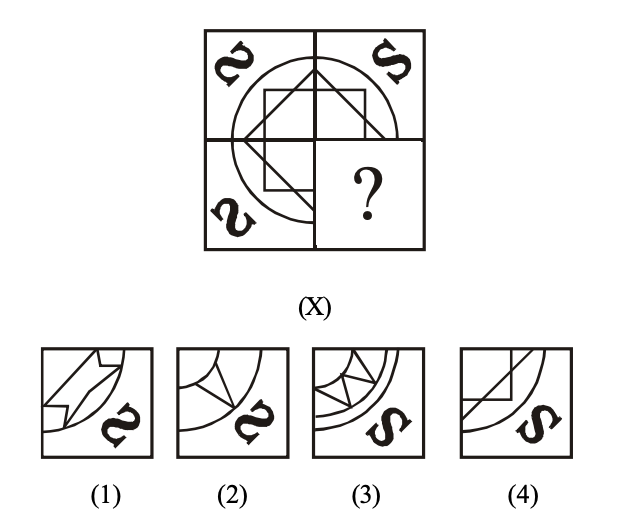
Example: Rotational Symmetry Through an Angle of 90°
Select a figure from the four alternatives, which when placed in the blank space of figure (X) would complete the pattern.
🔍 Analyze the Pattern
Observe that all the three visible quadrants contain the same design in different orientations. The design is repeated by rotating it through an angle of 90° clockwise.
Therefore, the missing quadrant can be obtained by rotating the corresponding design through 90° clockwise.
Among the answer figures, only Option (4) correctly continues the circle, square, diagonal lines and symbol orientation after the required rotation.
Correct Answer: Option (4)
⚡ Quick Exam Shortcut
Here, all the three equal parts have similar designs in rotated positions.
The missing part is obtained by rotating the corresponding figure through an angle of 90° clockwise.
Shortcut Answer: 90° clockwise rotation → Option (4).
Pattern 2: Diagonally Opposite Similarity
In these questions, diagonally opposite sections contain identical or closely related designs.
- Top-left matches bottom-right.
- Top-right matches bottom-left.
- Figure remains unchanged after 180° rotation.
- Missing part can be obtained from the opposite diagonal section.
Pattern 3: Mirror Image Recognition
Adjacent sections often behave as mirror images of each other.
- Left-right reflection
- Top-bottom reflection
- Vertical inversion
- Horizontal inversion
🔍 Recognition Tip
Always check whether the missing section is a reflected version of an adjacent section.
Pattern 4: Line & Curve Continuity
Many questions are solved simply by following the continuity of lines and curves.
- Straight lines continue smoothly.
- Curved lines complete circles or arcs.
- Intersections remain aligned.
- Broken patterns become complete.
Pattern 5: Design Repetition
Many Completion of Figures questions contain repeating motifs or designs.
- Repeated symbols
- Repeated geometric shapes
- Repeated line structures
- Repeated decorative patterns
Logical Deduction Framework
Expert candidates use logical deduction rather than trial and error.
Ask These Questions
- What pattern is visible in the figure?
- Is there symmetry?
- Do opposite sections match?
- Do adjacent sections mirror each other?
- Can the figure be rotated?
- Do lines continue through the missing area?
- Which option maintains the design perfectly?
Strategic Thinking Framework
SMART Completion Strategy
S → Study the incomplete figure carefully
M → Monitor patterns and symmetry
A → Analyze line and shape continuity
R → Relate visible sections logically
T → Test answer options systematically
Common Mistakes Students Make
- Choosing visually similar options without analysis.
- Ignoring line continuity.
- Missing rotational symmetry.
- Overlooking mirror-image relationships.
- Ignoring diagonal similarity.
- Focusing only on shapes and not patterns.
- Rushing through the options.
Expert Tips for Fast Solving
- Check symmetry before anything else.
- Follow all lines entering the missing section.
- Compare diagonally opposite parts.
- Test rotation possibilities.
- Look for reflected designs.
- Eliminate options that break continuity.
- Practice visual reasoning regularly.
Quick Learning Framework
Locate Missing Part
↓
Check Symmetry
↓
Analyze Pattern
↓
Verify Continuity
↓
Compare Options
↓
Complete the Figure Correctly
Final Takeaway
Pattern Recognition is the foundation of solving Completion of Figures questions. The ability to identify symmetry, rotations, mirror images, continuity, and design repetition enables candidates to determine the missing portion accurately.
Regular practice of these visual reasoning techniques significantly improves observation skills, logical thinking, spatial intelligence, and overall performance in competitive examinations.