Paragraph Formation
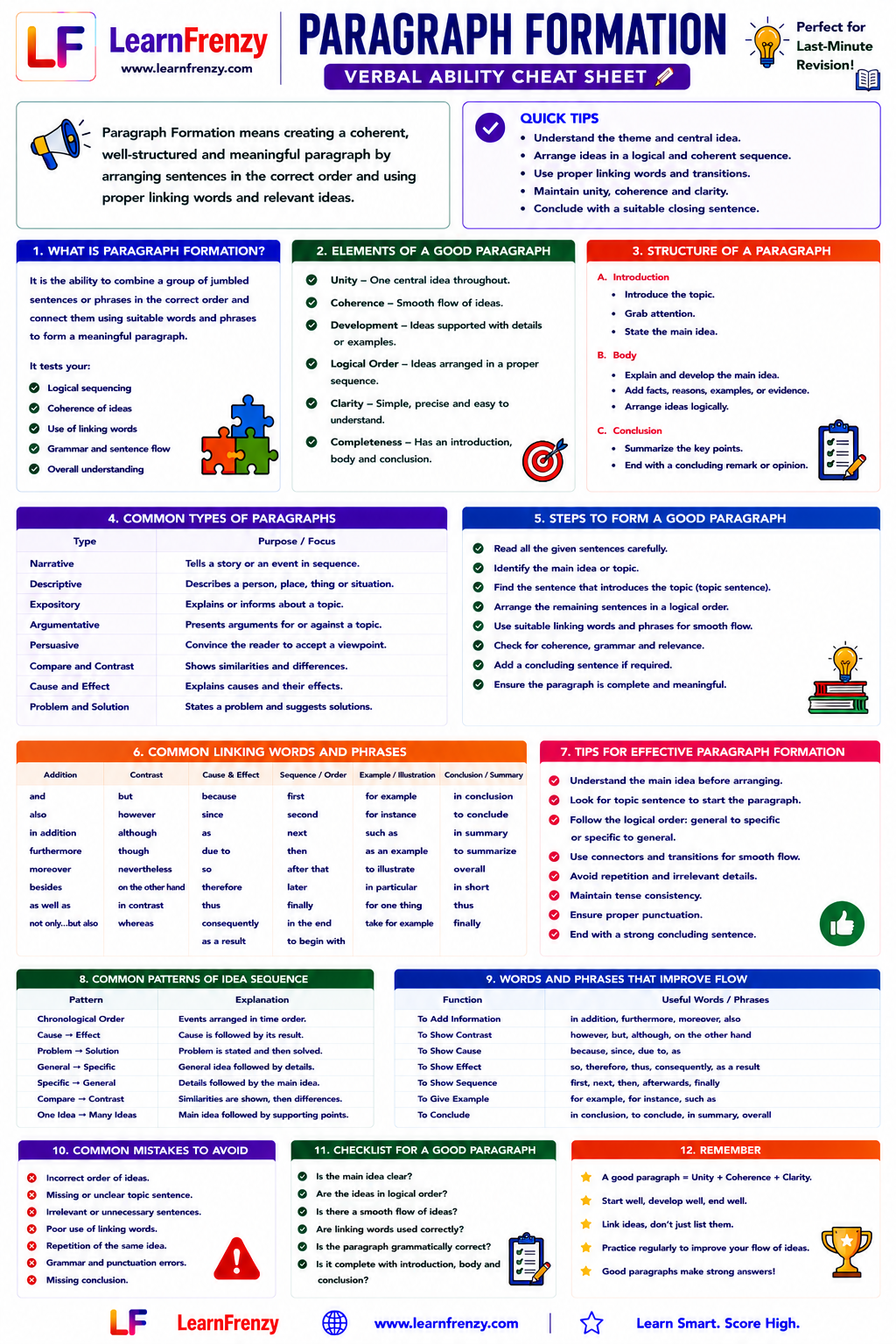
About This Cheat Sheet
Your quick reference guide to Paragraph Formation for competitive exams. This cheat sheet helps you arrange sentences logically, identify opening and closing sentences, and form coherent paragraphs.
📝 Paragraph Structure
- Topic Sentence
- Supporting Sentences
- Supporting Details & Examples
- Concluding Sentence
- Unity & Coherence
- Smooth Transitions
📊 Paragraph Organization
- Chronological Order
- Spatial Order
- Logical Order
- Cause-Effect Order
- Problem-Solution Order
- Compare-Contrast Order
- General-to-Specific Order
🔍 Identifying Sentences
- Opening Sentence (Main Idea)
- Supporting Sentences (Evidence)
- Closing Sentence (Conclusion)
- Transition Sentences
- Logical Connectors
- Flow & Coherence
📚 Elements of a Good Paragraph
- Topic Sentence
- Supporting Details
- Concluding Sentence
- Unity
- Coherence
- Transitions
🎯 Problem Types
- Identify Opening Sentence
- Identify Closing Sentence
- Arrange Middle Sentences
- Complete the Paragraph
- Logical Sequence
- Coherent Paragraph
📚 Exam Categories
- SSC & Banking
- Railways & UPSC
- CAT & MBA Entrance
- Defence & Insurance
- Placement Tests
- Other Competitive Exams
📝 Opening
Introduces Topic
Main Idea📊 Supporting
Evidence & Details
Explains Topic🔍 Closing
Summarizes & Concludes
Final Thought🔄 Transitions
Connects Ideas
Logical Flow📝 Paragraph Structure Reference
📝 Opening Sentence
- Purpose: Introduce main idea
- Features: No pronouns referring to previous
- Keywords: Topic, issue, subject
- Example: "Climate change is a global concern."
📝 Supporting Sentences
- Purpose: Provide evidence & details
- Features: Examples, facts, explanations
- Keywords: For example, in addition, moreover
- Example: "Rising temperatures cause sea levels to rise."
📝 Closing Sentence
- Purpose: Summarize & conclude
- Features: Draws conclusion
- Keywords: Thus, therefore, finally, in conclusion
- Example: "Therefore, urgent action is needed."
📊 Organization Orders
🔄 Logical Connectors
🎯 Quick Problem Examples
📝 Identify Opening
- Question: Which is the opening sentence?
- A) "Therefore, we must act." (Closing)
- B) "Social media has changed..." (Opening ✅)
- Answer: B (Introduces topic)
📝 Identify Closing
- Question: Which is the closing sentence?
- A) "Thus, education is essential." (Closing ✅)
- B) "Education is important..." (Opening)
- Answer: A (Draws conclusion)
📝 Arrange Sentences
- Sentences:
- A) "Therefore, we must recycle."
- B) "Plastic waste is increasing."
- C) "Recycling helps reduce waste."
- Order: B, C, A
📚 Elements of a Good Paragraph
📝 Topic Sentence
- Purpose: States main idea
- Position: Usually at beginning
- Example: "Reading improves vocabulary."
📝 Supporting Details
- Purpose: Explains and supports
- Features: Examples, facts, evidence
- Example: "Studies show that readers have larger vocabularies."
📝 Concluding Sentence
- Purpose: Summarizes and concludes
- Position: Usually at the end
- Example: "Therefore, reading is essential."
📋 Quick Reference: Elements of a Good Paragraph
📝 Unity
- Definition: All sentences support one main idea
- Check: Every sentence relates to topic
- Tip: Remove unrelated sentences
🔄 Coherence
- Definition: Logical flow of ideas
- Check: Smooth transitions between sentences
- Tip: Use logical connectors
🔗 Transitions
- Definition: Words connecting ideas
- Check: Use transition words
- Tip: Therefore, however, moreover, also
🎯 How to Solve Paragraph Formation Questions Quickly
The Golden Rule: Identify the opening sentence first – it introduces the main idea and doesn't refer to previous content. Then find the closing sentence – it summarizes or concludes the paragraph.
Step-by-Step Approach:
- Step 1: Read all sentences carefully
- Step 2: Identify the opening sentence (introduces topic)
- Step 3: Identify the closing sentence (concludes)
- Step 4: Arrange supporting sentences logically
- Step 5: Check logical connectors and flow
- Step 6: Verify the complete paragraph
Common Mistakes to Avoid:
- ❌ Starting with a sentence that has pronouns referring to previous content
- ❌ Ending with a sentence that introduces new information
- ❌ Ignoring logical connectors and transitions
- ❌ Not checking the flow and coherence
Proven Strategy: The "Opening-Closing" technique – identify the opening and closing sentences first. Then arrange the middle sentences based on logical flow, using transition words and connectors as clues.
Memory Trick: Remember the 4 Steps of Paragraph Formation:
- 📝 Find: Opening sentence (introduces topic)
- 📊 Find: Closing sentence (concludes)
- 🔄 Arrange: Middle sentences logically
- ✅ Verify: Check flow and coherence
💡 Pro Tips for Paragraph Formation
✅ Find the Opening First
The opening sentence introduces the topic – look for general statements
✅ Look for Connectors
Logical connectors like therefore, however, moreover help arrange sentences
✅ Check Pronoun References
Sentences with "it," "they," "this" usually come after the noun is introduced
✅ Practice with Passages
Practice with different types of paragraph formation questions
Download Cheat Sheet
Click the button below to download this high-resolution PNG cheat sheet.
Download PNG (5.2 MB)Preview
Still have questions?
We're here to help! Reach out to our support team for any queries.