Comprehension
About This Cheat Sheet
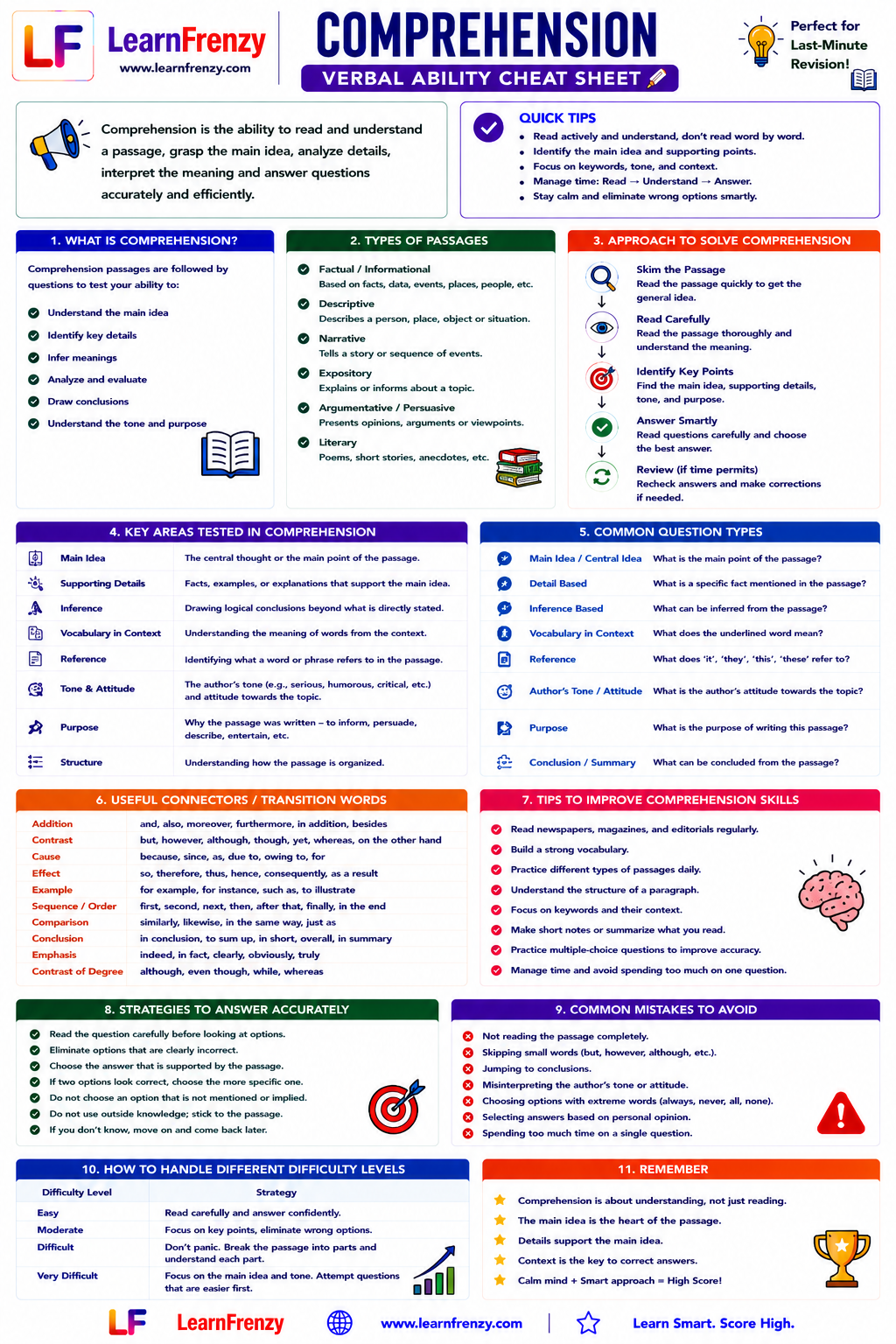
Your quick reference guide to Reading Comprehension for competitive exams. This cheat sheet helps you understand passages quickly, identify main ideas, make inferences, and answer questions accurately.
📖 Comprehension Strategies
- Skimming for Main Idea
- Scanning for Specific Information
- Understanding Tone & Mood
- Identifying Author's Purpose
- Distinguishing Facts vs Opinions
- Making Inferences & Conclusions
📊 Types of Questions
- Main Idea Questions
- Supporting Detail Questions
- Inference Questions
- Vocabulary in Context
- Author's Tone Questions
- Conclusion Questions
🔍 Question-Answer Techniques
- Locating Answers in Passage
- Eliminating Incorrect Options
- Identifying Distractors
- Time Management Strategies
- Answering with Precision
- Verifying with Passage
📝 Passage Types
- Narrative Passages
- Descriptive Passages
- Expository Passages
- Persuasive Passages
- Analytical Passages
- Mixed Passages
🧠 Understanding Passages
- Implicit vs Explicit Meaning
- Central Theme & Key Arguments
- Logical Structure of Passages
- Identifying Author's Viewpoint
- Understanding Text Organization
- Connecting Ideas & Flow
📚 Exam Categories
- SSC & Banking
- Railways & UPSC
- CAT & GMAT
- Defence & Insurance
- MBA Entrance
- Other Competitive Exams
📖 Main Idea
What is it about?
Central Theme🔍 Inference
Read between lines
Implied Meaning📊 Tone
Author's attitude
Mood & Voice📝 Purpose
Why written?
Author's Goal📖 Comprehension Strategies Reference
🔍 Before Reading
- Preview: Read title and introduction
- Skim: Get the main idea quickly
- Scan: Look for specific information
- Identify: Topic and purpose
- Predict: What will be discussed
🔍 During Reading
- Understand: Tone and mood
- Identify: Author's viewpoint
- Distinguish: Facts vs opinions
- Infer: Implied meanings
- Connect: Ideas and arguments
📊 Question Types
🔍 Answer Techniques
🎯 Quick Problem Examples
📖 Main Idea
- Question: What is the main idea?
- Passage: About climate change
- Options: A, B, C, D
- Answer: The one covering entire passage
🔍 Inference
- Question: What can be inferred?
- Clue: Implied meaning
- Options: A, B, C, D
- Answer: Logical conclusion
📊 Author's Tone
- Question: What is the tone?
- Passage: Critical/Appreciative
- Options: A, B, C, D
- Answer: Matches author's attitude
📝 Passage Types & Structures
📝 Narrative
- Purpose: Tell a story
- Features: Characters, plot, sequence
- Example: Biography, fiction
📝 Descriptive
- Purpose: Describe a person/place
- Features: Sensory details, adjectives
- Example: Travel writing, reviews
📝 Expository
- Purpose: Explain or inform
- Features: Facts, definitions, examples
- Example: Textbooks, articles
📝 Persuasive
- Purpose: Convince the reader
- Features: Arguments, opinions, evidence
- Example: Editorials, advertisements
📝 Analytical
- Purpose: Analyze a topic
- Features: Critical evaluation
- Example: Research papers, critiques
📝 Mixed
- Purpose: Combination of types
- Features: Multiple styles
- Example: Complex essays
📋 Quick Reference: Reading Strategies
📖 Skimming
- Purpose: Get main idea
- Read: Title, intro, conclusion
- Time: 30-60 seconds
🔍 Scanning
- Purpose: Find specific info
- Look: Keywords, dates, names
- Time: As needed
🔍 Inferring
- Purpose: Read between lines
- Use: Context clues
- Apply: Logical reasoning
🎯 How to Solve Reading Comprehension Quickly
The Golden Rule: Read the passage with a purpose – know what you're looking for before you start reading. Skim for the main idea and scan for specific details only when needed.
Step-by-Step Approach:
- Step 1: Read the title and introduction – get the topic
- Step 2: Skim the passage to get the main idea
- Step 3: Read the questions first (for scanning strategy)
- Step 4: Read the passage carefully for details
- Step 5: Answer questions using passage evidence
- Step 6: Eliminate wrong options and verify
Common Mistakes to Avoid:
- ❌ Reading the passage without any purpose
- ❌ Spending too much time on difficult questions
- ❌ Choosing answers based on prior knowledge (not passage)
- ❌ Forgetting to eliminate wrong options
Proven Strategy: The "Question First" technique – read the questions before reading the passage. This gives you a purpose and helps you know exactly what information to look for while reading.
Memory Trick: Remember the 5 Steps of RC:
- 📖 Preview: Title and introduction
- 🔍 Skim: Main idea
- 📊 Question: Read questions
- 📝 Read: Carefully with purpose
- ✅ Answer: Use passage evidence
💡 Pro Tips for Reading Comprehension
✅ Read with Purpose
Know what you're looking for before you start reading
✅ Eliminate Wrong Options
Remove options that are clearly wrong – it narrows down choices
✅ Watch for Distractors
Options that seem correct but are slightly wrong are traps
✅ Manage Your Time
Don't spend too long on any single question
Download Cheat Sheet
Click the button below to download this high-resolution PNG cheat sheet.
Download PNG (5.2 MB)Preview
Still have questions?
We're here to help! Reach out to our support team for any queries.