Ordering of Sentences
About This Cheat Sheet
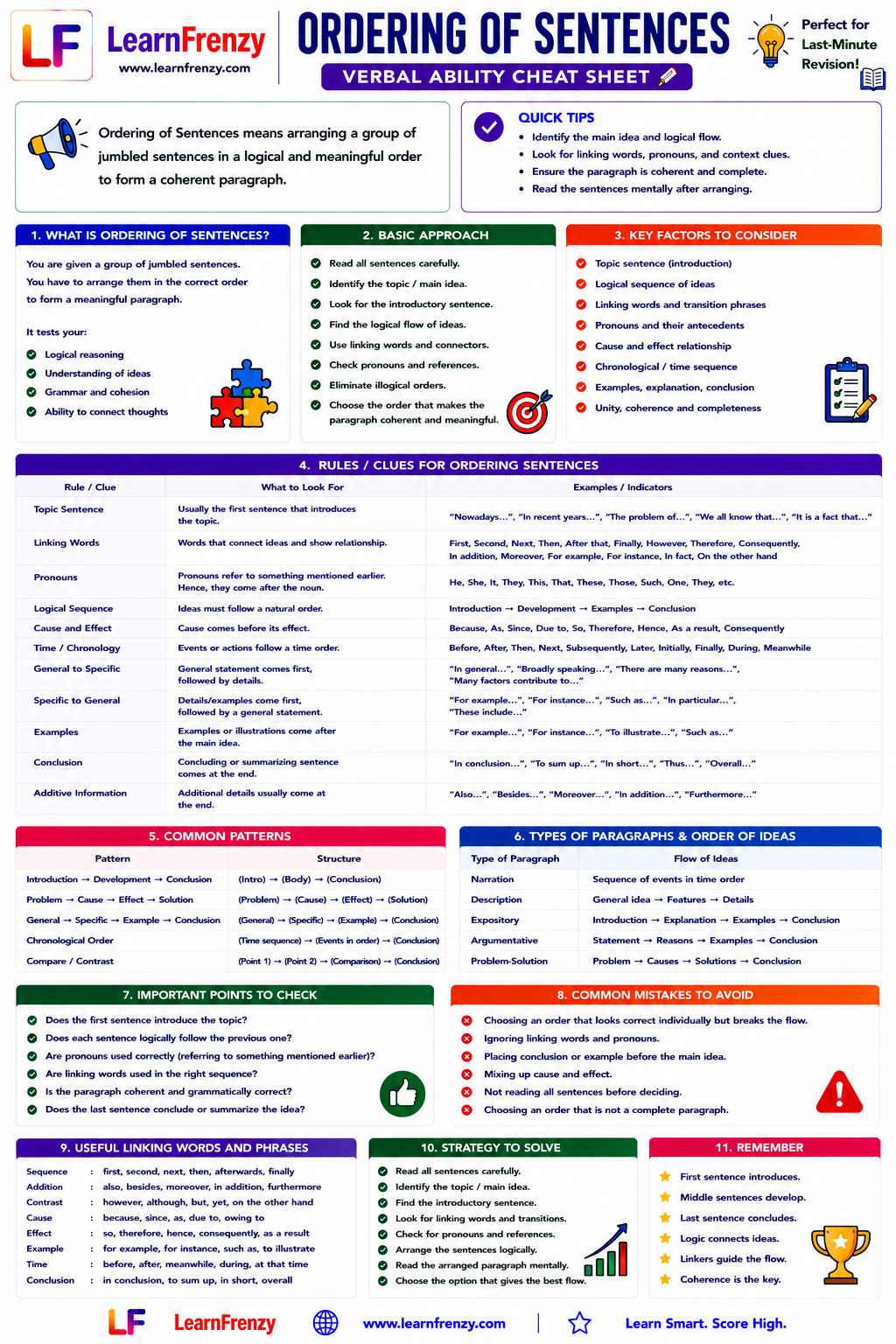
Your quick reference guide to Ordering of Sentences (Sentence Rearrangement/Para Jumble) for competitive exams. This cheat sheet helps you rearrange jumbled sentences into logical, coherent paragraphs by identifying key clues and applying proven strategies.
📝 Core Strategies
- Identify Topic Sentence
- Find Logical Connectors
- Check Pronoun References
- Identify Time Sequences
- Recognize Cause-Effect
- Spot Transition Words
📊 Organization Types
- Chronological Order
- Logical Order
- Cause-Effect Order
- Comparison-Contrast
- Problem-Solution
- General-to-Specific
🔍 Signal Words
- First, Next, Finally
- However, Therefore
- Consequently, Meanwhile
- Subsequently, Previously
- Initially, Subsequently
- Moreover, Furthermore
📚 Reference Techniques
- Pronoun Reference (it, they)
- Article Reference (a, an, the)
- Keyword Repetition
- Chronological Markers
- Logical Flow Patterns
- Elimination Strategy
🎯 Problem Types
- Six-Sentence Jumbles
- Five-Sentence Jumbles
- Four-Sentence Jumbles
- Sentence Insertion
- Odd Sentence Out
- Complete Paragraph
📚 Exam Categories
- SSC & Banking
- Railways & UPSC
- CAT & MBA Entrance
- Defence & Insurance
- Placement Tests
- Other Competitive Exams
📌 Topic Sentence
Introduces the subject
No prior references🔗 Connectors
Links ideas together
Therefore, however📌 Pronouns
Refer to previous nouns
It, they, this⏰ Time Markers
Sequence events
First, then, finally📝 Sentence Ordering Reference
📌 Opening Sentence
- Features: Introduces new topic
- No: Pronouns referring to previous
- No: Connectors like "therefore"
- Example: "Artificial intelligence is transforming healthcare."
🔗 Middle Sentences
- Features: Develop the topic
- Use: Connectors, pronouns, references
- Flow: Logical progression
- Example: "For instance, AI can detect diseases early."
🔚 Closing Sentence
- Features: Concludes the idea
- Use: Thus, therefore, in conclusion
- No: New information
- Example: "Thus, AI will revolutionize medicine."
📚 Reference Techniques
🔍 Signal Words & Connectors
🎯 Quick Problem Examples
📝 Identify Opening
- Question: Which is the opening sentence?
- A) "Therefore, we must act." (Closing)
- B) "Climate change is a global crisis." (Opening ✅)
- Answer: B (Introduces topic)
📌 Pronoun Reference
- Question: Which sentence comes first?
- A) "It was first discovered in 1928."
- B) "Penicillin is an antibiotic." ✅
- Answer: B (Introduces "Penicillin" before "It")
📌 Article Reference
- Question: Which sentence comes first?
- A) "The dog was barking loudly."
- B) "A dog was barking loudly." ✅
- Answer: B (First mention uses "a")
⚡ Shortcut Techniques
🚀 Opening-Closing Method
- Find opening sentence first
- Find closing sentence second
- Arrange middle sentences
- Verify with connectors
🔍 Elimination Strategy
- Eliminate impossible options
- Identify mandatory pairs
- Check pronoun references
- Verify logical flow
📌 Pair Identification
- Find mandatory pairs
- Look for cause-effect pairs
- Identify pronoun-noun pairs
- Check article reference pairs
📊 Logical Flow Patterns
⏰ Chronological Pattern
- Example: "First, the experiment began..."
- "Next, the data was collected..."
- "Finally, the results were analyzed..."
- Clues: Dates, time words, sequence adverbs
🔗 Cause-Effect Pattern
- Example: "Due to heavy rain..."
- "The roads became flooded..."
- "Therefore, traffic was delayed..."
- Clues: Because, therefore, consequently
📈 General-Specific Pattern
- Example: "Social media has changed communication..."
- "For example, Twitter allows instant updates..."
- "Thus, information spreads quickly..."
- Clues: For example, such as, in particular
🎯 How to Solve Sentence Rearrangement Questions Quickly
The Golden Rule: Always start by identifying the opening sentence – it introduces the topic independently without using pronouns or connectors that refer to previous content. Then find the closing sentence – it concludes the idea without introducing new information.
Step-by-Step Approach:
- Step 1: Read all sentences carefully and identify the topic
- Step 2: Find the opening sentence (no prior references, introduces topic)
- Step 3: Find the closing sentence (concludes, uses words like "therefore")
- Step 4: Identify mandatory pairs (pronoun-noun, article references)
- Step 5: Look for signal words and logical connectors
- Step 6: Eliminate incorrect options using the pairs
- Step 7: Verify the complete sequence for logical flow
Common Mistakes to Avoid:
- ❌ Starting with a sentence that uses "it," "they," or "this" without a noun
- ❌ Ending with a sentence that introduces new information
- ❌ Ignoring article references ("a" before "the")
- ❌ Missing chronological markers (dates, time words)
- ❌ Overlooking mandatory pairs
Proven Strategy: The "Pair-Elimination" technique – identify mandatory pairs first (e.g., pronoun-noun, article references), then use these pairs to eliminate impossible options. This narrows down choices and saves time.
Memory Trick: Remember the 5 Steps of Sentence Ordering:
- 📌 Find: Opening sentence (introduces topic)
- 🔗 Link: Mandatory pairs and connectors
- ⏰ Sequence: Chronological or logical order
- 📌 End: Closing sentence (concludes)
- ✅ Verify: Check coherence and flow
💡 Pro Tips for Sentence Rearrangement
✅ Start with the Opening
The opening sentence has no pronouns like "it" or "they" and no connectors like "therefore"
✅ Find Mandatory Pairs
Look for "a/an" → "the" pairs, pronoun → noun pairs, and cause → effect pairs
✅ Use Signal Words
Words like "however," "therefore," "first," "next" are strong clues for sequence
✅ Eliminate Options
Use pairs to eliminate options – if a pair is broken, eliminate that option
✅ Check Time Sequences
Dates, time words, and chronological markers help order sentences
✅ Practice Regularly
Practice with different difficulty levels to build speed and accuracy
📋 Quick Reference: Signal Words & Their Functions
⏰ Time/Sequence
- First
- Next
- Then
- Finally
- Meanwhile
- Subsequently
🔄 Contrast
- However
- Although
- Nevertheless
- But
- Yet
- In contrast
📈 Cause-Effect
- Therefore
- Because
- Since
- Consequently
- Thus
- As a result
➕ Addition
- Moreover
- Furthermore
- Also
- In addition
- Additionally
- Besides
Download Cheat Sheet
Click the button below to download this high-resolution PNG cheat sheet.
Download PNG (5.2 MB)Preview
Still have questions?
We're here to help! Reach out to our support team for any queries.