Indian Politics
About This Cheat Sheet
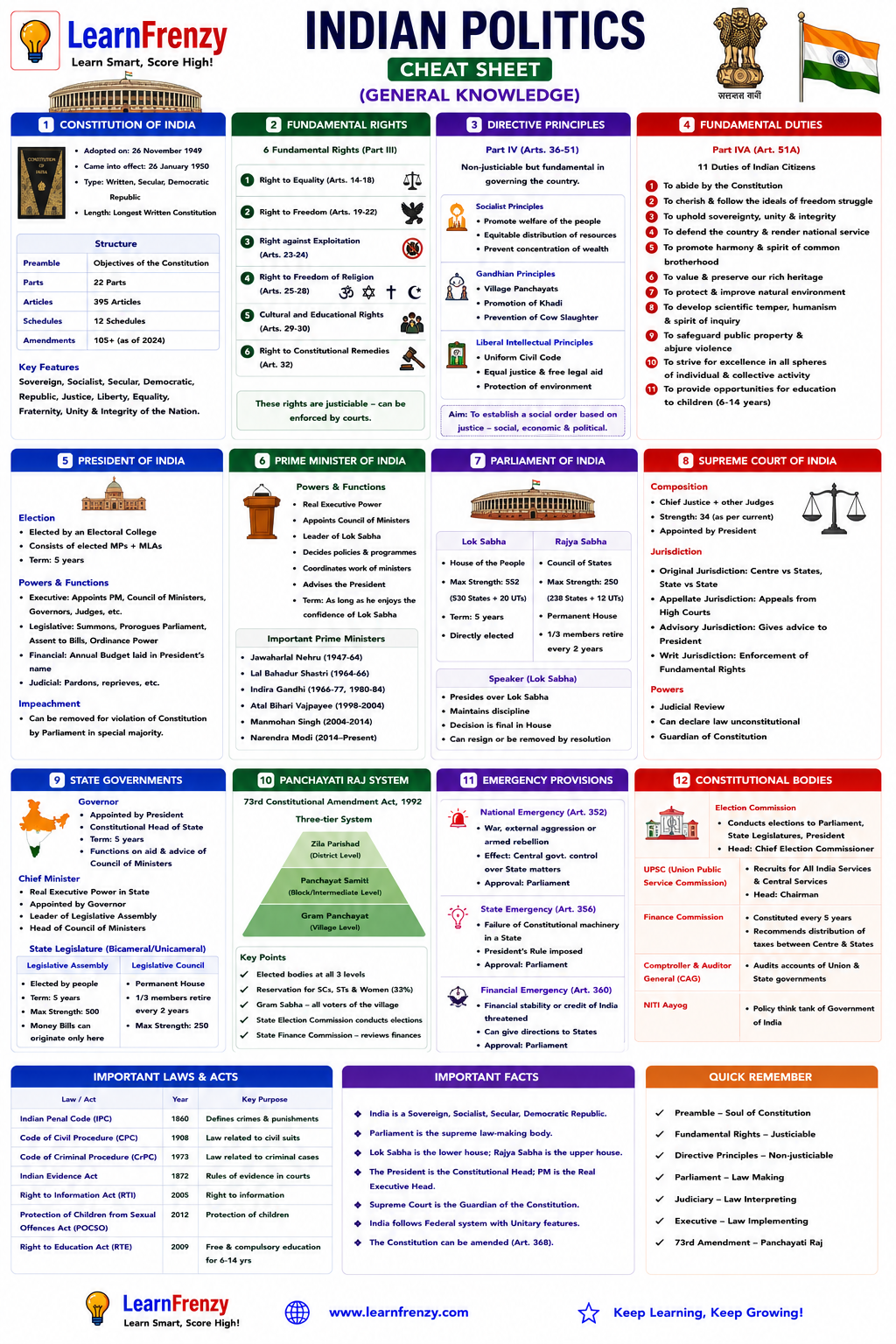
Your complete guide to Indian Politics for competitive exams. This cheat sheet covers the Constitution, Fundamental Rights, Directive Principles, and the functioning of the Indian political system.
📜 Constitution of India
- Adoption & Enactment
- Structure & Preamble
- Parts & Articles
- Schedules
- Basic Structure Doctrine
- Important Amendments
⚖️ Fundamental Rights & Duties
- Right to Equality
- Right to Freedom
- Right against Exploitation
- Right to Freedom of Religion
- Cultural & Educational Rights
- Right to Constitutional Remedies
- Fundamental Duties
📊 Directive Principles & Central Government
- Socialist, Gandhian & Liberal Principles
- President (Powers, Election, Impeachment)
- Vice President
- Prime Minister (Powers, Functions)
- Council of Ministers
- Parliament (Lok Sabha, Rajya Sabha)
🏛️ Judiciary & State Government
- Supreme Court (Composition, Powers)
- Chief Justices of India
- Governor & Chief Minister
- State Legislature
- State Judiciary
- Centre-State Relations
🏘️ Local Government & Emergency
- Panchayati Raj (73rd Amendment)
- Municipalities (74th Amendment)
- National Emergency
- State Emergency
- Financial Emergency
- Emergency Provisions
📚 Exam Categories
- SSC & Banking
- Railways & UPSC
- State PSC
- Defence & Insurance
- CAT & MBA Entrance
- Other Competitive Exams
📅 Adopted
Nov 26, 1949
Constitution Day📅 Enacted
Jan 26, 1950
Republic Day📜 Articles
448
Originally 395📋 Schedules
12
Originally 8🇮🇳 Presidents & Prime Ministers of India
Dr. Rajendra Prasad
1950-1962 | First President
Jawaharlal Nehru
1947-1964 | First PM
Dr. S. Radhakrishnan
1962-1967 | President
Indira Gandhi
1966-1977, 1980-1984 | PM
Dr. A.P.J. Abdul Kalam
2002-2007 | President
Atal Bihari Vajpayee
1998-2004 | PM
Pranab Mukherjee
2012-2017 | President
Narendra Modi
2014-Present | PM
🏛️ Parliament Structure
Lower House | Max 552 Members
Upper House | Max 250 Members
Presides over Lok Sabha
Vice President presides over Rajya Sabha
February - May
July - August
⚖️ Supreme Court
Highest Judicial Authority
34 (including CJI)
Disputes between states/Centre
Appeals from High Courts
Advises President on law
Reviews laws for constitutionality
⚡ Emergency Provisions - Quick Reference
🇮🇳 National Emergency
Article 352
War, External Aggression, Armed Rebellion🏛️ State Emergency
Article 356
President's Rule in State💰 Financial Emergency
Article 360
Financial Instability⚖️ Fundamental Rights vs Directive Principles
✅ Fundamental Rights
- Part III of Constitution
- Justiciable (Enforceable by courts)
- Individual rights
- Negative obligations on state
- Example: Article 14 - Right to Equality
📋 Directive Principles
- Part IV of Constitution
- Non-Justiciable (Not enforceable)
- Social and economic rights
- Positive obligations on state
- Example: Article 44 - Uniform Civil Code
📋 Quick Reference: Important Constitutional Facts
📜 Constitution
- Adopted: Nov 26, 1949
- Enacted: Jan 26, 1950
- Parts: 25 (originally 22)
- Articles: 448 (originally 395)
- Schedules: 12 (originally 8)
- Length: Longest Constitution
- Framed by: Constituent Assembly
- Chairman: Dr. B.R. Ambedkar
- First President: Dr. Rajendra Prasad
- First PM: Jawaharlal Nehru
- First VP: Dr. S. Radhakrishnan
- First Chief Justice: H.J. Kania
- Form of Government: Parliamentary Democracy
- Preamble: "We, the People of India"
- Federal System: Quasi-Federal
⚖️ Key Articles
- Art 1: Name and Territory
- Art 12: Definition of State
- Art 14: Right to Equality
- Art 15: Prohibition of Discrimination
- Art 16: Equal Opportunity in Employment
- Art 17: Abolition of Untouchability
- Art 19: Freedom of Speech
- Art 21: Right to Life
- Art 21A: Right to Education
- Art 32: Constitutional Remedies
- Art 44: Uniform Civil Code
- Art 51A: Fundamental Duties
- Art 72: Pardoning Power
- Art 74: Council of Ministers
- Art 112: Annual Budget
- Art 155: Appointment of Governor
- Art 226: High Courts' Power
- Art 280: Finance Commission
- Art 324: Election Commission
- Art 343: Official Language
- Art 352: National Emergency
- Art 356: President's Rule
- Art 360: Financial Emergency
- Art 368: Amendment Procedure
- Art 370: Special Status to J&K
🏛️ Important Amendments
- 1st (1951): Ninth Schedule
- 7th (1956): State Reorganization
- 15th (1963): HC Judges Retirement
- 24th (1971): Judiciary - Amendment
- 26th (1971): Privy Purses
- 39th (1975): Election Disputes
- 42nd (1976): "Mini Constitution"
- 44th (1978): Restored FRs
- 52nd (1985): Anti-Defection
- 61st (1989): Voting Age 18
- 65th (1990): SC/ST Commission
- 69th (1991): Delhi NCT
- 71st (1992): Konkani, Manipuri, Nepali
- 73rd (1992): Panchayati Raj
- 74th (1992): Municipalities
- 77th (1995): Reservation in Promotions
- 79th (1999): SC/ST Reservation
- 80th (2000): Pooling of Taxes
- 84th (2001): Delimitation
- 86th (2002): Right to Education
- 88th (2003): Service Tax
- 89th (2003): SC/ST Commission
- 91st (2003): Council of Ministers
- 92nd (2003): Bodo, Dogri, Maithili, Santhali
- 93rd (2005): OBC Reservation
- 95th (2009): SC/ST Reservation
- 97th (2011): Co-operative Societies
- 99th (2014): NJAC
- 101st (2016): GST
- 103rd (2019): EWS Reservation
- 104th (2020): SC/ST Extended
- 106th (2023): Women Reservation
🎯 How to Master Indian Politics Quickly
The Golden Rule: Indian Politics questions are largely constitutional and factual. Focus on understanding the structure of government, key articles, and important amendments. Create a mental map of how the system works.
Step-by-Step Approach:
- Step 1: Start with the Preamble and understand its significance
- Step 2: Learn Fundamental Rights and Directive Principles
- Step 3: Understand the structure of Central and State governments
- Step 4: Memorize key articles, schedules, and amendments
- Step 5: Practice with previous year questions
Common Mistakes to Avoid:
- ❌ Confusing Fundamental Rights with Directive Principles
- ❌ Mixing up powers of President and Prime Minister
- ❌ Forgetting important constitutional amendments
- ❌ Ignoring the Panchayati Raj system
Proven Strategy: The "Structure-Function" technique – first understand the structure of each institution (who is part of it, how it is formed), then learn its functions (what it does, what powers it has). This helps in answering both factual and analytical questions.
Memory Trick: Remember the key constitutional parts:
- ⚖️ Part III: Fundamental Rights
- 📋 Part IV: Directive Principles
- 🔄 Part IVA: Fundamental Duties
- 🏛️ Part V: The Union
- 🏘️ Part IX: Panchayats
- ⚡ Part XVIII: Emergency Provisions
💡 Pro Tips for Indian Politics
✅ Understand the Structure
Draw a diagram of the political system – it helps visualize the structure
✅ Remember Key Articles
Articles 14-32, 356, 368 are frequently asked
✅ Know the Presidents & PMs
Important Presidents and Prime Ministers and their contributions
✅ Practice with Current Affairs
Follow current political events – many questions come from recent developments
Download Cheat Sheet
This cheat sheet has 3 pages. Choose download option:
Preview
Still have questions?
We're here to help! Reach out to our support team for any queries.