Chemistry
About This Cheat Sheet
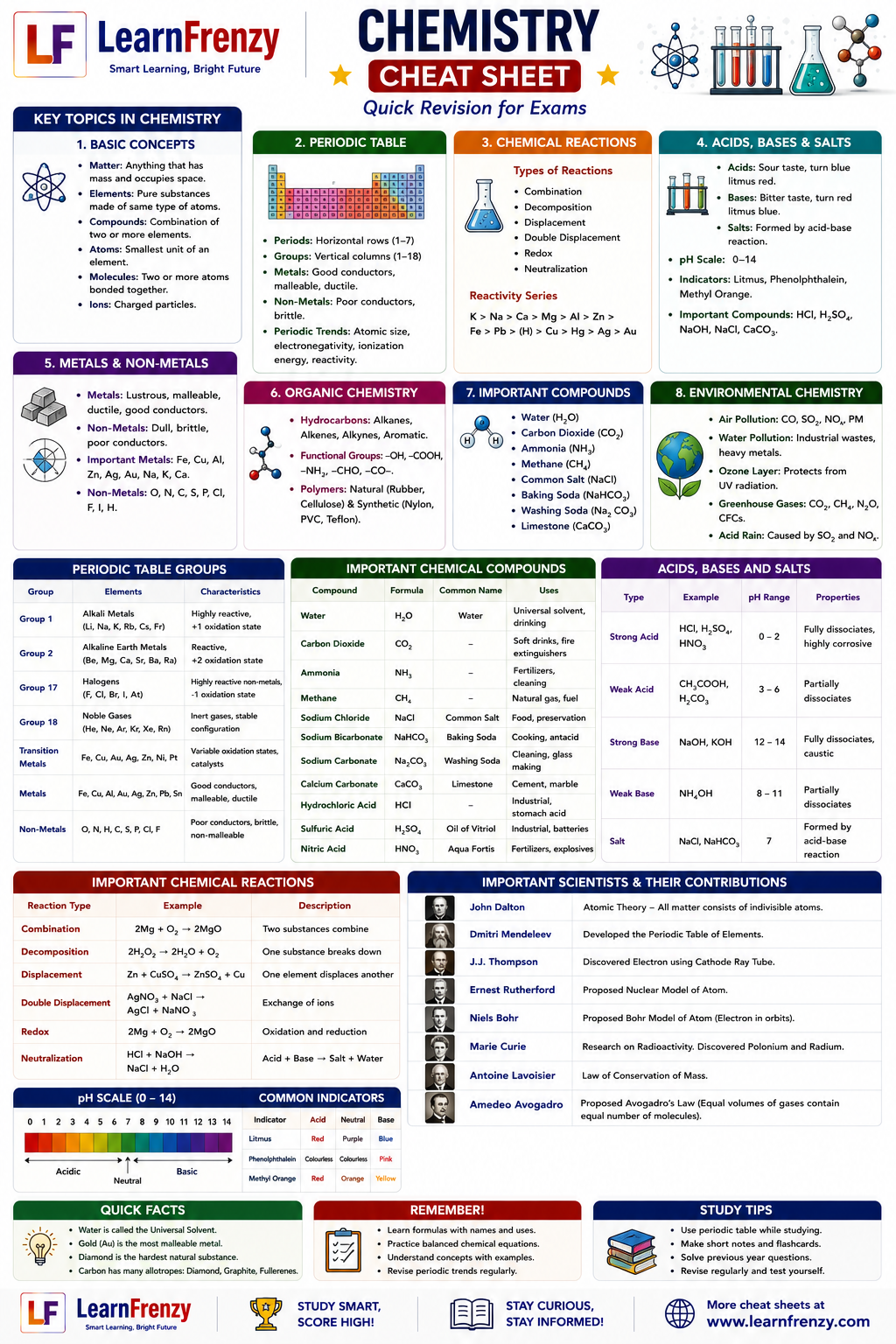
Hey there! Welcome to your complete guide to Chemistry for competitive exams. I've put together everything you need to know in one place — from Basic Concepts and the Periodic Table to Chemical Reactions, Acids and Bases, Organic Chemistry, Important Compounds, and more. Whether you're preparing for SSC, Banking, Railways, UPSC, or State PSC exams, this cheat sheet covers formulas, reactions, periodic trends, and shortcut techniques to help you score better.
⚛️ Basic Concepts
- Matter - Solid, Liquid, Gas
- Elements - 118 known elements
- Compounds - Two or more elements
- Mixtures - Physically combined
- Atoms - Smallest unit
- Molecules - Group of atoms
- Ions - Charged particles
- Valency - Combining capacity
📊 Periodic Table
- Groups - 18 vertical columns
- Periods - 7 horizontal rows
- Metals - Left side
- Non-Metals - Right side
- Metalloids - Along staircase
- Atomic Size - Decreases across period
- Electronegativity - Increases across period
- Ionization Energy - Increases across period
🧪 Chemical Reactions
- Combination - A + B → AB
- Decomposition - AB → A + B
- Displacement - A + BC → AC + B
- Double Displacement - AB + CD → AD + CB
- Redox - Oxidation & Reduction
- Exothermic - Releases heat
- Endothermic - Absorbs heat
- Neutralization - Acid + Base → Salt + Water
🧪 Acids, Bases & Salts
- Acids - pH < 7 (Sour taste)
- Bases - pH > 7 (Bitter taste)
- Salts - pH = 7 (Neutral)
- pH Scale - 0 to 14
- Indicators - Litmus, Phenolphthalein
- HCl - Hydrochloric Acid
- NaOH - Sodium Hydroxide
- NaCl - Common Salt
🔬 Organic Chemistry
- Alkanes - Single bonds (C-C)
- Alkenes - Double bonds (C=C)
- Alkynes - Triple bonds (C≡C)
- Alcohols - -OH group
- Aldehydes - -CHO group
- Ketones - -CO- group
- Carboxylic Acids - -COOH group
- Polymers - Plastics, Rubber
🧪 Important Compounds
- H₂O - Water
- CO₂ - Carbon Dioxide
- NH₃ - Ammonia
- CH₄ - Methane
- NaCl - Common Salt
- NaHCO₃ - Baking Soda
- Na₂CO₃ - Washing Soda
- CaCO₃ - Calcium Carbonate
⚛️ 118
Known Elements
Periodic Table🧪 pH Scale
0 (Acid) to 14 (Base)
7 = Neutral🧬 Organic
Carbon Compounds
Functional Groups🧪 NaCl
Common Salt
Table Salt📊 Periodic Table Groups
🔵 Group 1: Alkali Metals
- Elements: Li, Na, K, Rb, Cs, Fr
- Characteristics: Highly reactive
- Oxidation State: +1
- Key Point: React with water
🟢 Group 2: Alkaline Earth
- Elements: Be, Mg, Ca, Sr, Ba, Ra
- Characteristics: Reactive
- Oxidation State: +2
- Key Point: Found in minerals
🟡 Group 17: Halogens
- Elements: F, Cl, Br, I, At
- Characteristics: Highly reactive non-metals
- Oxidation State: -1
- Key Point: Salt formers
🟣 Group 18: Noble Gases
- Elements: He, Ne, Ar, Kr, Xe, Rn
- Characteristics: Inert, stable
- Key Point: Full electron shell
- Use: Lighting, welding
📊 Periodic Trends
🧪 Metals & Non-Metals
🧪 Acids, Bases & Salts
🔴 Acids
- pH Range: 0 to 6.9
- Properties: Sour taste, turns blue litmus red
- Strong Acids: HCl, H₂SO₄, HNO₃
- Weak Acids: CH₃COOH, H₂CO₃
- Examples: Stomach acid, Citric acid
🔵 Bases
- pH Range: 7.1 to 14
- Properties: Bitter taste, turns red litmus blue
- Strong Bases: NaOH, KOH, Ca(OH)₂
- Weak Bases: NH₄OH
- Examples: Soap, Toothpaste
🟣 Salts
- pH Range: 7 (Neutral)
- Formation: Acid + Base → Salt + Water
- Common Salt: NaCl (Table salt)
- Baking Soda: NaHCO₃
- Washing Soda: Na₂CO₃
🧪 Important Chemical Compounds
💧 Water (H₂O)
- Common Name: Water
- Uses: Universal solvent, drinking
- Key Point: Essential for life
🌫️ CO₂
- Common Name: Carbon Dioxide
- Uses: Soft drinks, fire extinguishers
- Key Point: Greenhouse gas
🧪 NH₃
- Common Name: Ammonia
- Uses: Fertilizers, cleaning
- Key Point: Pungent smell
🔥 CH₄
- Common Name: Methane
- Uses: Natural gas, fuel
- Key Point: Greenhouse gas
🧪 More Important Compounds
🧂 NaCl
- Common Name: Common Salt
- Uses: Food, preservation
- Key Point: Table salt
🧪 NaHCO₃
- Common Name: Baking Soda
- Uses: Cooking, antacid
- Key Point: Mild base
🧼 Na₂CO₃
- Common Name: Washing Soda
- Uses: Cleaning, glass making
- Key Point: Strong base
🪨 CaCO₃
- Common Name: Limestone
- Uses: Cement, marble
- Key Point: Found in shells
🧪 Important Acids, Bases & Salts
🧪 Important Acids
- HCl - Hydrochloric Acid (Stomach acid)
- H₂SO₄ - Sulfuric Acid (Industrial, batteries)
- HNO₃ - Nitric Acid (Fertilizers, explosives)
- CH₃COOH - Acetic Acid (Vinegar)
- H₂CO₃ - Carbonic Acid (Soft drinks)
🧪 Important Bases
- NaOH - Sodium Hydroxide (Caustic soda)
- KOH - Potassium Hydroxide (Caustic potash)
- Ca(OH)₂ - Calcium Hydroxide (Lime)
- NH₄OH - Ammonium Hydroxide (Cleaning)
- Mg(OH)₂ - Magnesium Hydroxide (Antacid)
🧪 Important Salts
- NaCl - Common Salt (Table salt)
- NaHCO₃ - Baking Soda (Cooking, antacid)
- Na₂CO₃ - Washing Soda (Cleaning)
- CaCO₃ - Calcium Carbonate (Limestone)
- AgNO₃ - Silver Nitrate (Lab use)
🧪 Types of Chemical Reactions
🔥 Combination
- Definition: Two or more substances combine
- Example: 2Mg + O₂ → 2MgO
- Key Point: Forms a single product
💥 Decomposition
- Definition: One substance breaks down
- Example: 2H₂O₂ → 2H₂O + O₂
- Key Point: Forms multiple products
🔄 Displacement
- Definition: One element displaces another
- Example: Zn + CuSO₄ → ZnSO₄ + Cu
- Key Point: More reactive element displaces less reactive
🧪 More Chemical Reactions
🔄 Double Displacement
- Definition: Exchange of ions
- Example: AgNO₃ + NaCl → AgCl + NaNO₃
- Key Point: Precipitate formation
⚡ Redox
- Definition: Oxidation + Reduction
- Example: 2Mg + O₂ → 2MgO
- Key Point: Electron transfer
🧪 Neutralization
- Definition: Acid + Base → Salt + Water
- Example: HCl + NaOH → NaCl + H₂O
- Key Point: pH becomes 7
🔬 Important Scientists in Chemistry
⚛️ John Dalton
- Contribution: Atomic Theory
- Year: 1808
- Key Point: First modern atomic theory
📊 Mendeleev
- Contribution: Periodic Table
- Year: 1869
- Key Point: Arranged by atomic weight
⚡ J.J. Thompson
- Contribution: Discovery of Electron
- Year: 1897
- Key Point: Plum pudding model
🔬 Marie Curie
- Contribution: Radioactivity, Radium
- Year: 1898
- Key Point: Two Nobel Prizes
🔬 More Important Scientists
🪐 Ernest Rutherford
- Contribution: Nuclear Model of Atom
- Year: 1911
- Key Point: Gold foil experiment
⚛️ Niels Bohr
- Contribution: Bohr Model of Atom
- Year: 1913
- Key Point: Fixed energy levels
🧪 Lavoisier
- Contribution: Law of Conservation of Mass
- Year: 1774
- Key Point: Father of Modern Chemistry
📐 Avogadro
- Contribution: Avogadro's Law
- Key Point: 6.022 × 10²³ (Avogadro's number)
🌍 Environmental Chemistry
🌫️ Air Pollution
- Major Pollutants: CO₂, CO, SO₂, NOx, CFCs
- Sources: Vehicles, Industry, Burning
- Effects: Global warming, Acid rain
- Control: Catalytic converters, Filters
🌍 Ozone Layer
- Location: Stratosphere
- Function: Blocks UV radiation
- Depletion: CFCs (Chlorofluorocarbons)
- Montreal Protocol: 1987 (Phase-out CFCs)
🌧️ Acid Rain
- Cause: SO₂ and NOx in atmosphere
- Effect: Damages buildings, forests, lakes
- pH: < 5.6
- Control: Reduce emissions
🌡️ Greenhouse Gases
🌫️ CO₂
- Source: Burning fossil fuels
- Contribution: Major greenhouse gas
- Key Point: Rising levels
🔥 CH₄
- Source: Agriculture, landfills
- Contribution: 25× more potent than CO₂
- Key Point: Natural gas
💨 N₂O
- Source: Fertilizers, industry
- Contribution: 298× more potent than CO₂
- Key Point: Laughing gas
🧪 CFCs
- Source: Refrigerants, aerosols
- Contribution: Ozone depletion
- Key Point: Banned under Montreal Protocol
🎯 Chemistry Quick Revision
The Golden Rule: Focus on the Periodic Table trends, important compounds and their formulas, and types of chemical reactions. Most competitive exam questions test your ability to match compounds with their formulas and identify reaction types.
Quick Memory Tricks:
- 📌 Acid Formula: HCl (Hydrochloric), H₂SO₄ (Sulfuric), HNO₃ (Nitric)
- 📌 Base Formula: NaOH (Sodium Hydroxide), KOH (Potassium Hydroxide)
- 📌 Salt Formula: NaCl (Common Salt), NaHCO₃ (Baking Soda), Na₂CO₃ (Washing Soda)
- 📌 pH Scale: 0-6 (Acid), 7 (Neutral), 8-14 (Base)
- 📌 Reaction Types: Combination (A+B→AB), Decomposition (AB→A+B), Displacement (A+BC→AC+B)
Exam Strategy:
- Step 1: Read the question — identify if it's about formulas, reactions, or properties
- Step 2: For compounds, match the formula with the correct name
- Step 3: For reactions, identify the type (combination, decomposition, displacement)
- Step 4: For periodic table, use trends to eliminate options
- Step 5: For environmental chemistry, remember key pollutants
💡 Pro Tips for Chemistry
✅ Memorize Important Formulas
H₂O (Water), NaCl (Common Salt), NaHCO₃ (Baking Soda), H₂SO₄ (Sulfuric Acid).
✅ Learn Periodic Trends
Atomic size decreases across period, increases down group. Electronegativity increases across period.
✅ Know Reaction Types
Combination, Decomposition, Displacement, Double Displacement, Redox, Neutralization.
✅ Remember pH Scale
pH 0-6.9 = Acidic, pH 7 = Neutral, pH 7.1-14 = Basic.
✅ Environmental Chemistry
CO₂ (Greenhouse), CFCs (Ozone depletion), SO₂ (Acid rain), NOx (Acid rain).
✅ Important Scientists
Dalton (Atomic Theory), Mendeleev (Periodic Table), Marie Curie (Radioactivity).
🧪 Quick Reference: Important Compounds Summary
🧪 Compound
- H₂O
- CO₂
- NH₃
- CH₄
- NaCl
- NaHCO₃
- Na₂CO₃
- CaCO₃
- HCl
- H₂SO₄
- HNO₃
📚 Common Name
- Water
- Carbon Dioxide
- Ammonia
- Methane
- Common Salt
- Baking Soda
- Washing Soda
- Limestone
- Hydrochloric Acid
- Sulfuric Acid
- Nitric Acid
🎯 Uses
- Universal solvent
- Soft drinks
- Fertilizers
- Fuel
- Food, preservation
- Cooking, antacid
- Cleaning, glass
- Cement, marble
- Industrial, stomach
- Batteries, industry
- Fertilizers, explosives
🟠 Type
- Compound
- Oxide
- Base
- Hydrocarbon
- Salt
- Salt (Base)
- Salt (Base)
- Salt (Carbonate)
- Acid
- Acid
- Acid
🧪 Quick Reference: Reaction Types Summary
🔥 Combination
- Example: 2Mg + O₂ → 2MgO
- Key: Two substances → One product
- Use: Synthesis reactions
💥 Decomposition
- Example: 2H₂O₂ → 2H₂O + O₂
- Key: One substance → Two products
- Use: Breaking down compounds
🔄 Displacement
- Example: Zn + CuSO₄ → ZnSO₄ + Cu
- Key: More reactive displaces less
- Use: Metal reactivity
Download Cheat Sheet
This cheat sheet has 2 pages. Choose download option:
Preview
Still have questions?
We're here to help! Reach out to our support team for any queries.