Five Figure Series
Practice and master this topic with our carefully crafted questions.
Each of the following questions consists of five figures marked A, B, C, D and E called the Problem Figures followed by four other figures marked 1, 2, 3 and 4 called the Answer Figures. Select a figure from amongst the Answer Figures which will continue the same series as established by the five Problem Figures.
Select a figure from amongst the Answer Figures which will continue the same series as established by the five Problem Figures.
| Problem Figures | Answer Figures |
|---|---|
|
|
Pattern Identified: Cyclic Rotation of Arrow and Dot Positions
🔍 Analysis
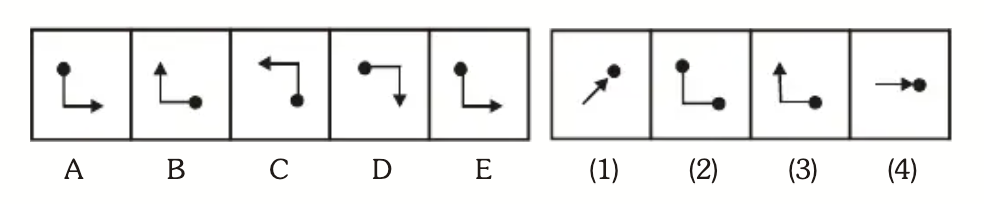
Each figure consists of an L-shaped line having a dot at one end and an arrow at the other end.
Observe the direction of the arrow:
- Figure A → Arrow points right (→)
- Figure B → Arrow points upward (↑)
- Figure C → Arrow points left (←)
- Figure D → Arrow points downward (↓)
- Figure E → Arrow points right (→)
Thus, the arrow rotates 90° anti-clockwise in every successive figure.
Now observe the position of the dot:
- Figure A → Dot at the top end
- Figure B → Dot at the right end
- Figure C → Dot at the bottom end
- Figure D → Dot at the left end
- Figure E → Dot again at the top end
Therefore, the dot moves cyclically through the positions:
Top → Right → Bottom → Left → Top → Right
Since Figure E has the arrow pointing right and the dot at the top position, the next figure must have:
- Arrow pointing upward (90° anti-clockwise rotation)
- Dot at the right end (next cyclic position)
Among the answer figures, only Figure (3) satisfies both conditions.
Correct Answer: Option (C)
Select a figure from amongst the Answer Figures which will continue the same series as established by the five Problem Figures.
| Problem Figures | Answer Figures |
|---|---|
|
|
Pattern Identified: Cyclic Corner Movement with Alternate Orientation
🔍 Analysis
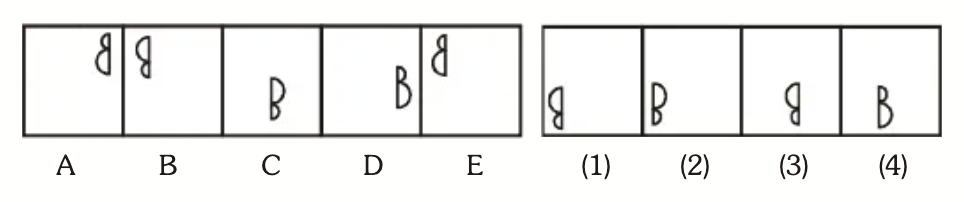
The symbol moves through the four corners in a clockwise sequence: Top-right → Top-left → Bottom-left → Bottom-right → Top-right.
At the same time, the symbol alternates its facing direction in every figure.
Therefore, after Figure E, the symbol must appear at the top-left position and face right. This matches Figure (1).
Correct Answer: Option (A)
Select a figure from amongst the Answer Figures which will continue the same series as established by the five Problem Figures.
| Problem Figures | Answer Figures |
|---|---|
|
|
Pattern Identified: Repetition of Alternate Figures with Progressive Modification
🔍 Analysis
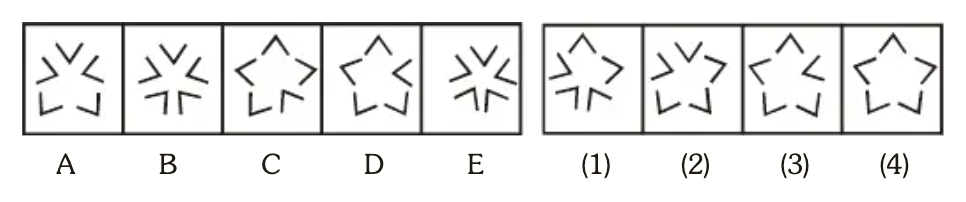
Observe the figures in two separate groups:
- Group 1: A, C and E
- Group 2: B, D and the missing figure
Figures A and E are identical. This indicates that the series has completed one cycle and starts repeating from Figure E.
Now compare Figures B and D. Both belong to the second group and represent successive stages of the same pattern. Therefore, after Figure E (which repeats Figure A), the next figure must correspond to the next stage after Figure B.
Notice that Figure (1) has the same arrangement as Figure B but with the expected advancement of the pattern. It naturally continues the sequence established by the previous figures.
A useful shortcut for such series questions is:
A ≈ E ⇒ Next Figure ≈ B
Hence, the figure that best continues the series is Option (1).
Correct Answer: Option (A)
Select a figure from amongst the Answer Figures which will continue the same series as established by the five Problem Figures.
| Problem Figures | Answer Figures |
|---|---|
|
|
Pattern Identified: One Dot is Replaced by a Cross (×) in Every Step
🔍 Analysis
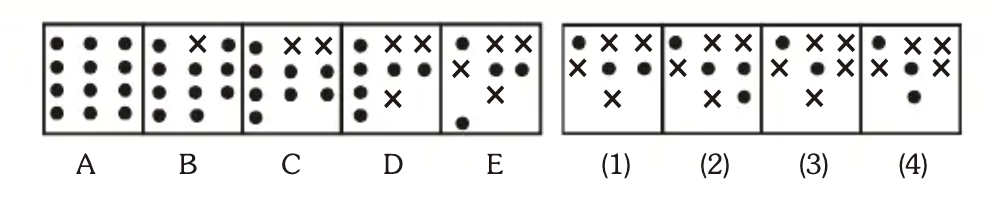
Figure A contains only dots arranged in four rows and three columns.
In each successive figure, exactly one dot is replaced by a cross (×). The replacement follows a fixed order.
Let us count the number of crosses in each figure:
| Figure | Number of Crosses (×) |
|---|---|
| A | 0 |
| B | 1 |
| C | 2 |
| D | 3 |
| E | 4 |
Therefore, the next figure must contain 5 crosses.
Now observe the positions of the crosses:
- 1st cross appears at the top-middle position.
- 2nd cross appears at the top-right position.
- 3rd cross appears at the third-row middle position.
- 4th cross appears at the second-row left position.
- The next logical position is the second-row right position.
So, one more dot should be replaced by a cross at the remaining corresponding position.
Among the answer figures, only Option (3) shows exactly five crosses placed according to this pattern.
Correct Answer: (C)
Select a figure from amongst the Answer Figures which will continue the same series as established by the five Problem Figures.
| Problem Figures | Answer Figures |
|---|---|

|
|
Pattern Identified: Clockwise Addition of Petals
🔍 Analysis
The figure develops into a flower by adding one new petal in each successive step.
The petals are added in a clockwise direction around the centre. Figure E contains five petals, and the next vacant position receives the new petal.
Among the answer figures, Option (1) shows the correct continuation of the petal-addition pattern.
Correct Answer: Option (A)
⚡ Quick Exam Shortcut
Do not just count the petals. Also observe the position where each new petal is added.
The flower grows by adding one petal at the next vacant location around the centre. Identifying the next vacant position immediately leads to the correct answer.
Hence, Option (A) is the correct answer.
Select a figure from amongst the Answer Figures which will continue the same series as established by the five Problem Figures.
| Problem Figures | Answer Figures |
|---|---|

|
|
Pattern Identified: Cyclic Movement with Rotation of the Bent Shape
🔍 Analysis
The bent figure and the cross move together from one position to another inside the box. Simultaneously, the bent figure rotates step by step.
The position sequence and rotational pattern indicate that after Figure E, the figure should appear at the next location with the bent shape rotated accordingly and the cross placed beneath it.
Among the answer figures, only Option (3) satisfies both the movement and rotation patterns.
Correct Answer: Option (C)
Select a figure from amongst the Answer Figures which will continue the same series as established by the five Problem Figures.
| Problem Figures | Answer Figures |
|---|---|

|
|
Pattern Identified: Alternating Rotation of External Markers
🔍 Analysis
The external marker around the wheel follows a rotational pattern. The dot and arrow appear in a fixed sequence, and the arrow changes its position around the wheel in successive figures.
After the lower-right arrow in Figure E, the next position in the sequence is the left side of the wheel. Among the answer figures, only Option (4) satisfies this condition.
Correct Answer: Option (D)
⚡ Quick Exam Shortcut
Ignore the wheel and focus only on the external dot/arrow.
Track its movement around the circle: Bottom → Right → Lower-right → Left.
The next position matches Option (D).
Select a figure from amongst the Answer Figures which will continue the same series as established by the five Problem Figures.
| Problem Figures | Answer Figures |
|---|---|

|
|
Pattern Identified: Progressive Conversion and Clockwise Movement of the Open Figure
🔍 Analysis
Figure A contains a single open L-shaped figure.
In Figure B, the L-shape becomes a square at the top position and a new L-shape appears at the bottom position.
In Figures C and D, the open figure gradually gets converted into squares until four single squares are formed.
In Figure E, the transformation enters the next stage. The left-side squares become double squares while the remaining squares stay single.
The incomplete L-shaped figure now starts reappearing and moving clockwise through the corner positions. Therefore, after Figure E, the next figure should contain:
- Two double squares on the left side
- One single square at the top-right
- An L-shaped figure at the bottom-right position
Only answer figures,Option (4) satisfies this arrangement.
Correct Answer: Option (D)
Select a figure from amongst the Answer Figures which will continue the same series as established by the five Problem Figures.
| Problem Figures | Answer Figures |
|---|---|

|
|
Pattern Identified: Continuous 45° Clockwise Rotation of the Entire Figure
🔍 Analysis
The chain of dots rotates 45° clockwise in every successive figure.
| Figure | Direction of Dot Chain |
|---|---|
| A | Vertical |
| B | Diagonal (\) |
| C | Horizontal |
| D | Diagonal (/) |
| E | Vertical |
Thus, the pattern is:
Vertical → Diagonal → Horizontal → Diagonal → Vertical → Diagonal
Therefore, the next figure must be a diagonal (\) arrangement.
Now observe the letters C and S. They remain attached to the two ends of the chain and rotate together with it.
In Figure E:
- S is at the upper end.
- C is at the lower end.
After rotating the entire figure by another 45° clockwise, the arrangement becomes:
- S at the upper-left end.
- C at the lower-right end.
- The highlighted dot occupies the corresponding position on the diagonal chain.
Among the answer figures, only Option (1) satisfies all these conditions.
Correct Answer: Option (A)
⚡ Quick Exam Shortcut
Ignore the letters initially and focus only on the direction of the dot chain:
Vertical → Diagonal → Horizontal → Diagonal → Vertical
The next figure must therefore be Diagonal (\).
Now rotate the letters C and S together with the chain. This immediately gives the arrangement shown in Option (1).
Shortcut Answer: Rotate Figure E by 45° clockwise → Option (1).
Select a figure from amongst the Answer Figures which will continue the same series as established by the five Problem Figures.
| Problem Figures | Answer Figures |
|---|---|

|
|
Pattern Identified: Progressive Movement of the Lower Curved Segments
🔍 Analysis
The figure is formed by five curved segments arranged around the centre. The top, left and right segments remain almost fixed, while the two lower curved segments gradually change their positions.
From Figures C, D and E, the lower arcs move progressively inward and continue following the same pattern.
Applying the next step of this movement produces the arrangement shown in answer figure Option (1).
Correct Answer: Option (A)
⚡ Quick Exam Shortcut
Ignore the top, left and right arcs and focus only on the two bottom arcs.
Track their movement from Figures C → D → E. The next position obtained by continuing the same movement pattern matches answer figure Option (1).
Shortcut Answer: Follow the lower arc movement → Option (A).