Choosing the Missing Figure in a Series
Practice and master this topic with our carefully crafted questions.
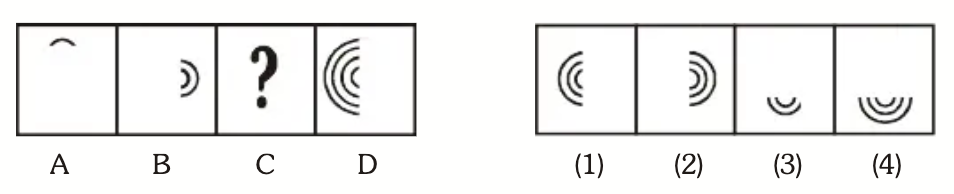
In each of the following questions, there is a set of four figures labelled A, B, C and D called the Problem Set followed by a set of four other figures labelled 1,2,3 and 4 called the Answer Set. Fig. (C) contains a question mark. Select a suitable figure from the Answer Set which will substitute this question mark so that a series is formed by the figures A, B, C and D taken in order. The number of the selected figure is the answer.
Select a suitable figure from the Answer Set which will substitute this question mark so that a series is formed by the figures A, B, C and D taken in order. The number of the selected figure is the answer.
| Problem Figures | Answer Figures |
|---|---|
|
|
Pattern Identified: Increase in Number of Curved Arcs by One in Each Step
🔍 Analysis
Observe the number of curved arcs in each figure:
| Figure | Number of Arcs |
|---|---|
| A | 1 |
| B | 2 |
| C | ? |
| D | 4 |
Since the number of arcs increases by one in every step, Figure C must contain 3 arcs.
Now observe the orientation:
- Figure A contains 1 arc opening downward.
- Figure B contains 2 arcs facing right.
- Figure D contains 4 arcs opening upward.
Therefore, the missing figure should be the intermediate stage containing 3 arcs before reaching the 4-arc upward arrangement.
Among the answer figures, only Option (4) contains exactly 3 arcs arranged in the required intermediate position.
Correct Answer: Option (D)
⚡ Quick Exam Shortcut
Count only the number of arcs:
1 → 2 → ? → 4
The missing figure must contain 3 arcs.
Then check the orientation progression from A to D. The figure with 3 arcs that fits between the second and fourth stages is Option (4).
Shortcut Answer: 1 → 2 → 3 → 4 arcs → Option (4).
Select a suitable figure from the Answer Set which will substitute this question mark so that a series is formed by the figures A, B, C and D taken in order. The number of the selected figure is the answer.
| Problem Figures | Answer Figures |
|---|---|

|
|
Pattern Identified: Alternate Addition of Arrow and Circle Columns
🔍 Analysis
Observe the figures carefully:
- Figure A contains only one upward arrow.
- Figure B contains an upward arrow, a downward arrow and one circle.
- Figure D contains four vertical columns arranged alternately as arrows and circles.
The pattern is formed by adding one new column at each stage.
Figure B contains:
↑ ●
↓
Figure D contains:
↑ ● ↑ ●
↓ ● ↓
Therefore, Figure C must be the intermediate stage obtained by adding one more arrow-column and one more circle-column to Figure B before reaching Figure D.
The required arrangement is:
↑ ● ↑
↓ ●
Among the answer figures, only Option (1) shows this exact intermediate configuration.
Correct Answer: Option (A)
⚡ Quick Exam Shortcut
Look at the number of vertical columns:
A = 1 column
B = 2 columns
C = 3 columns
D = 4 columns
The series adds one column at a time in alternating order:
Arrow Column → Circle Column → Arrow Column → Circle Column
The figure that correctly lies between B and D is Option (1).
Shortcut Answer: Follow the column addition pattern → Option (1).
Select a suitable figure from the Answer Set which will substitute this question mark so that a series is formed by the figures A, B, C and D taken in order. The number of the selected figure is the answer.
| Problem Figures | Answer Figures |
|---|---|

|
|
Pattern Identified: Increasing Symbol Complexity with Corner-Line Movement
🔍 Analysis
The corner symbol changes progressively:
Triangle → Square → Circle → Star
Therefore, the missing figure must contain a circle.
At the same time, the double diagonal lines move around the corners and reach the upper side in the later part of the sequence.
The missing figure should therefore contain a circle with the corner lines positioned as shown in Option (4), forming the correct transition to Figure D.
Correct Answer: (D)
⚡ Quick Exam Shortcut
Look at the symbols only:
Triangle → Square → Circle → Star
The missing figure must contain a circle.
Then compare the position of the corner lines and select the circle figure that best bridges Figures B and D.
Shortcut Answer: Circle + matching corner lines → Option (4).
Select a suitable figure from the Answer Set which will substitute this question mark so that a series is formed by the figures A, B, C and D taken in order. The number of the selected figure is the answer.
| Problem Figures | Answer Figures |
|---|---|

|
|
Pattern Identified: Simultaneous Reduction of L-Shapes and Dots
🔍 Analysis
Each figure contains:
- Nested L-shaped lines.
- A group of dots.
Observe the changes from left to right:
| Figure | L-Shapes | Dots |
|---|---|---|
| A | 3 | 4 |
| B | 2 | 3 |
| C | ? | ? |
| D | 1 | 2 |
From A to B:
- One L-shape is removed.
- One dot is removed.
Following the same pattern, the missing figure should be an intermediate stage between B and D.
Since Figure D contains:
- 1 L-shape
- 2 dots
Figure C should contain:
- 2 L-shapes
- 2 dots
Among the answer figures, only Option (2) shows exactly two nested L-shapes and two dots.
Correct Answer: (B)
⚡ Quick Exam Shortcut
Count the two components separately:
L-Shapes: 3 → 2 → 2 → 1
Dots: 4 → 3 → 2 → 2
The missing figure must therefore contain:
- 2 L-shapes
- 2 dots
This matches Option (2).
Select a suitable figure from the Answer Set which will substitute this question mark so that a series is formed by the figures A, B, C and D taken in order. The number of the selected figure is the answer.
| Problem Figures | Answer Figures |
|---|---|

|
|
Pattern Identified: Progressive Increase in the Number of Parallel Lines
🔍 Analysis
The figure consists of:
- Vertical lines at the top and bottom.
- Horizontal lines at the left and right.
Count the number of parallel lines in each figure:
| Figure | Vertical Lines (Top & Bottom) | Horizontal Lines (Left & Right) |
|---|---|---|
| A | 1 | 1 |
| B | 2 | 1 |
| C | 2 | 2 |
| D | 3 | 2 |
The pattern is:
(1,1) → (2,1) → (2,2) → (3,2)
That is, one set of lines increases first, then the other set catches up.
Therefore, the missing figure must contain:
- 2 vertical lines at the top and bottom.
- 2 horizontal lines at the left and right.
Among the answer figures, only Option (1) shows exactly this arrangement.
Correct Answer: (A)
⚡ Quick Exam Shortcut
Count the parallel lines:
(1,1) → (2,1) → ? → (3,2)
To reach (3,2), the missing step must be:
(2,2)
This means:
- 2 vertical lines at top and bottom.
- 2 horizontal lines at left and right.
This matches Option (1).
Select a suitable figure from the Answer Set which will substitute this question mark so that a series is formed by the figures A, B, C and D taken in order. The number of the selected figure is the answer.
| Problem Figures | Answer Figures |
|---|---|

|
|
Pattern Identified: Transfer of Dots from the Lower Half to the Upper Half
🔍 Analysis
Treat the figure as a domino having an upper compartment and a lower compartment.
| Figure | Upper Half | Lower Half |
|---|---|---|
| A | 1 | 4 |
| B | 3 | 3 |
| C | 4 | 3 |
| D | 5 | 2 |
Observe the pattern:
- From A to B, two dots move from the lower half to the upper half.
- From B to C, one additional dot is added to the upper half while the lower half remains unchanged.
- From C to D, one dot shifts from the lower half to the upper half.
Therefore, the missing figure must contain:
- 4 dots in the upper compartment
- 3 dots in the lower compartment
Among the answer figures, only Option (4) shows this arrangement.
Correct Answer: (D)
⚡ Quick Exam Shortcut
Count the dots in the two compartments:
(1,4) → (3,3) → ? → (5,2)
The upper compartment gains dots while the lower compartment gradually loses dots.
The intermediate figure must therefore be:
(4,3)
This corresponds to Option (4).
Select a suitable figure from the Answer Set which will substitute this question mark so that a series is formed by the figures A, B, C and D taken in order. The number of the selected figure is the answer.
| Problem Figures | Answer Figures |
|---|---|

|
|
Pattern Identified: Simultaneous Rotation of Both Arrows and Position Shift of Circles
🔍 Analysis
Compare Figure A with Figure B:
- The two circles shift to diagonally opposite positions.
- The straight arrow rotates by 180°.
- The curved arrow also reverses its direction.
Now apply the same relationship in reverse between Figures C and D.
Since Figure D contains:
- A straight arrow pointing towards the upper-left.
- A curved arrow directed towards the lower-left.
- Two circles positioned diagonally.
The preceding figure (C) must contain:
- A straight arrow pointing towards the lower-right.
- A curved arrow directed towards the lower-right.
- The corresponding diagonal circle positions.
Among all the answer figures, only Option (4) satisfies these conditions and transforms correctly into Figure D.
Correct Answer: (D)
⚡ Quick Exam Shortcut
Treat the figures as pairs:
A → B
C → D
Identify the transformation from A to B:
- Circles move diagonally.
- Straight arrow reverses direction.
- Curved arrow reverses direction.
Apply the same rule backward from D and you obtain Option (4).
Shortcut Answer: Use pair transformation → Option (4).
Select a suitable figure from the Answer Set which will substitute this question mark so that a series is formed by the figures A, B, C and D taken in order. The number of the selected figure is the answer.
| Problem Figures | Answer Figures |
|---|---|

|
|
Pattern Identified: Increase in Number of Elements with Alternating Position Change
🔍 Analysis
Observe the figures carefully:
- Figure A contains one circle at the top of a vertical line.
- Figure B contains two circles at the bottom with two upward arrows.
- Figure D contains four circles at the bottom with four upward arrows.
The series is not merely increasing the number of units. The arrangement alternates between opposite positions.
| Figure | Number of Elements | Position of Circles | Arrow Direction |
|---|---|---|---|
| A | 1 | Top | None |
| B | 2 | Bottom | Upward |
| C | 3 | Top | Downward |
| D | 4 | Bottom | Upward |
Thus two patterns occur simultaneously:
- The number of elements increases by one: 1 → 2 → 3 → 4.
- The arrangement alternates:
Top circles → Bottom circles → Top circles → Bottom circles
Downward arrows → Upward arrows → Downward arrows → Upward arrows
Therefore, Figure C must contain:
- 3 circles at the top.
- 3 downward arrows.
Among the answer figures, only Option (3) satisfies these conditions.
Correct Answer: (C)
⚡ Quick Exam Shortcut
Check two things:
Number of units: 1 → 2 → 3 → 4
Position: Top → Bottom → Top → Bottom
Since Figure B has bottom circles with upward arrows and Figure D repeats the same arrangement with four units, the missing Figure C must be the opposite arrangement with three units.
Shortcut Answer: Alternate position + increase count → Option (3).
Select a suitable figure from the Answer Set which will substitute this question mark so that a series is formed by the figures A, B, C and D taken in order. The number of the selected figure is the answer.
| Problem Figures | Answer Figures |
|---|---|

|
|
Pattern Identified: Progressive Shading of Squares in Clockwise Order
🔍 Analysis
Each square passes through three stages:
Empty → Half Shaded → Fully Shaded
The transformation moves clockwise through the four cells:
Top-Left → Bottom-Left → Bottom-Right → Top-Right
By Figure C:
- Top-left is fully shaded.
- Bottom-left is fully shaded.
- Bottom-right is half shaded.
- Top-right remains empty.
Among the answer figures, only Option (2) satisfies this arrangement.
Correct Answer: (B)
⚡ Quick Exam Shortcut
Follow the movement of the half-shaded square:
Top-Left → Bottom-Left → Bottom-Right → Top-Right
The previous half-shaded square becomes fully shaded, while the next square becomes half shaded.
This gives Option (2).
Select a suitable figure from the Answer Set which will substitute this question mark so that a series is formed by the figures A, B, C and D taken in order. The number of the selected figure is the answer.
| Problem Figures | Answer Figures |
|---|---|

|
|
Pattern Identified: Progressive Reduction of Shape Sides + Increase in Vertical Marks
🔍 Analysis
Two independent patterns operate simultaneously.
Pattern 1: Shape Simplification
The main figure gradually loses one side in each successive step:
| Figure | Shape Status |
|---|---|
| A | Closed pentagon-like figure |
| B | One side removed |
| C | Another side removed |
| D | Only the corner-shaped structure remains |
Therefore, Figure C must be the intermediate stage between B and D.
Pattern 2: Vertical Strokes
The number of vertical strokes increases regularly:
0 → 1 → 2 → 3
Thus Figure C must contain two vertical strokes.
Among the options:
- Option (1) has two strokes but does not fit the side-removal pattern.
- Option (3) has two strokes and the correct intermediate shape.
- Option (2) has only one stroke.
- Option (4) returns to the original closed figure.
Correct Answer: (C)
⚡ Quick Exam Shortcut
Focus on two things:
Shape: 5 sides → 4 sides → 3 sides → 2 sides
Marks: 0 → 1 → 2 → 3
The missing figure must therefore have:
- An intermediate 3-sided/open shape.
- Exactly 2 vertical marks.
This matches Option (3).