Completion of Series
🧠 Build a strong foundation in logical reasoning with clear explanations and real-world examples. Understand core concepts and develop critical thinking skills.
Introduction & Key Concepts
Study MaterialCompletion of Series
The Non Verbal Reasoning section of competitive examinations frequently includes questions from the topic Completion of Series. This topic is considered highly important because it tests a candidate’s observation skills, logical thinking, visual analysis, and pattern recognition ability.
In these questions, a sequence of figures follows a particular pattern. Candidates are required to identify the hidden rule and determine the missing figure, next figure, incorrect figure, or complete the sequence logically.
Questions from Completion of Series are commonly asked in SSC, Banking, Railway, Defence, State PSC, Insurance, CDS, NDA, and various aptitude examinations.
What is a Series?
A Series is a sequential arrangement of figures, symbols, shapes, or patterns that follow a specific logical rule or transformation from one figure to the next.
The transformation in a series may involve:
- Rotation of figures
- Movement of symbols
- Change in position
- Addition or deletion of elements
- Change in size or direction
- Mirror or water image concepts
- Changing shading or patterns
- Step-wise movement of objects
Types of Questions in Completion of Series
| Question Type | Description |
|---|---|
| Choosing the Next Figure | Find the figure that logically follows the series |
| Choosing the Missing Figure | Select the missing figure in the sequence |
| Wrong Figure Detection | Identify the incorrect figure in the series |
| Incorrect Order Detection | Detect the figure placed in wrong order |
| Pattern Recognition | Identify hidden visual transformation rules |
Importance of Completion of Series
Logical Thinking
Improves analytical and logical reasoning ability.
Observation Skills
Enhances the ability to identify visual patterns quickly.
Competitive Exams
Frequently asked in reasoning and aptitude sections.
Speed & Accuracy
Helps improve solving speed and visual accuracy.
Basic Concepts Used in Series Questions
- Rotation
- Direction Change
- Angle Movement
- Clockwise Rotation
- Anti-clockwise Rotation
- Step Movement
- Addition or Deletion of Figures
- Mirror & Water Image Logic
- Shading Patterns
- Position Change
Concept of Rotation
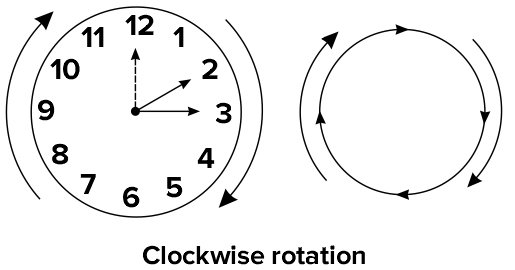
The movement of a figure around a fixed point is known as Rotation. Rotation is one of the most important concepts in Non Verbal Reasoning series questions.
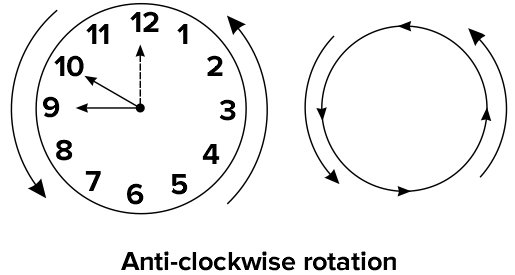
The simplest example of rotation can be observed in the movement of the hour and minute hands of a clock.
Rotation mainly occurs in two ways:
1. Clockwise Rotation
When a figure rotates in the same direction as the hands of a clock, the movement is called Clockwise Rotation.
Examples:
- 90° clockwise rotation
- 180° clockwise rotation
- 270° clockwise rotation
2. Anti-clockwise Rotation
When a figure rotates opposite to the direction of the hands of a clock, the movement is called Anti-clockwise Rotation.
Examples:
- 90° anti-clockwise rotation
- 180° anti-clockwise rotation
- 270° anti-clockwise rotation
Concept of Angles
Figures in a series may rotate by fixed angles either clockwise or anti-clockwise. Understanding angles is extremely important for solving figure-based reasoning questions quickly.
The dotted figure represents the original position while the dark figure shows the final rotated position.
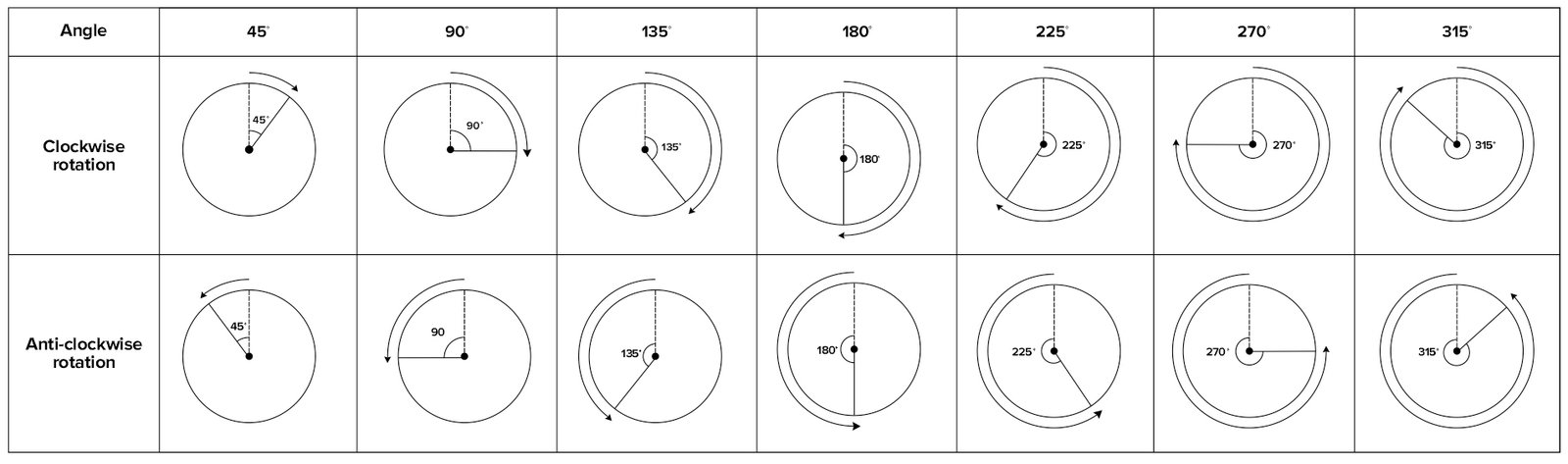
| Angle | Meaning |
|---|---|
| 90° | Quarter Rotation |
| 180° | Half Rotation |
| 270° | Three-Quarter Rotation |
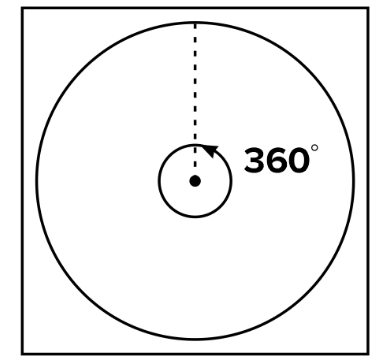
| 360° | Complete Rotation |
Concept of Angle in a Square
The concept of angular rotation also applies to square figures because a square also forms a complete angle of 360° around its center.
When a square rotates:
- 90° rotation changes its side position
- 180° rotation turns it upside down
- 360° rotation returns it to original position
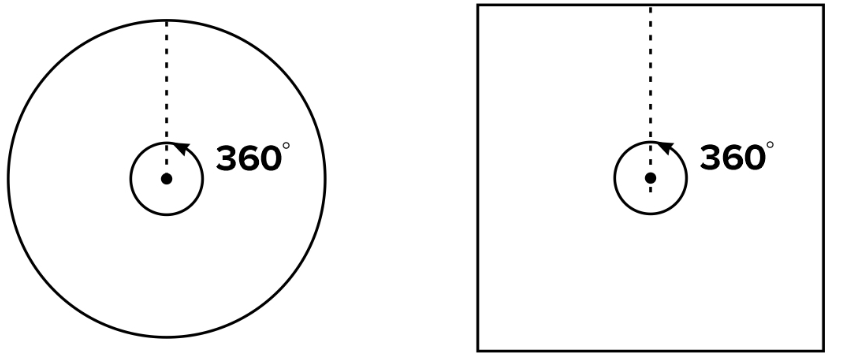
Combining circular and square rotations helps understand figure transformation more clearly.
Concept of Steps
In many series questions, the complete figure does not rotate. Instead, one or more symbols inside the figure move systematically from one position to another. This movement is called a Step Movement.
Understanding step movement is very important for solving advanced Non Verbal Reasoning questions.
The concept of steps is closely related to angles.
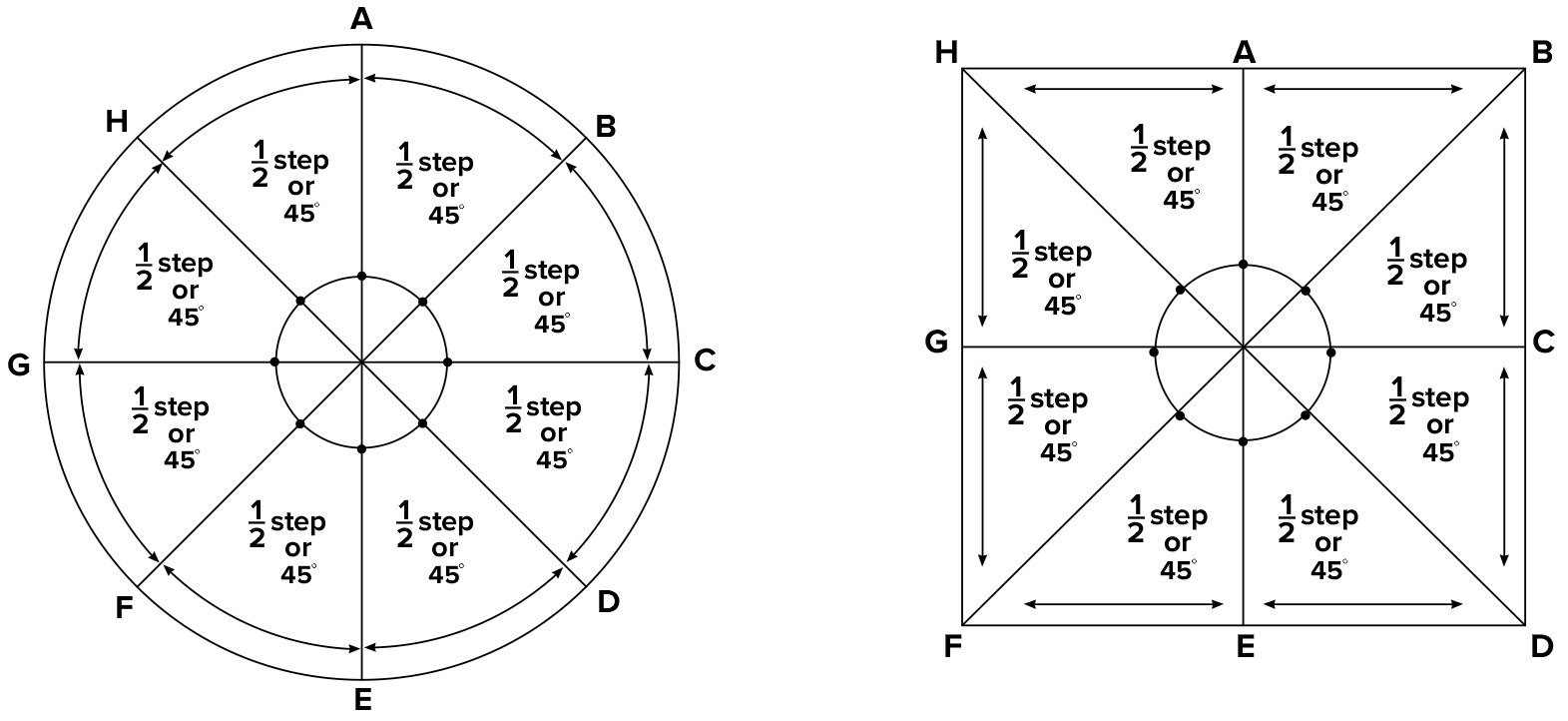
From the above figure:
- 45° movement represents half-step movement
- 90° movement represents one-step movement
- Symbols may move clockwise or anti-clockwise
- Step patterns are commonly repeated in reasoning series
Common Patterns in Series Questions
- Rotation of complete figure
- Movement of inner symbols
- Changing directions of arrows
- Increasing or decreasing shapes
- Mirror image transformations
- Alternate pattern changes
- Shifting positions of dots or lines
- Addition or removal of elements
Tips to Solve Completion of Series Questions
- Observe the complete figure carefully.
- Check rotation direction first.
- Identify angle movement patterns.
- Look for repeating symbol movement.
- Compare adjacent figures logically.
- Use elimination method for options.
- Practice different visual patterns regularly.
Common Mistakes Students Make
- Ignoring rotation direction
- Confusing clockwise with anti-clockwise movement
- Missing hidden symbol movement
- Ignoring angle changes
- Focusing only on outer figures
- Overlooking alternate patterns
Quick Learning Framework
Learn Rotation Concepts
↓
Understand Angle Movement
↓
Study Step-wise Transformations
↓
Identify Hidden Patterns
↓
Practice Figure Series Questions
↓
Improve Non Verbal Reasoning Skills
Final Takeaway
Completion of Series is one of the most important topics in Non Verbal Reasoning that tests observation skills, logical thinking, and visual analysis ability.
A strong understanding of rotation, angles, step movement, and pattern recognition helps candidates solve series questions quickly and accurately in competitive examinations.