Completion of Figures - Base Level
Practice and master this topic with our carefully crafted questions.
In such problems, a figure following a particular sequence or pattern is given, in which a part, usually one-fourth, is left blank. This problem figure is followed by four alternative figures. One is required to choose the one which best fits into the blank space of problem figure so as to complete the original pattern.
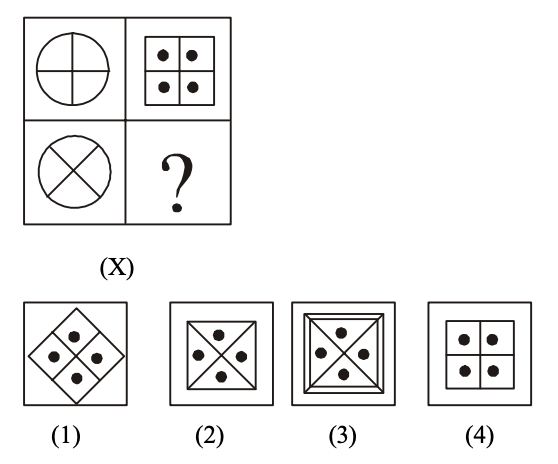
Select a figure from amongst four alternatives, which when placed in the blank space of fig. (X) would complete the pattern.
🔍 Analyze the Pattern
The figure in the right column is obtained by replacing the circle with a square while preserving the internal divisions.
In the top row:
- Circle divided into 4 parts → Square divided into 4 parts.
- A dot is placed in each section.
Applying the same rule to the bottom row:
- The circle divided by diagonal lines must become a square divided into four diagonal sections.
- Each section should contain one dot.
Among the answer figures, only fig.(1) satisfies these conditions.
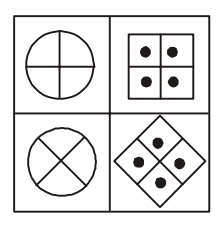
Correct Answer: (A)
⚡ Quick Exam Shortcut
Compare the top row:
Circle → Square
"+" division → "+" division with dots
Apply the same rule to the bottom row:
Circle with "X" division → Square with "X" division and dots
Shortcut Answer: Replace the circle with a square and keep the same division pattern → Option (A).
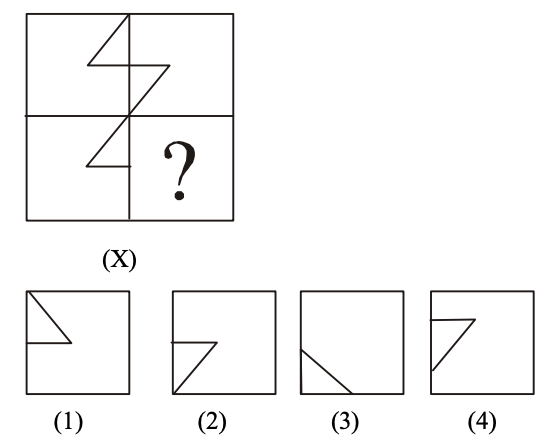
Select a figure from amongst four alternatives, which when placed in the blank space of fig. (X) would complete the pattern.
🔍 Analyze the Pattern
The figure is formed by a continuous zig-zag line passing through all four quadrants.
The missing quadrant must continue the line entering from the centre and complete the final zig-zag segment.
- A diagonal line should rise from the bottom-left corner toward the centre.
- A horizontal line should extend from the centre toward the right.
- The line must join smoothly with the existing segments.
Among the answer figures, only fig.(2) correctly completes the continuous pattern.
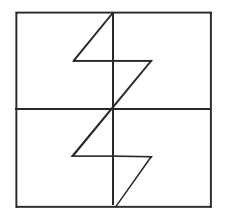
Correct Answer: (B)
⚡ Quick Exam Shortcut
Trace the zig-zag line across the quadrants.
The missing part must continue the incoming diagonal and finish with a horizontal segment.
Shortcut Answer: Continue the zig-zag pattern → Option (B).
Select a figure from amongst four alternatives, which when placed in the blank space of fig. (X) would complete the pattern.
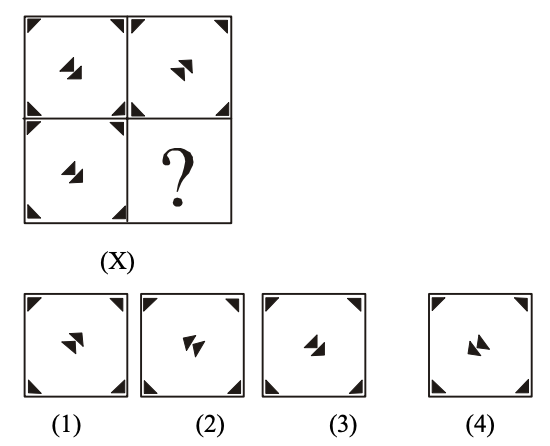
🔍 Analyze the Pattern
The corner triangles remain unchanged in every quadrant, so the deciding factor is the orientation of the two small central triangles.
Observe the column-wise pattern:
- Top-Left and Bottom-Left quadrants have the same orientation.
- Therefore, Top-Right and Bottom-Right quadrants must also have the same orientation.
The central figure in the missing quadrant should therefore match the orientation of the top-right quadrant.
Among the answer figures, only fig.(1) satisfies this condition.
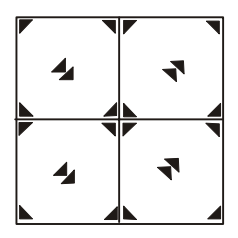
Correct Answer: (A)
⚡ Quick Exam Shortcut
Compare the figures column-wise.
Left column figures are identical, so the missing figure must match the orientation of the top-right figure.
Shortcut Answer: Match the top-right quadrant → Option (A).
Select a figure from amongst four alternatives, which when placed in the blank space of fig. (X) would complete the pattern.
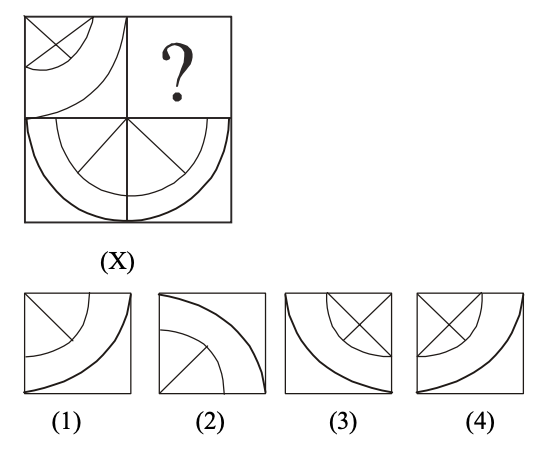
🔍 Analyze the Pattern
Observe the continuation of the circular arcs and diagonal lines around the centre of the figure.
The missing quadrant must:
- Continue the outer circular band.
- Continue the inner circular arc.
- Complete the crossed diagonal pattern visible in the upper-left section.
Among the answer figures, only fig.(3) correctly matches all incoming arcs and diagonal lines.
Correct Answer: (C)
⚡ Quick Exam Shortcut
Focus on the top-left quadrant.
The crossed diagonals and inner arc must appear symmetrically in the top-right quadrant as well.
Only Option (3) completes both the circular band and the X-shaped line pattern correctly.
Shortcut Answer: Continue the arcs + X-pattern → Option (C).
Select a figure from amongst four alternatives, which when placed in the blank space of fig. (X) would complete the pattern.
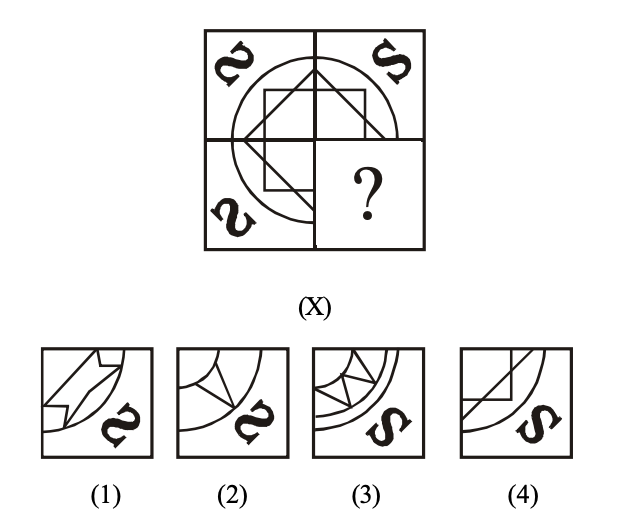
🔍 Analyze the Pattern
Observe that all the three visible quadrants contain the same design in different orientations. The design is repeated by rotating it through an angle of 90° clockwise.
Therefore, the missing quadrant can be obtained by rotating the corresponding design through 90° clockwise.
Among the answer figures, only fig.(4) correctly continues the circle, square, diagonal lines and symbol orientation after the required rotation.
Correct Answer: (D)
⚡ Quick Exam Shortcut
Here, all the three equal parts have similar designs in rotated positions.
The missing part is obtained by rotating the corresponding figure through an angle of 90° clockwise.
Shortcut Answer: 90° clockwise rotation → Option (D).
In each of the following questions, a figure series is given out of which the last figure is missing. Find which of the given alternatives (1), (2), (3) or (4) would complete the series.
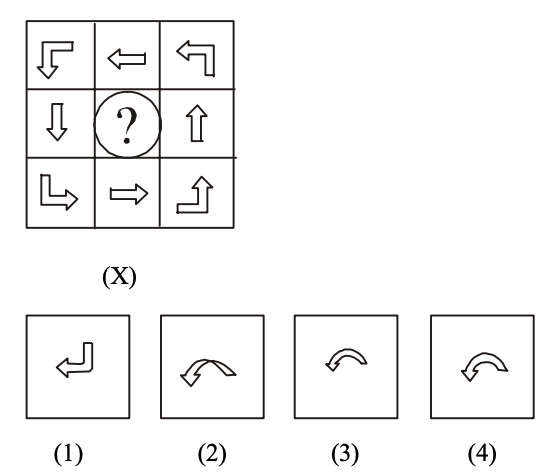
🔍 Analyze the Pattern
Observe the arrows row-wise.
Top row:
↓ + ← = ↙ type turn
Bottom row:
→ + ↑ = ↗ type turn
The centre figure should therefore represent a smooth curved transition joining the opposite directional movements.
Also, notice that the figures around the centre become progressively smoother:
- Corner cells contain bent arrows.
- Edge cells contain straight arrows.
- The centre should contain the curved version of the same directional change.
Among the answer figures:
- Fig. (1) is still a bent arrow.
- Fig. (2) contains an extra bend and does not fit the pattern.
- Fig. (3) has the curve in the wrong direction.
- Fig. (4) provides the correct smooth curved arrow matching the directional flow of the matrix.
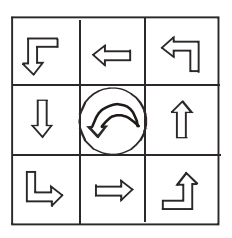
Correct Answer: (D)
⚡ Quick Exam Shortcut
Look at the arrangement:
- Corner cells = bent arrows
- Middle edge cells = straight arrows
- Centre cell = curved arrow
The curve must match the overall directional flow of the surrounding arrows.
Shortcut Answer: Curved version of the surrounding turns → Option (D).
In each of the following questions, a figure series is given out of which the last figure is missing. Find which of the given alternatives (1), (2), (3) or (4) would complete the series.
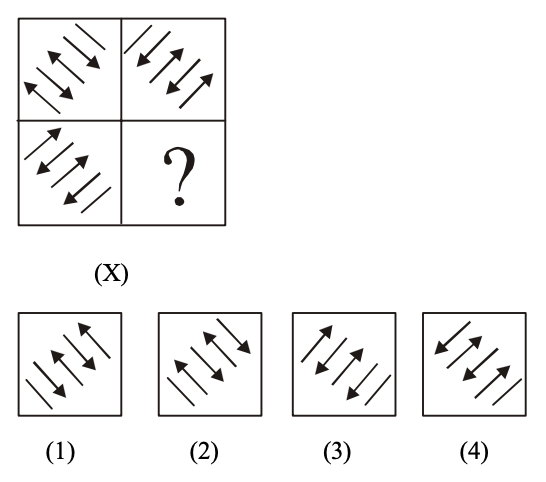
🔍 Analyze the Pattern
Observe the arrangement of the arrows in the four quadrants.
The figure is symmetric about the centre of the square.
- The top-left and bottom-right quadrants form a corresponding pair.
- The top-right and bottom-left quadrants form another corresponding pair.
- The positions of the arrows on the slanting lines must remain consistent across the figure.
The missing quadrant should therefore contain:
- One arrow pointing upward-right (↗).
- One arrow pointing downward-left (↙).
- The arrows placed on the correct slanting lines to maintain symmetry.
Among the answer figures, only Fig. (1) correctly matches both the arrow directions and their positions relative to the neighbouring quadrants.
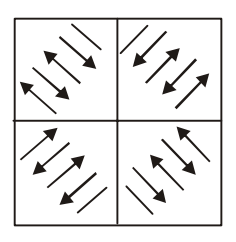
Correct Answer: (A)
⚡ Quick Exam Shortcut
Do not count arrow directions only.
Check the symmetry of the complete figure and match the exact positions of the arrows on the parallel lines.
The missing quadrant mirrors the arrangement in the opposite quadrant.
Shortcut Answer: Match the arrow positions and symmetry → Option (A).
Which answer figure will complete the pattern in the question figure?
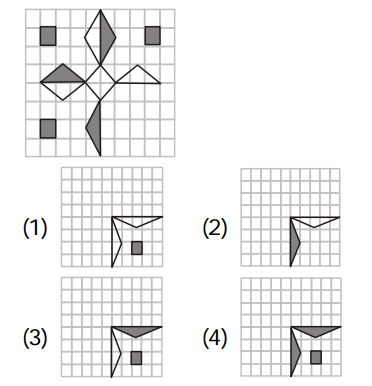
🔍 Analyze the Figure
This is an embedded-figure (extraction) question. We need to identify which option exactly represents the required part of the given figure.
Observe the relevant portion carefully:
- The upper horizontal arm contains a shaded triangular region.
- A small shaded square appears below the arm.
- The outline lines of the figure continue downward.
- No additional shaded vertical triangular blade is included in the extracted part.
Now compare the options:
- Fig. (1) omits the shaded regions.
- Fig. (2) contains only one shaded portion.
- Fig. (4) includes an extra shaded vertical blade that does not belong to the required extracted figure.
- Fig. (3) contains exactly the shaded top triangle, the square block and the correct line arrangement.
Therefore, Fig. (3) is the exact match.
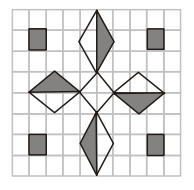
Correct Answer: (C)
⚡ Quick Exam Shortcut
Focus only on the shaded elements inside the required portion.
- One shaded triangular section on the top arm.
- One shaded square.
- No extra shaded vertical blade.
Only Fig. (3) matches these features exactly.
Shortcut Answer: Match the exact shaded regions → Option (C).
In the following question, which answer figure will complete the pattern in the question figure ?
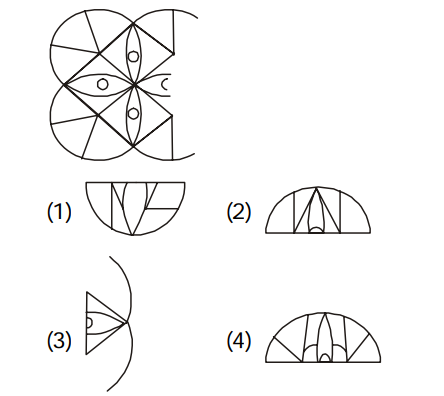
🔍 Analyze the Figure
Look at the central portion of the given figure.
We can identify:
- A triangular region pointing towards the centre.
- A small oval inside the triangle.
- Two straight lines meeting at a central point.
- A curved boundary on the outer side.
Now compare the answer figures.
- Fig. (1) contains additional horizontal divisions not required.
- Fig. (2) introduces extra enclosing segments.
- Fig. (4) contains additional side sectors that are not part of the exact hidden figure.
- Fig. (3) exactly matches the triangular shape, central oval and curved boundary present in the original figure.
Since an embedded-figure question requires the exact figure and not a larger composite pattern, fig.(3) is the correct match.
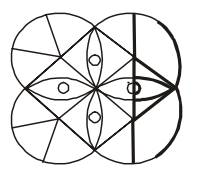
Correct Answer: (C)
⚡ Quick Exam Shortcut
For embedded-figure questions:
- Find the smallest exact match.
- Ignore extra surrounding shapes.
- Reject options that add additional sectors or lines.
The triangular shape with the small oval and curved boundary appears exactly as shown in fig.(3).
Shortcut Answer: Exact hidden figure match → Option (C).
In the following question, which answer figure will complete the pattern in the question figure ?
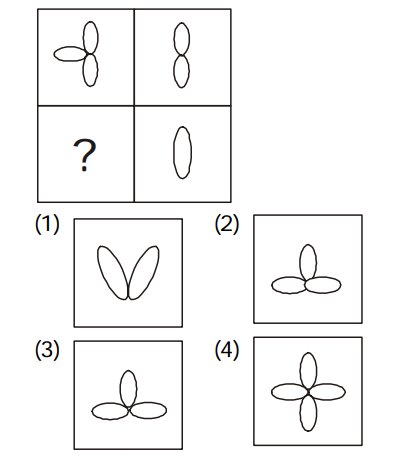
🔍 Analyze the Pattern
Observe the figures in clockwise order:
Bottom-Right → Top-Right → Top-Left → Bottom-Left
Starting from the bottom-right figure:
- Bottom-Right contains 1 leaflet.
- Top-Right contains 2 leaflets.
- Top-Left contains 3 leaflets.
- The missing figure should therefore contain 4 leaflets.
Each new leaflet is added in the anticlockwise direction.
Thus the sequence becomes:
1 → 2 → 3 → 4 leaflets
Among the answer figures, only Fig. (4) shows four leaflets arranged according to this pattern.
Correct Answer: (D)
⚡ Quick Exam Shortcut
Count the leaflets in clockwise order:
1 → 2 → 3 → 4
A new leaflet is added at each step in the anticlockwise direction.
Therefore, the missing figure must contain 4 leaflets.
Shortcut Answer: Add one leaflet anticlockwise → Option (D).