Syllogism
About This Cheat Sheet
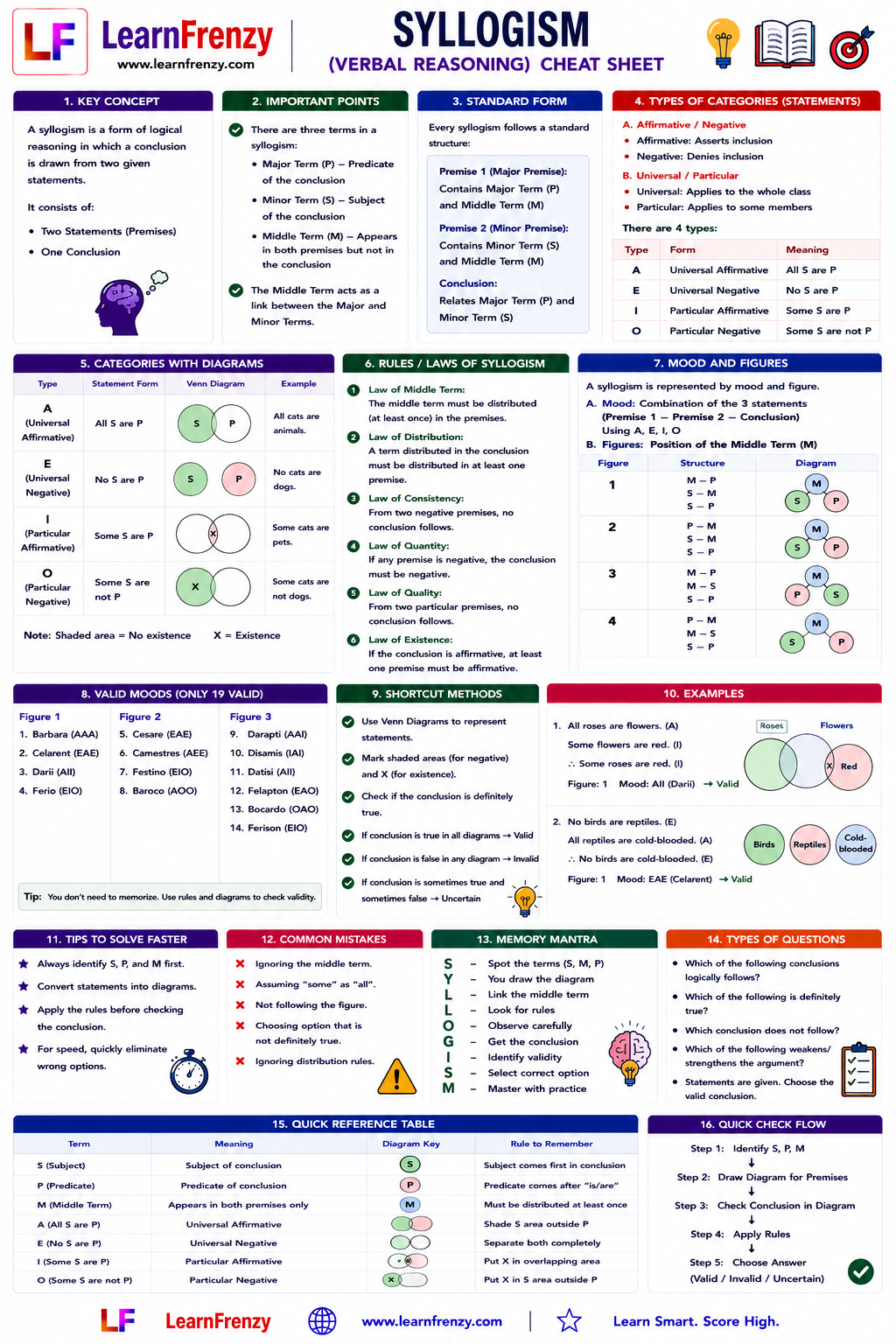
Your complete guide to Syllogism for competitive exams. This cheat sheet helps you quickly understand how to draw logical conclusions from given statements using Venn diagrams and systematic reasoning.
📝 Types of Statements
- All A are B (Universal Affirmative)
- Some A are B (Particular Affirmative)
- No A are B (Universal Negative)
- Some A are not B (Particular Negative)
- Possibility Cases
- Affirmative & Negative Statements
📊 Venn Diagram Representations
- Overlapping Sets
- Subset Relationships
- Disjoint Sets
- Complementary Pairs
- Multiple Set Diagrams
- Diagram Interpretation
🔄 Conversion Rules
- Some A are B → Some B are A
- All A are B → Some B are A
- No A are B → No B are A
- Some A are not B → (No Conversion)
- Immediate Inference
- Mediate Inference
🎯 Conclusions & Deductions
- Definite Conclusions
- Possible Conclusions
- Complementary Pairs (Either-Or)
- Definite vs Possible
- Logical Deductions
- Valid Arguments
🛠️ Solving Techniques
- Crossing Method
- Elimination Method
- Venn Diagram Method
- Minimal Possibility Approach
- Logical Reasoning
- Systematic Analysis
📚 Exam Categories
- SSC & Banking
- Railways & UPSC
- CAT & MBA Entrance
- Defence & Insurance
- Placement Tests
- Other Competitive Exams
🎯 Your Guide to Solving Syllogism Questions
The Golden Rule: In syllogism, what is true for the whole is true for the part, but what is true for the part is NOT always true for the whole. Always draw Venn diagrams to visualize relationships.
Step-by-Step Approach:
- Step 1: Identify the type of each statement (All, Some, No, Some Not)
- Step 2: Draw Venn diagrams for each statement
- Step 3: Combine all diagrams to find all possible relationships
- Step 4: Check each conclusion against your diagrams
- Step 5: Determine if the conclusion is definite, possible, or invalid
Common Mistakes to Avoid:
- ❌ Assuming "All A are B" also means "All B are A"
- ❌ Confusing "Some" with "All"
- ❌ Ignoring complementary pairs (Either-Or cases)
- ❌ Forgetting that "Some A are not B" does not convert
- ❌ Drawing only one possible Venn diagram
Proven Strategy: The "Minimal Possibility" approach – always consider the most general relationship first. Draw multiple Venn diagrams if needed to check all possibilities.
Memory Trick: Remember the four statement types:
- All → Universal Affirmative
- Some → Particular Affirmative
- No → Universal Negative
- Some Not → Particular Negative
Either-Or Rule: When two conclusions have the same subject and predicate but are contradictory (e.g., "Some A are B" and "No A are B"), the "Either-Or" case applies when all other possibilities are exhausted.
💡 Pro Tips for Syllogism Questions
✅ Always Draw Venn Diagrams
Visual representation eliminates confusion and errors
✅ Don't Make Unwarranted Assumptions
Only what is explicitly stated can be assumed
✅ Check All Possibilities
Draw multiple Venn diagrams to test all possible relationships
✅ Remember Conversion Rules
Some A are B → Some B are A (valid). All A are B → Some B are A (valid)
Download Cheat Sheet
Click the button below to download this high-resolution PNG cheat sheet.
Download PNG (4.0 MB)Preview
Still have questions?
We're here to help! Reach out to our support team for any queries.