Number System
About This Cheat Sheet
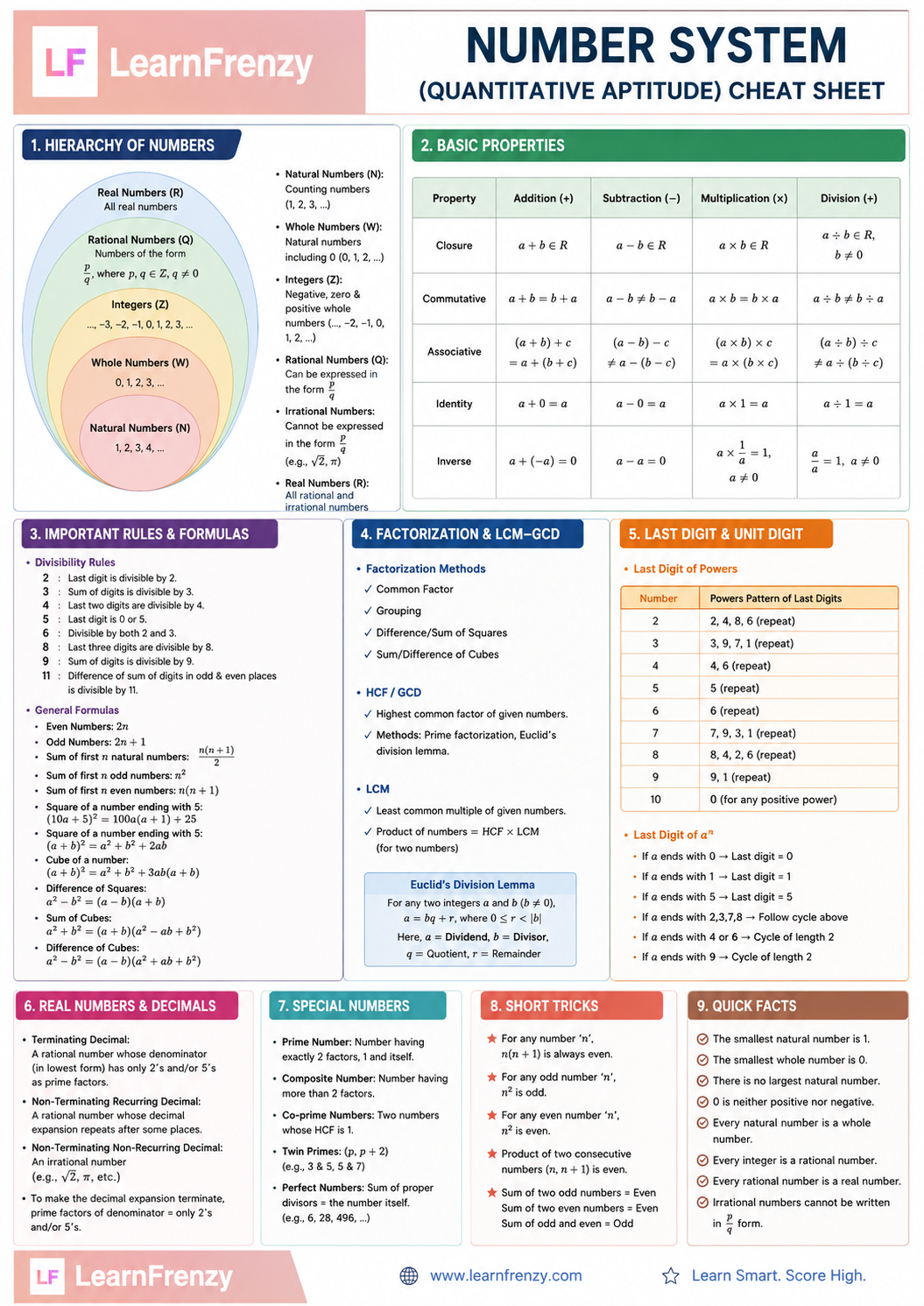
Hey there! Welcome to your complete guide to Number System for competitive exams. I've put together everything you need to know — from types of numbers (natural, whole, integers, rational, irrational, real, prime, composite, even, odd, co-prime) to divisibility rules (2 to 19), factors and multiples, LCM and HCF, remainders and modulus, unit digit concepts, number of trailing zeros, base system (binary, octal, hexadecimal), and important formulas with solved examples. Whether you're preparing for SSC, Banking, Railway, UPSC, or other government exams, this cheat sheet covers concepts and shortcut techniques to help you score better.
🔢 Types of Numbers
- Natural Numbers: 1, 2, 3, 4, ...
- Whole Numbers: 0, 1, 2, 3, ...
- Integers: ..., -3, -2, -1, 0, 1, 2, 3, ...
- Rational Numbers: p/q form (q ≠ 0)
- Irrational Numbers: Not in p/q form
- Real Numbers: Rational + Irrational
- Prime Numbers: >1, only 2 factors
- Composite Numbers: >1, >2 factors
📏 Divisibility Rules
- 2: Last digit even
- 3: Sum of digits divisible by 3
- 4: Last 2 digits divisible by 4
- 5: Last digit 0 or 5
- 6: Divisible by 2 and 3
- 7: Double last digit, subtract
- 8: Last 3 digits divisible by 8
- 9: Sum of digits divisible by 9
📊 LCM & HCF
- LCM: Least Common Multiple
- HCF: Highest Common Factor
- LCM × HCF: = Product of numbers
- Prime Factorization: Find factors
- Division Method: For HCF
- LCM of Fractions: LCM of numerators / HCF of denominators
- HCF of Fractions: HCF of numerators / LCM of denominators
- Applications: Time, speed, distance
🔁 Remainders & Modulus
- Remainder Theorem: Dividend = Divisor × Quotient + Remainder
- Negative Remainder: r = (d - n) where n > d
- Modulus Operation: a mod b
- Cyclicity of Remainders: Pattern repeats
- Euler's Theorem: a^φ(n) ≡ 1 (mod n)
- Fermat's Theorem: a^(p-1) ≡ 1 (mod p)
- Chinese Remainder Theorem: Solve simultaneous congruences
- Wilson's Theorem: (p-1)! ≡ -1 (mod p)
🔟 Unit Digit & Cyclicity
- Cyclicity of 2: 2, 4, 8, 6
- Cyclicity of 3: 3, 9, 7, 1
- Cyclicity of 4: 4, 6
- Cyclicity of 7: 7, 9, 3, 1
- Cyclicity of 8: 8, 4, 2, 6
- Cyclicity of 9: 9, 1
- Unit Digit of a^b: Find pattern
- Trailing Zeros: Count 5s in factorial
🔢 Base System
- Binary: Base 2 (0, 1)
- Octal: Base 8 (0-7)
- Decimal: Base 10 (0-9)
- Hexadecimal: Base 16 (0-9, A-F)
- Conversion: Any base to decimal
- Decimal to Binary: Divide by 2
- Decimal to Octal: Divide by 8
- Decimal to Hex: Divide by 16
🔢 Prime
Only 2 factors
2, 3, 5, 7...📏 Divisibility
2, 3, 4, 5, 6, 7, 8, 9
Quick rules📊 LCM × HCF
= Product of numbers
Important formula🔟 Unit Digit
Cyclicity pattern
2, 3, 7, 8🔢 Types of Numbers
📌 Number Type
- Natural Numbers
- Whole Numbers
- Integers
- Rational Numbers
- Irrational Numbers
- Real Numbers
- Prime Numbers
- Composite Numbers
- Even Numbers
- Odd Numbers
- Co-prime Numbers
📝 Definition
- Counting numbers: 1, 2, 3, 4, ...
- Natural + 0: 0, 1, 2, 3, ...
- ..., -3, -2, -1, 0, 1, 2, 3, ...
- Numbers in p/q form (q ≠ 0)
- Not in p/q form (√2, π)
- Rational + Irrational numbers
- >1 with exactly 2 factors
- >1 with more than 2 factors
- Divisible by 2: 0, 2, 4, 6, ...
- Not divisible by 2: 1, 3, 5, 7, ...
- HCF = 1 (e.g., 2 & 3)
💡 Examples
- 1, 2, 3, 4, 5, ...
- 0, 1, 2, 3, 4, ...
- -2, -1, 0, 1, 2
- 2/3, 5/7, 0.75
- √2, √3, π, e
- All rational + irrational
- 2, 3, 5, 7, 11, 13
- 4, 6, 8, 9, 10, 12
- 0, 2, 4, 6, 8, 10
- 1, 3, 5, 7, 9, 11
- 2 & 3, 4 & 5, 8 & 9
📏 Divisibility Rules
🔢 Rule
- 2
- 3
- 4
- 5
- 6
- 7
- 8
- 9
- 10
- 11
- 13
- 17
- 19
📝 Condition
- Last digit is even (0, 2, 4, 6, 8)
- Sum of digits divisible by 3
- Last 2 digits divisible by 4
- Last digit is 0 or 5
- Divisible by 2 and 3
- Double last digit, subtract from rest, divisible by 7
- Last 3 digits divisible by 8
- Sum of digits divisible by 9
- Last digit is 0
- Difference of (sum odd places - sum even places) divisible by 11
- Four times last digit + rest, divisible by 13
- Five times last digit - rest, divisible by 17
- Two times last digit + rest, divisible by 19
💡 Example
- 246 → 6 is even ✓
- 123 → 1+2+3=6 ✓
- 124 → 24 divisible by 4 ✓
- 125 → 5 ✓
- 246 → even + sum=12 ✓
- 133 → 13 - 6 = 7 ✓
- 1240 → 240 divisible by 8 ✓
- 153 → 1+5+3=9 ✓
- 250 → 0 ✓
- 121 → (1+1) - 2 = 0 ✓
- 78 → 8×4+7=39 ✓
- 85 → 5×5-8=17 ✓
- 57 → 7×2+5=19 ✓
⚠️ Note
- Check last digit
- Sum all digits
- Check last 2 digits
- Check last digit
- Combine 2 and 3
- Repeat if needed
- Check last 3 digits
- Sum all digits
- Check last digit
- Difference method
- Four times + rest
- Five times - rest
- Two times + rest
📊 LCM & HCF
📌 Concept
- LCM
- HCF
- LCM × HCF
- LCM of Fractions
- HCF of Fractions
📝 Formula / Method
- Least Common Multiple
- Highest Common Factor
- = Product of two numbers
- = LCM (numerators) / HCF (denominators)
- = HCF (numerators) / LCM (denominators)
💡 Example
- LCM(4,6) = 12
- HCF(4,6) = 2
- 4 × 6 = 24 = 12 × 2 ✓
- LCM(2/3, 4/5) = LCM(2,4) / HCF(3,5) = 4/1 = 4
- HCF(2/3, 4/5) = HCF(2,4) / LCM(3,5) = 2/15
🔟 Unit Digit & Cyclicity
🔢 Number
- 2
- 3
- 4
- 5
- 6
- 7
- 8
- 9
- 0
- 1
🔄 Cyclicity
- 2, 4, 8, 6 (4-cycle)
- 3, 9, 7, 1 (4-cycle)
- 4, 6 (2-cycle)
- 5 (1-cycle)
- 6 (1-cycle)
- 7, 9, 3, 1 (4-cycle)
- 8, 4, 2, 6 (4-cycle)
- 9, 1 (2-cycle)
- 0 (1-cycle)
- 1 (1-cycle)
📝 Pattern
- 2¹=2, 2²=4, 2³=8, 2⁴=16(6)
- 3¹=3, 3²=9, 3³=27(7), 3⁴=81(1)
- 4¹=4, 4²=16(6)
- 5¹=5, 5²=25(5)
- 6¹=6, 6²=36(6)
- 7¹=7, 7²=49(9), 7³=343(3), 7⁴=2401(1)
- 8¹=8, 8²=64(4), 8³=512(2), 8⁴=4096(6)
- 9¹=9, 9²=81(1)
- Always 0
- Always 1
💡 Example
- Unit digit of 2¹⁰⁰: 100 mod 4 = 0 → 6
- Unit digit of 3⁵⁰: 50 mod 4 = 2 → 9
- Unit digit of 4²⁵: 25 mod 2 = 1 → 4
- Unit digit of 5⁷⁵: 5
- Unit digit of 6⁹⁹: 6
- Unit digit of 7⁶⁰: 60 mod 4 = 0 → 1
- Unit digit of 8²⁰: 20 mod 4 = 0 → 6
- Unit digit of 9³⁰: 30 mod 2 = 0 → 1
- Unit digit of 10⁵: 0
- Unit digit of 1⁵⁰: 1
📝 Important Formulas
📌 Formula
- Sum of first n natural numbers
- Sum of squares of first n natural numbers
- Sum of cubes of first n natural numbers
- Sum of first n even numbers
- Sum of first n odd numbers
- Product of n natural numbers
📝 Formula
- n(n+1)/2
- n(n+1)(2n+1)/6
- [n(n+1)/2]²
- n(n+1)
- n²
- n! (n factorial)
💡 Example (n=5)
- 5×6/2 = 15
- 5×6×11/6 = 55
- (5×6/2)² = 225
- 5×6 = 30
- 25
- 5! = 120
🔟 Trailing Zeros
📌 Concept
- Trailing Zeros in n!
- Trailing Zeros in product
- Method
📝 Formula / Method
- Number of zeros = floor(n/5) + floor(n/25) + floor(n/125) + ...
- Count powers of 5 in factorization
- Divide n by 5 repeatedly and sum quotients
🔢 Base System
📌 Base
- Binary
- Octal
- Decimal
- Hexadecimal
🔢 Digits
- 0, 1
- 0, 1, 2, 3, 4, 5, 6, 7
- 0, 1, 2, 3, 4, 5, 6, 7, 8, 9
- 0-9, A(10), B(11), C(12), D(13), E(14), F(15)
📝 Base Value
- Base 2
- Base 8
- Base 10
- Base 16
💡 Example
- 1011₂ = 1×8+0×4+1×2+1 = 11₁₀
- 17₈ = 1×8+7 = 15₁₀
- 123₁₀ = 123
- A3₁₆ = 10×16+3 = 163₁₀
🔄 Conversion Between Bases
📌 Conversion
- Any Base → Decimal
- Decimal → Binary
- Decimal → Octal
- Decimal → Hex
- Binary → Octal
- Binary → Hex
- Octal → Binary
- Hex → Binary
📝 Method
- Multiply each digit by base^position
- Divide by 2 repeatedly
- Divide by 8 repeatedly
- Divide by 16 repeatedly
- Group bits in 3s (octal)
- Group bits in 4s (hex)
- Each digit → 3 bits
- Each digit → 4 bits
💡 Example
- 101₁₀ = 1×4+0×2+1 = 5₁₀
- 13₁₀ → 1101₂
- 15₁₀ → 17₈
- 255₁₀ → FF₁₆
- 101101₂ → 55₈
- 101101₂ → 2D₁₆
- 7₈ → 111₂
- F₁₆ → 1111₂
🔢 Important Number Systems
📌 System
- Natural Numbers
- Whole Numbers
- Integers
- Rational Numbers
- Irrational Numbers
- Real Numbers
📝 Includes
- Positive integers only
- Natural + 0
- Positive + Negative + 0
- p/q form (q ≠ 0)
- Non-terminating, non-repeating
- Rational + Irrational
🔢 Examples
- 1, 2, 3, 4, ...
- 0, 1, 2, 3, ...
- ..., -3, -2, -1, 0, 1, ...
- 1/2, 3/4, 0.25, 0.333...
- √2, π, e, √3
- All rational + irrational
💡 Key Point
- Smallest natural = 1
- Smallest whole = 0
- No smallest integer
- Can be terminating or repeating
- Cannot be expressed as p/q
- All numbers on number line
🎯 Number System Quick Revision
The Golden Rule: Understand the fundamentals — types of numbers, divisibility rules, and LCM/HCF are the building blocks. Master unit digit cyclicity for fast calculation in exams.
Quick Memory Tricks:
- 📌 Divisibility: "2 Even, 3 Sum, 4 Last Two, 5 End, 6 Both 2&3, 9 Sum, 11 Difference"
- 📌 Unit Digit Cyclicity: "2-4-8-6, 3-9-7-1, 4-6, 5-5, 6-6, 7-9-3-1, 8-4-2-6, 9-1, 0-0, 1-1"
- 📌 LCM × HCF: = Product of two numbers
- 📌 Trailing Zeros: Count 5s in factorial
- 📌 Base Conversion: Multiply by base powers
Exam Strategy:
- Step 1: Identify the type of number problem
- Step 2: Apply divisibility rules for quick checks
- Step 3: Use unit digit cyclicity for large powers
- Step 4: Apply LCM/HCF formulas for ratio problems
- Step 5: Use base conversion for binary/hex questions
💡 Pro Tips for Number System
✅ Learn Divisibility Rules
Memorize rules for 2, 3, 4, 5, 6, 7, 8, 9, 11. These are frequently tested in competitive exams.
✅ Master Unit Digit Cyclicity
Unit digit problems appear in almost every exam. Learn the cyclicity patterns of 2, 3, 4, 7, 8, 9.
✅ LCM × HCF Formula
For two numbers, LCM × HCF = Product of numbers. This is extremely useful for quickly solving problems.
✅ Trailing Zeros in Factorial
Always count powers of 5. Formula: floor(n/5) + floor(n/25) + floor(n/125) + ...
✅ Base System Conversions
Practice converting between binary, octal, decimal, and hexadecimal. These are common in computer aptitude sections.
✅ Practice Remainder Problems
Euler's Theorem, Fermat's Theorem, and Chinese Remainder Theorem are high-level concepts that appear in advanced exams.
📋 Quick Reference: Divisibility Rules Summary
🔢 Number
- 2
- 3
- 4
- 5
- 6
- 7
- 8
- 9
- 10
- 11
- 13
- 17
- 19
📝 Rule
- Last digit even
- Sum of digits divisible by 3
- Last 2 digits divisible by 4
- Last digit 0 or 5
- Divisible by 2 and 3
- Double last digit, subtract from rest
- Last 3 digits divisible by 8
- Sum of digits divisible by 9
- Last digit 0
- Difference of (odd-even sum) divisible by 11
- 4 × last digit + rest
- 5 × last digit − rest
- 2 × last digit + rest
💡 Check
- 246 ✓
- 123 ✓
- 124 ✓
- 125 ✓
- 246 ✓
- 133 ✓
- 1240 ✓
- 153 ✓
- 250 ✓
- 121 ✓
- 78 ✓
- 85 ✓
- 57 ✓
⚠️ Action
- Check last digit
- Sum digits
- Check last 2
- Check last digit
- Combine 2 and 3
- Repeat if needed
- Check last 3
- Sum digits
- Check last digit
- Find difference
- 4× + rest
- 5× − rest
- 2× + rest
🔟 Quick Reference: Unit Digit Summary
🔢 Number
- 2
- 3
- 4
- 5
- 6
- 7
- 8
- 9
- 0
- 1
🔄 Cyclicity
- 2, 4, 8, 6
- 3, 9, 7, 1
- 4, 6
- 5
- 6
- 7, 9, 3, 1
- 8, 4, 2, 6
- 9, 1
- 0
- 1
📝 Length
- 4
- 4
- 2
- 1
- 1
- 4
- 4
- 2
- 1
- 1
💡 Example
- 2⁵⁰ → 50%4=2 → 4
- 3⁶⁰ → 60%4=0 → 1
- 4²⁵ → 25%2=1 → 4
- 5⁷⁵ → 5
- 6⁹⁹ → 6
- 7⁷⁰ → 70%4=2 → 9
- 8⁴⁰ → 40%4=0 → 6
- 9³⁰ → 30%2=0 → 1
- 0⁵⁰ → 0
- 1⁵⁰ → 1
Download Cheat Sheet
Click the button below to download this high-resolution PNG cheat sheet.
Download PNG (1.0 MB)Preview
Still have questions?
We're here to help! Reach out to our support team for any queries.