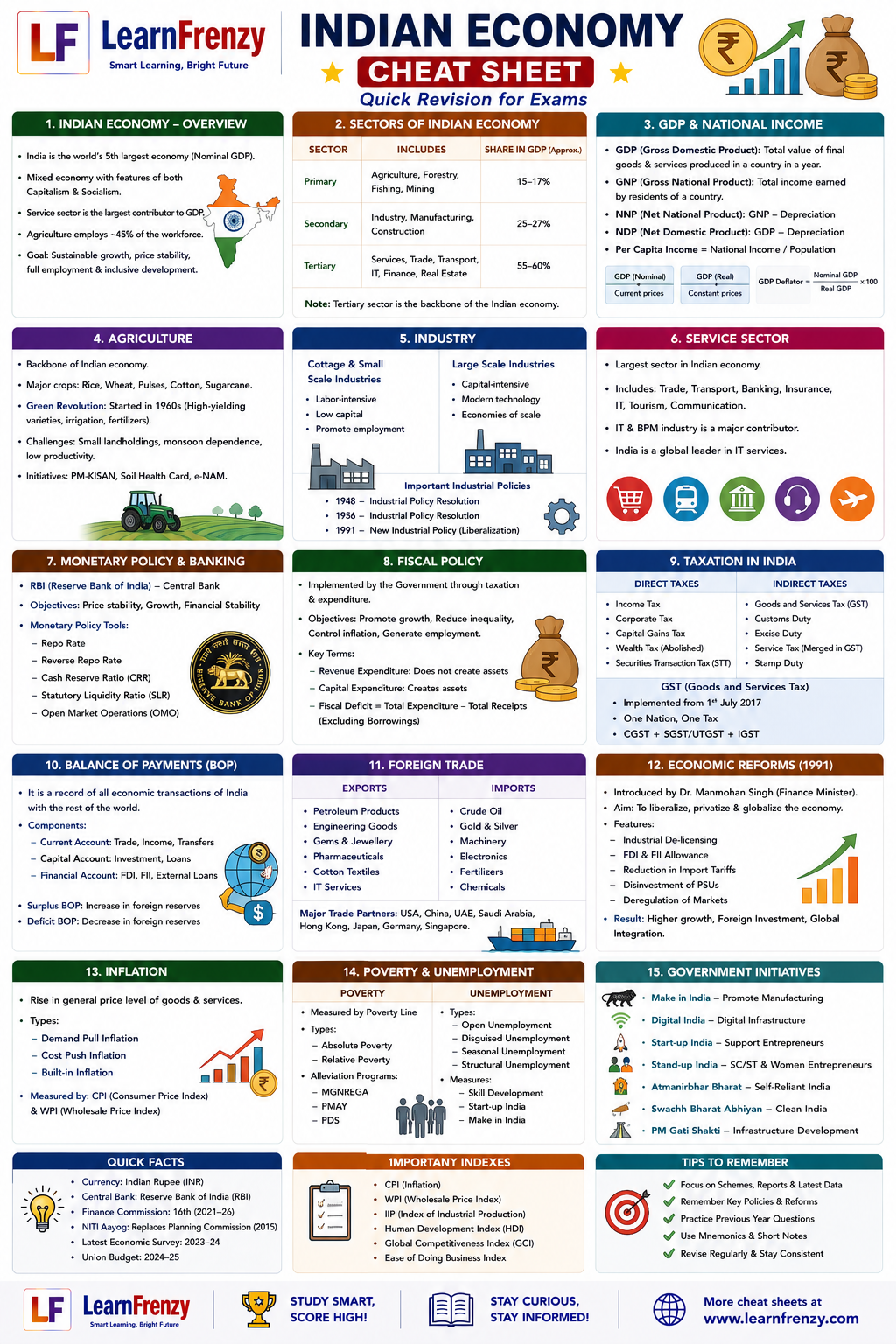
Indian Economy
About This Cheat Sheet
Hey there! Welcome to your complete guide to Indian Economy for competitive exams. I've put together everything you need to know in one place — from Basic Concepts like GDP and Inflation to Economic Planning, Agriculture, Industry, Banking, Finance, Government Schemes, Taxes, and more. Whether you're preparing for SSC, Banking, Railways, UPSC, or State PSC exams, this cheat sheet covers important indicators, plans, schemes, and shortcut techniques to help you score better.
📊 Basic Concepts
- GDP - Gross Domestic Product
- GNP - Gross National Product
- NNP - Net National Product
- Per Capita Income - Income per person
- Inflation - Rising prices
- Deflation - Falling prices
- Recession - Economic decline
- Stagflation - Inflation + Recession
📝 Economic Planning
- Planning Commission - 1950-2014
- NITI Aayog - 2015 onwards
- Five Year Plans - 12 Plans (1951-2017)
- First Plan - Agriculture (1951-56)
- Second Plan - Industrialization (1956-61)
- Plan Holiday - 1966-69
- Rolling Plans - Annual plans
- NITI Aayog - Governing Council
🌾 Agriculture
- Green Revolution - Food production (1960s)
- White Revolution - Milk production
- Blue Revolution - Fish production
- Pink Revolution - Meat/Poultry
- Yellow Revolution - Oilseeds
- Land Reforms - Tenancy, Ceiling
- APMC - Agricultural marketing
- Pradhan Mantri Fasal Bima Yojana - Crop insurance
🏭 Industry
- Industrial Policy - 1948, 1956, 1991
- Public Sector - Government owned
- Private Sector - Private owned
- MSME - Micro, Small, Medium Enterprises
- Make in India - 2014 (Manufacturing)
- PLI Scheme - Production Linked Incentive
- Cottage Industries - Handicrafts
- Large Scale Industries - Heavy industries
🏦 Banking & Finance
- RBI - Central Bank (1935)
- Monetary Policy - RBI's control tools
- Repo Rate - Lending rate to banks
- Reverse Repo - Borrowing rate from banks
- CRR - Cash Reserve Ratio
- SLR - Statutory Liquidity Ratio
- NABARD - Agricultural development
- SIDBI - Small industry development
📜 Govt Schemes
- PM Jan Dhan Yojana - Financial inclusion
- PM Awas Yojana - Housing for All
- PM Ujjwala Yojana - LPG connections
- PM Mudra Yojana - Micro enterprises
- Digital India - Digitalization
- Startup India - Startups
- Ayushman Bharat - Health insurance
- Swachh Bharat - Cleanliness
📊 GDP
~$3.5 Trillion
5th Largest Economy🏦 RBI
Central Bank
Est. 1935📜 GST
2017
One Nation One Tax📈 NITI
2015
Replaced Planning Commission📊 Important Economic Indicators
📈 GDP
- Full Form: Gross Domestic Product
- Current: ~$3.5 trillion
- Rank: 5th largest economy
- Growth Rate: ~6-7%
💰 Per Capita Income
- Definition: Income per person
- Current: ~$2,500
- PPP: ~$9,000
- Rank: 140+ globally
📊 Inflation Rate
- Definition: Rate of price increase
- Current: ~5-6%
- Monitored by: RBI
- Target: 4% (±2%)
📊 More Economic Indicators
📉 Fiscal Deficit
- Definition: Excess of expenditure over revenue
- Current: ~5.9% of GDP
- Target: 4.5% by 2025-26
- Monitored by: FRBM Act
💱 Forex Reserves
- Definition: Foreign exchange reserves
- Current: ~$600 billion
- Rank: 4th globally
- Managed by: RBI
📊 Current Account Deficit
- Definition: Trade deficit + Net income
- Current: ~2.5% of GDP
- Impact: Rupee depreciation
- Managed by: RBI
🏦 RBI Monetary Policy Tools
🏦 RBI Functions
📝 Five Year Plans
📅 Plan 1-3
- First Plan (1951-56): Agriculture
- Second Plan (1956-61): Industrialization
- Third Plan (1961-66): Self-sufficiency
📅 Plan 4-6
- Fourth Plan (1969-74): Growth with Stability
- Fifth Plan (1974-79): Garibi Hatao
- Sixth Plan (1980-85): Employment Generation
📅 Plan 7-9
- Seventh Plan (1985-90): Food, Work, Productivity
- Eighth Plan (1992-97): Human Resource Development
- Ninth Plan (1997-2002): Quality of Life
📅 Plan 10-12
- Tenth Plan (2002-07): Employment, Poverty Reduction
- Eleventh Plan (2007-12): Faster, Sustainable Growth
- Twelfth Plan (2012-17): Inclusive Growth
📜 Important Government Schemes
📜 Financial Inclusion
- PM Jan Dhan Yojana (2014) - Bank accounts
- PM Mudra Yojana (2015) - Micro enterprises
- Jeevan Suraksha - Insurance schemes
- Atal Pension Yojana - Pension for all
🏠 Housing & Infrastructure
- PM Awas Yojana (2015) - Housing for All
- Smart Cities Mission (2015) - Smart cities
- AMRUT - Urban infrastructure
- Swachh Bharat (2014) - Cleanliness
🧑💼 Skill & Education
- Skill India (2015) - Skill development
- Digital India (2015) - Digitalization
- Startup India (2016) - Startups
- PM Kaushal Vikas Yojana - Skill training
📜 More Government Schemes
🌾 Agriculture & Food
- PM Fasal Bima Yojana - Crop insurance
- PM Kisan Samman Nidhi - Income support
- National Food Security Mission - Food security
- E-NAM - National Agricultural Market
🩺 Health & Welfare
- Ayushman Bharat (2018) - Health insurance
- National Health Mission - Health services
- PM Ujjwala Yojana (2016) - LPG connections
- Mid-Day Meal Scheme - School meals
👩 Women & Child
- Beti Bachao Beti Padhao - Save girl child
- Sukanya Samriddhi Yojana - Girl child savings
- PM Matru Vandana Yojana - Maternity benefits
- Integrated Child Development Scheme - Child development
💰 Important Taxes in India
🔄 GST (2017)
- Full Form: Goods and Services Tax
- Type: Indirect Tax
- Slabs: 0%, 5%, 12%, 18%, 28%
- Key: One Nation One Tax
📊 Income Tax
- Type: Direct Tax
- Slabs: Up to 30%
- New Regime: 2020 onwards
- Exemption: Up to ₹2.5 lakh
🏢 Corporate Tax
- Type: Direct Tax
- Rate: Up to 30%
- New Rate: 22% (new companies)
- Key: Tax on company profits
📦 Customs Duty
- Type: Indirect Tax
- Imports: Goods coming in
- Exports: Goods going out
- Key: Protect domestic industry
📊 Fiscal Policy - Budget Terms
📊 Union Budget
- Presented by: Finance Minister
- Date: February 1 (from 2017)
- Types: Revenue & Capital
- Key: Annual financial statement
📈 Fiscal Deficit
- Definition: Revenue + Capital expenditure - Revenue receipts
- Current: ~5.9% of GDP
- Target: 4.5% by 2025-26
- FRBM: Fiscal Responsibility Act
📉 Revenue Deficit
- Definition: Revenue expenditure - Revenue receipts
- Impact: Borrowing for consumption
- Difference: Revenue deficit vs Fiscal deficit
- FRBM: Binds government to reduce deficit
📈 Financial Markets
📊 Stock Exchanges
- BSE: Bombay Stock Exchange (1875) - Sensex
- NSE: National Stock Exchange (1992) - Nifty
- SEBI: Securities & Exchange Board of India
- Regulator: SEBI (1992)
💰 Mutual Funds
- Definition: Pooled investment vehicle
- Types: Equity, Debt, Hybrid, Index
- Regulator: SEBI
- Key: Professional fund management
🛡️ Insurance
- LIC: Life Insurance Corporation (1956)
- IRDAI: Insurance Regulatory Authority
- Types: Life, Health, General
- PFRDA: Pension Fund Regulatory Authority
🌍 Foreign Trade
📊 Balance of Trade
- Definition: Exports - Imports
- Surplus: Exports > Imports
- Deficit: Imports > Exports
- Current: Trade deficit
💱 Balance of Payments
- Definition: All transactions with rest of world
- Components: Current Account, Capital Account
- Key: Must balance
- RBI: Manages BoP
💵 FDI & FPI
- FDI: Foreign Direct Investment (Long-term)
- FPI: Foreign Portfolio Investment (Short-term)
- FEMA: Foreign Exchange Management Act
- Policy: Government regulates FDI
🎯 Indian Economy Quick Revision
The Golden Rule: Focus on key indicators, RBI tools, government schemes, and budget terms. Most competitive exam questions test your ability to match schemes with their purpose and recall current economic indicators.
Quick Memory Tricks:
- 📌 RBI Tools: "Repo, Reverse, CRR, SLR, MSF, OMO" — all used to control money supply
- 📌 Five Year Plans: "First = Agriculture, Second = Industrialization, Fifth = Garibi Hatao"
- 📌 Revolutions: "Green = Food, White = Milk, Blue = Fish, Pink = Meat, Yellow = Oilseeds"
- 📌 Schemes: "Jan Dhan = Bank Accounts, Ujjwala = LPG, Mudra = Micro, Awas = Housing"
Exam Strategy:
- Step 1: Read the question — identify if it's about indicators, schemes, or policies
- Step 2: For schemes, match with launch year and purpose
- Step 3: For RBI tools, understand their impact on money supply
- Step 4: For budget terms, know the definitions
- Step 5: Use elimination to remove wrong options
💡 Pro Tips for Indian Economy
✅ Know Current Indicators
GDP (~$3.5T), Inflation (~5-6%), Fiscal Deficit (~5.9%), Forex Reserves (~$600B).
✅ RBI Tools & Rates
Repo Rate, Reverse Repo, CRR, SLR — know their current rates and impact.
✅ Five Year Plans
Remember the focus of each plan. First = Agriculture, Second = Industrialization.
✅ Government Schemes
PM Jan Dhan (2014), PM Ujjwala (2016), Ayushman Bharat (2018), GST (2017).
✅ Budget Terms
Fiscal Deficit, Revenue Deficit, Primary Deficit — know the differences.
✅ Revolutions in India
Green = Food, White = Milk, Blue = Fish, Pink = Meat, Yellow = Oilseeds.
📊 Quick Reference: Economic Indicators Summary
📊 Indicator
- GDP
- Per Capita Income
- Inflation Rate
- Fiscal Deficit
- Forex Reserves
- Current Account Deficit
- Unemployment Rate
- Growth Rate
📈 Current
- ~$3.5 trillion
- ~$2,500
- ~5-6%
- ~5.9% of GDP
- ~$600 billion
- ~2.5% of GDP
- ~7-8%
- ~6-7%
📚 Significance
- 5th largest economy
- Lower middle income
- RBI monitors
- FRBM target
- 4th globally
- Managed by RBI
- Rising concern
- Post-COVID recovery
🎯 Source
- MOSPI
- MOSPI
- RBI/MOSPI
- Government
- RBI
- RBI
- Government
- MOSPI
📜 Quick Reference: Government Schemes Summary
📜 Scheme
- PM Jan Dhan Yojana
- PM Awas Yojana
- PM Ujjwala Yojana
- PM Mudra Yojana
- Digital India
- Startup India
- Skill India
- Ayushman Bharat
- Swachh Bharat
- Smart Cities Mission
📅 Year
- 2014
- 2015
- 2016
- 2015
- 2015
- 2016
- 2015
- 2018
- 2014
- 2015
🎯 Purpose
- Financial inclusion
- Housing for All
- LPG connections
- Micro enterprises
- Digitalization
- Startup promotion
- Skill development
- Health insurance
- Cleanliness
- Smart city development
📊 Impact
- 40+ crore accounts
- 1 crore+ houses
- 8 crore+ connections
- 2 crore+ loans
- Digital infrastructure
- 50,000+ startups
- 2 crore+ trained
- 5 crore+ families
- Open defecation free
- 100 cities selected
Download Cheat Sheet
This cheat sheet has 2 pages. Choose download option:
Preview
Still have questions?
We're here to help! Reach out to our support team for any queries.