General Science
About This Cheat Sheet
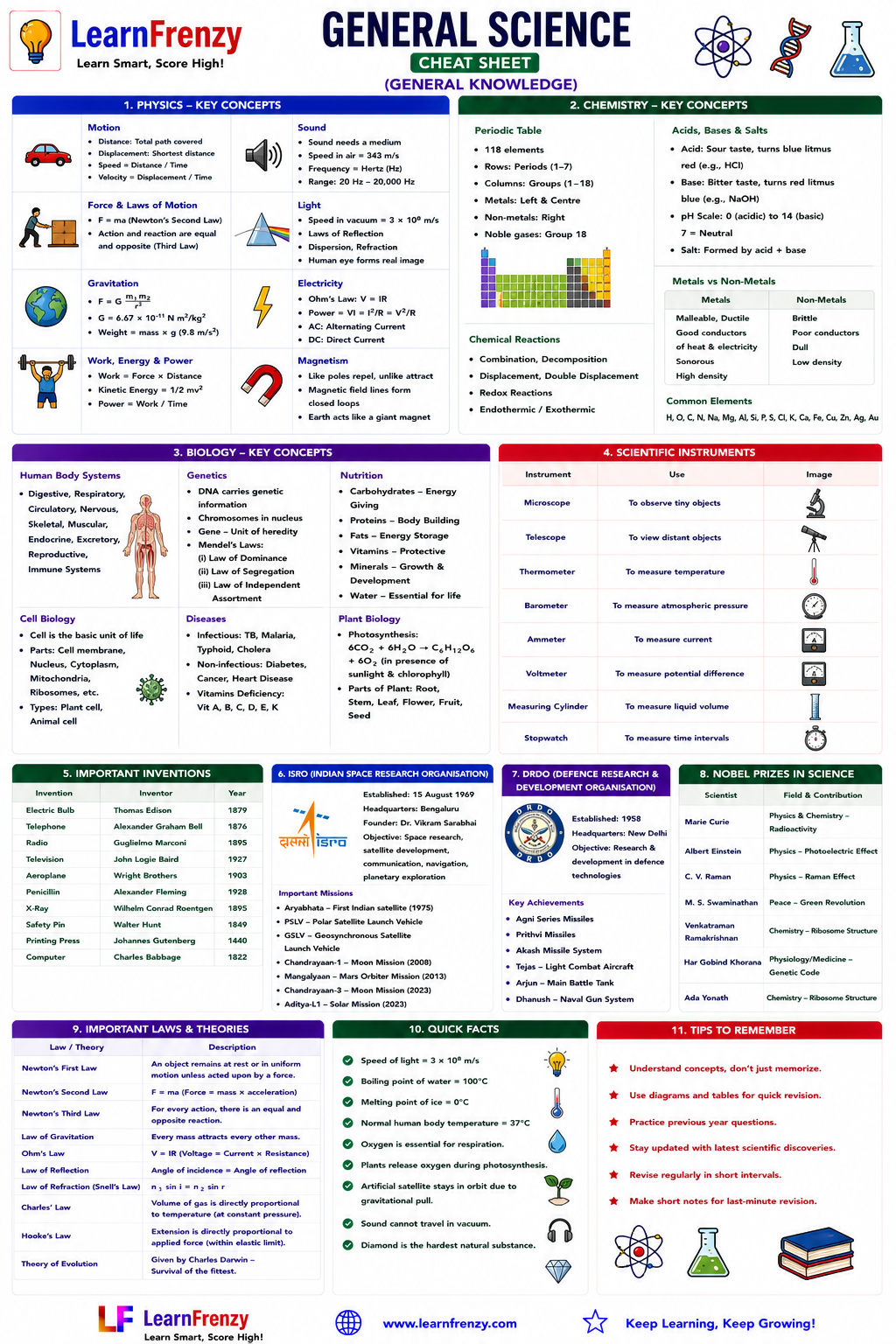
Your complete guide to General Science for competitive exams. This cheat sheet covers essential concepts in Physics, Chemistry, Biology, and Space Science with key facts and discoveries.
⚛️ Physics
- Motion, Force & Energy
- Work, Power & Gravitation
- Sound, Light & Heat
- Electricity & Magnetism
- Nuclear Physics & Mechanics
- Thermodynamics & Optics
- Important Laws & SI Units
🧪 Chemistry
- Matter, Elements & Compounds
- Atomic Structure & Periodic Table
- Chemical Reactions
- Acids, Bases & Salts
- Metals & Non-Metals
- Organic Chemistry
- Important Compounds & Formulas
🧬 Biology - Human Body
- Digestive, Respiratory & Circulatory
- Nervous, Excretory & Reproductive
- Endocrine, Skeletal & Muscular
- Immune System
- Cell Biology, DNA & RNA
- Genetics & Evolution
🌱 Biology - Plants & Ecology
- Photosynthesis & Respiration
- Transpiration & Reproduction
- Plant Physiology
- Ecosystems & Food Chains
- Environmental Issues
- Biodiversity & Conservation
🚀 Space & Defence Science
- Indian Space Research (ISRO)
- Defence Research (DRDO)
- Space Missions & Satellites
- Important Space Terms
- Nobel Prize Winners in Science
- Scientists & Their Contributions
📚 Exam Categories
- SSC & Banking
- Railways & UPSC
- State PSC
- Defence & Insurance
- CAT & MBA Entrance
- Other Competitive Exams
⚛️ Physics
3×10⁸ m/s
Speed of Light🧪 Chemistry
H₂O
Chemical Formula of Water🧬 Biology
206 Bones
Human Body Skeleton🚀 Space
ISRO
Indian Space Research📐 Important Scientific Laws & Formulas
⚛️ Physics
- Newton's 1st Law: Inertia
- Newton's 2nd Law: F = ma
- Newton's 3rd Law: Action = Reaction
- Ohm's Law: V = IR
- E = mc²: Einstein
- F = Gm₁m₂/r²: Gravitation
- KE = ½mv²: Kinetic Energy
- PE = mgh: Potential Energy
- P = W/t: Power
- Speed of Light: 3×10⁸ m/s
🧪 Chemistry
- Avogadro's Law: 6.022×10²³
- pH Scale: 0-14
- V₁/T₁ = V₂/T₂: Charles' Law
- P₁V₁ = P₂V₂: Boyle's Law
- PV = nRT: Ideal Gas Law
- Molarity: Moles/Liter
- Mole Concept: Mass/Molar Mass
- Law of Conservation: Mass
- Law of Constant: Proportion
- Law of Multiple: Proportion
🧬 Biology
- Cell Theory: All cells from cells
- DNA: Double Helix
- Central Dogma: DNA→RNA→Protein
- Photosynthesis: 6CO₂ + 6H₂O → C₆H₁₂O₆ + 6O₂
- Respiration: C₆H₁₂O₆ + 6O₂ → 6CO₂ + 6H₂O
- Mendelian Laws: Inheritance
- Natural Selection: Darwin
- Blood Groups: A, B, AB, O
- Genotype: Genetic makeup
- Phenotype: Physical traits
🇮🇳 Indian Scientists
Raman Effect | Nobel Prize (1930)
Father of Indian Nuclear Programme
Father of Indian Space Programme
Missile Man of India
Radio Waves | Plant Physiology
Chandrasekhar Limit | Nobel (1983)
🔬 Important Discoveries
C.V. Raman | 1928
Watson & Crick | 1953
Alexander Fleming | 1928
Wilhelm Roentgen | 1895
Henri Becquerel | 1896
Albert Einstein | 1905
🚀 ISRO Missions & Space Facts
🛰️ ISRO Missions
- Chandrayaan-1: 2008
- Chandrayaan-2: 2019
- Chandrayaan-3: 2023
- Mangalyaan: 2013
- Aditya-L1: 2023
- Gaganyaan: Planned
- PSLV: Polar Satellite Launch
- GSLV: Geo-Satellite Launch
- Aryabhata: First Indian Satellite
- GSAT Series: Communication
🪐 Space Facts
- Largest Planet: Jupiter
- Hottest Planet: Venus
- Coldest Planet: Neptune
- Closest Star: Sun
- Nearest Galaxy: Andromeda
- Largest Moon: Ganymede
- Most Craters: Moon
- Ozone Layer: Stratosphere
- Aurora: Northern Lights
- Black Hole: Gravity
🔬 Scientists & Discoveries
- Newton: Laws of Motion
- Einstein: Relativity
- Edison: Light Bulb
- Bell: Telephone
- Darwin: Evolution
- Pasteur: Germ Theory
- Fleming: Penicillin
- Marconi: Radio
- Bohr: Atomic Model
- Curie: Radioactivity
🏆 Nobel Prize Winners in Science
⚛️ Physics
- 1901: W.C. Roentgen
- 1921: Albert Einstein
- 1930: C.V. Raman
- 1965: Feynman, Schwinger
- 1979: S. Glashow, A. Salam
- 1983: S. Chandrasekhar
- 2017: LIGO Team
🧪 Chemistry
- 1901: J.H. van't Hoff
- 1911: Marie Curie
- 1934: Harold Urey
- 1962: Watson, Crick
- 1980: P. Berg, W. Gilbert
- 2019: J. Goodenough
🧬 Medicine
- 1905: Robert Koch
- 1923: Frederick Banting
- 1945: Alexander Fleming
- 1968: Holley, Khorana
- 2006: Fire, Mello
- 2020: Alter, Houghton, Rice
📋 Quick Reference: Important Scientific Facts
⚛️ Physics
- Newton: Laws of Motion
- Einstein: Theory of Relativity
- Speed of Light: 3×10⁸ m/s
- Sound Speed: 343 m/s
- SI Unit of Force: Newton
- SI Unit of Energy: Joule
- SI Unit of Power: Watt
- Ohm's Law: V = IR
- Gravity: 9.8 m/s²
- F=ma: Force Equation
🧪 Chemistry
- Water: H₂O
- Hydrogen: H
- Oxygen: O₂
- Carbon Dioxide: CO₂
- Salt: NaCl
- Baking Soda: NaHCO₃
- Vinegar: CH₃COOH
- Ammonia: NH₃
- pH Scale: 0-14
- Avogadro's Number: 6.022×10²³
🧬 Biology
- Human Body: 206 Bones
- Blood: 5-6 Litres
- Heart: 72 beats/min
- Lungs: Left (2 lobes), Right (3 lobes)
- DNA: Double Helix
- Cell: Basic Unit of Life
- Vitamin C: Citrus Fruits
- Hemoglobin: Carries Oxygen
- Insulin: Regulates Sugar
- Adrenaline: Fight-or-flight
🎯 How to Master General Science Quickly
The Golden Rule: General Science questions in competitive exams are mostly fact-based and conceptual. Focus on understanding basic concepts and remembering key scientists, discoveries, and their contributions.
Step-by-Step Approach:
- Step 1: Focus on NCERT science textbooks (Class 6-10) – they are the foundation
- Step 2: Create concise notes for each subject – Physics, Chemistry, Biology
- Step 3: Memorize important scientific terms and definitions
- Step 4: Learn about scientists and their discoveries
- Step 5: Practice with previous year questions
Common Mistakes to Avoid:
- ❌ Memorizing without understanding the concepts
- ❌ Confusing scientists with their discoveries
- ❌ Mixing up SI units and their symbols
- ❌ Ignoring important scientific laws
Proven Strategy: The "Concept-Fact" technique – first understand the concept, then memorize the facts around it. For example: Learn Newton's laws (concept), then remember the dates, experiments, and impact (facts).
Memory Trick: Remember the key branches and their focus:
- ⚛️ Physics: Matter, Energy, Motion, Force, Light, Sound, Electricity
- 🧪 Chemistry: Elements, Compounds, Reactions, Acids, Bases, Salts
- 🧬 Biology: Human Body, Plants, Cells, Genetics, Evolution, Ecology
- 🚀 Space: ISRO, Satellites, Space Missions, Scientists
💡 Pro Tips for General Science
✅ Focus on NCERT
NCERT Science books (Class 6-10) are the most important resource
✅ Learn Scientists
Memorize important scientists and their discoveries
✅ Know SI Units
SI units and their symbols are frequently asked
✅ Practice Daily
Solve at least 10 science questions daily
Download Cheat Sheet
This cheat sheet has 2 pages. Choose download option:
Preview
Still have questions?
We're here to help! Reach out to our support team for any queries.