Direction Sense Test
About This Cheat Sheet
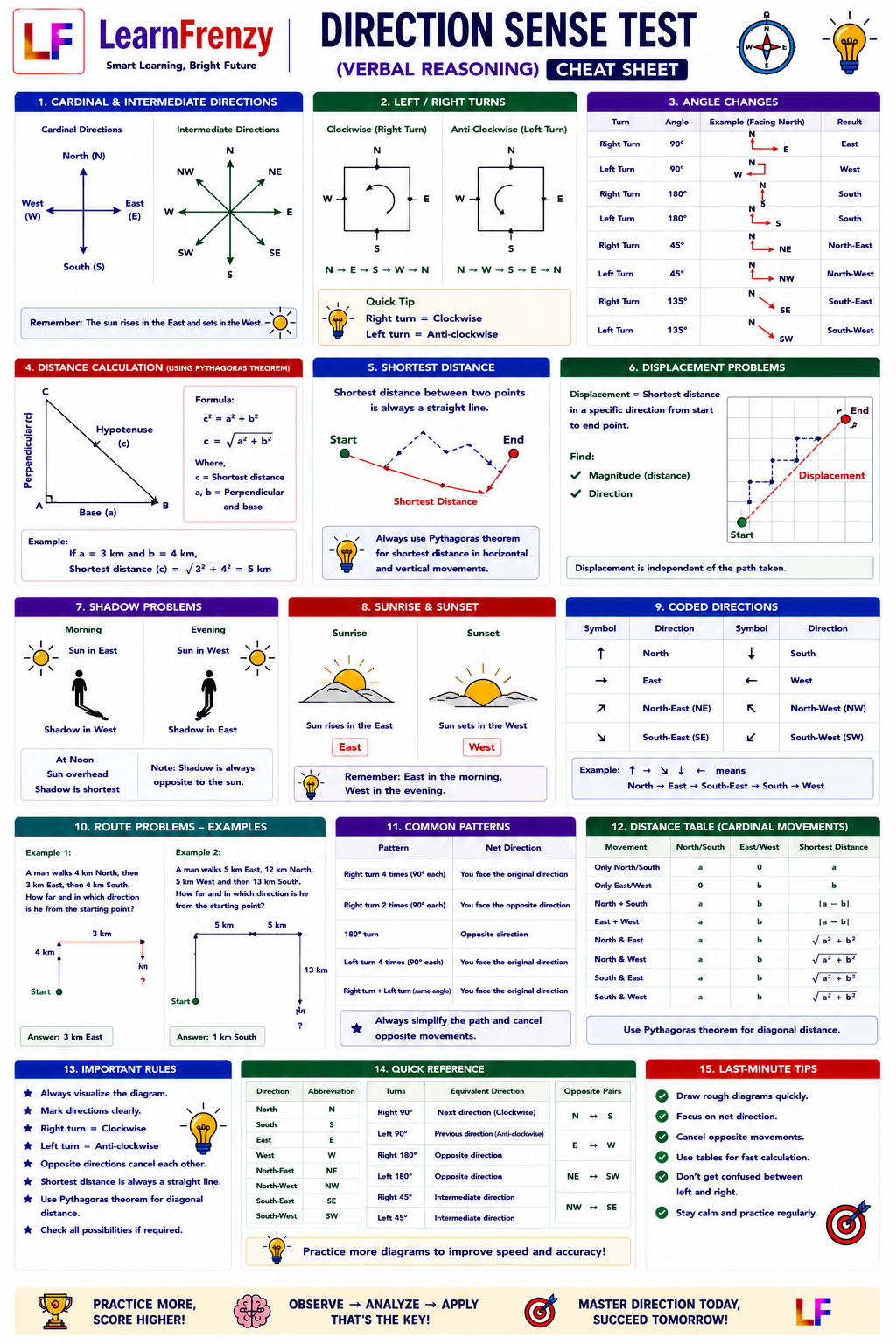
Your complete guide to Direction Sense Test for competitive exams. This cheat sheet helps you track movements, calculate distances, and determine final positions using logical reasoning and Pythagoras theorem.
🧭 Basic Directions
- North, South, East, West
- North-East, North-West
- South-East, South-West
- Cardinal Directions (N, S, E, W)
- Intermediate Directions (NE, NW, SE, SW)
- Compass Basics
🔄 Turns & Rotations
- Left Turn (90° Anti-Clockwise)
- Right Turn (90° Clockwise)
- 180° Turn (U-Turn)
- 135° Turn (45° + 90°)
- 45° Turn (Half Right/Left)
- Angle-Based Direction Changes
📐 Distance & Displacement
- Pythagoras Theorem
- Shortest Distance Formula
- Distance Between Two Points
- Displacement Problems
- Route-Based Problems
- Finding Final Position
☀️ Shadow & Sun Concepts
- Morning Shadow (West)
- Evening Shadow (East)
- Noon Shadow (None/South)
- Sunrise Direction
- Sunset Direction
- Shadow Direction Based on Sun
🎯 Problem Types
- Final Direction After Movements
- Final Position After Movements
- Direction Between Points
- Distance Between Points
- Coded Direction Problems
- Shadow-Based Problems
📚 Exam Categories
- SSC & Banking
- Railways & UPSC
- CAT & MBA Entrance
- Defence & Insurance
- Placement Tests
- Other Competitive Exams
🧭 Directions
N, E, S, W
Cardinal Points🔄 Left Turn
N→W→S→E
Anti-Clockwise🔄 Right Turn
N→E→S→W
Clockwise📐 Pythagoras
a² + b² = c²
Shortest Distance🧭 Direction Cycle
🔄 Left Turn (Anti-Clockwise)
- North → West
- West → South
- South → East
- East → North
- NE → NW
- SE → NE
🔄 Right Turn (Clockwise)
- North → East
- East → South
- South → West
- West → North
- NE → SE
- SE → SW
📐 Angles & Directions
- 90°: NE ↔ SE ↔ SW ↔ NW
- 45°: N ↔ NE ↔ E
- 135°: N ↔ SE ↔ S
- 180°: N ↔ S, E ↔ W
- 270°: N ↔ E ↔ S ↔ W
☀️ Shadow Rules
📐 Distance Formulas
🎯 Quick Problem Examples
📐 Basic Direction
- Question: A person walks 5 km East
- Then 3 km North
- Final Position: NE of start
- Distance: √(5² + 3²) = √34 km
- Answer: NE, √34 km
🔄 Turns & Turns
- Question: A person starts North
- Turns Left → West
- Turns Right → North
- Turns Right → East
- Final Direction: East
- Answer: East
☀️ Shadow Example
- Question: Person walking East
- Shadow falls on left
- Time: Evening
- Answer: Person is facing East
- Shadow falls West
📋 Quick Reference: Direction Rules
🔄 Turn Rules
- Left: N→W→S→E
- Right: N→E→S→W
- 180°: Opposite Direction
- 45°: Half Turn
- 135°: 45° + 90°
☀️ Shadow Rules
- Morning: Shadow West
- Evening: Shadow East
- Noon: Shadow South
- Sunrise: East
- Sunset: West
📐 Distance Formulas
- Straight: Add/Subtract
- Diagonal: √(a² + b²)
- Shortest: Pythagoras
- Displacement: Final - Initial
- Total: Sum of all moves
🎯 How to Solve Direction Sense Questions Quickly
The Golden Rule: Always use the reference point as the starting position. Track each movement step by step, using North as "Up" on paper and maintaining consistent scale for distances.
Step-by-Step Approach:
- Step 1: Mark the starting point on paper
- Step 2: Draw each movement with correct direction and distance
- Step 3: Track left and right turns carefully
- Step 4: Find the final position on the diagram
- Step 5: Use Pythagoras theorem for shortest distance
Common Mistakes to Avoid:
- ❌ Forgetting to rotate the reference frame with each turn
- ❌ Confusing left and right turns
- ❌ Forgetting that East + West cancel each other
- ❌ Not using Pythagoras theorem for diagonal distances
Proven Strategy: The "Draw as You Go" technique – never try to visualize direction problems mentally. Always draw a rough diagram on paper. Mark the starting point (S) and trace each movement with arrows. This eliminates confusion and ensures accuracy.
Memory Trick: Remember the direction cycle:
- 🔄 Left Turn → Anti-Clockwise (N→W→S→E→N)
- 🔄 Right Turn → Clockwise (N→E→S→W→N)
- 🔴 Opposite Direction → 180° Turn
- 📐 Diagonal → NE, NW, SE, SW
💡 Pro Tips for Direction Sense Test
✅ Draw a Diagram
Always draw a rough diagram – it's the key to solving direction problems
✅ Use Consistent Scale
Use a consistent unit (e.g., 1 cm = 1 km) for accurate distance
✅ Track Left/Right Carefully
Left and right change with direction – re-evaluate after each turn
✅ Use Pythagoras for Diagonal
For shortest distance between two points, apply Pythagoras theorem
Download Cheat Sheet
This cheat sheet has 2 pages. Choose download option:
Preview
Still have questions?
We're here to help! Reach out to our support team for any queries.