Data Interpretation

Pie Chart 4

Data Interpretation Exercise Mode

Pie Chart 4

Practice and master this topic with our carefully crafted questions.

5 Questions
8 Minutes
0% Completed
QUEST ? !
Directions to Solve

Study the following pie-chart and the table and answer the questions based on them.

Proportion of Population of Seven Villages in 1997
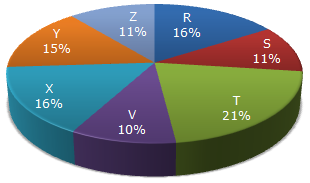
Village

% Population Below Poverty Line

X

38

Y

52

Z

42

R

51

S

49

T

46

V

58


Question 1
Find the population of village S if the population of village X below poverty line in 1997 is 12160.

A
18500
B
20500
C
22000
D
26000
Correct Answer: Option C

Let the population of village X be x.

Then, 38% of x = 12160   =>   x =12160 x 100

38
= 32000.

Now, if s be the population of village S, then

16 : 11 = 32000 : s     =>     s =(11 x 3200)= 22000.
16
Question 2
The ratio of population of village T below poverty line to that of village Z below poverty line in 1997 is :

A
11 : 23
B
13 : 11
C
23 : 11
D
11 : 13
Correct Answer: Option C

Let N be the total population of all the seven villages.

Then, population of village T below poverty line 

= 46% of (21% of N)

and Population of villages Z below the poverty line

 = 42% of (11% of N)

Therefore Required ratio =46% of (21% of N)=46 x 21


42% of (11 % of N)42 x 11

= 23/11.
Question 3
If the population of village R in 1997 is 32000, then what will be the population of village Y below poverty line in that year ?

A
14100
B
15600
C
16500
D
17000
Correct Answer: Option B

Population of village R = 32000 (given).

Let the population of village Y be y.

Then, 16 : 15 = 32000 : y     => y =(15 x 32000)

16

= 30000.

Therefore Population of village Y below poverty line 

= 52% of 30000 = 15600

Question 4
If in 1998, the population of village Y and V increase by 10% each and the percentage of population below poverty line remains unchanged for all the villages, then find the population of village V below poverty line in 1998, given that the population of village Y in 1997 was 30000.

A
11250
B
12760
C
13140
D
13780
Correct Answer: Option B

Population of village Y in 1997 = 30000 (given).

Let the population of village V in 1997 be v.

Then, 15 : 10 = 30000 : v     =>     v =30000 x 10

15

= 20000.

Now, population of village V in 1998 

= 20000 + (10% of 20000) = 22000.

Therefore Population of village V below poverty line in 1998 

= 58% of 22000 = 12760.

Question 5
If in 1999, the population of village R increase by 10% while that of village Z reduces by 5% compared to that in 1997 and the percentage of population below poverty line remains unchanged for all the villages, then find the approximate ratio of population of village R below poverty line to the ratio of population of village Z below poverty line for the year 1999.

A
2 : 1
B
3 : 2
C
4 : 3
D
5 : 4
Correct Answer: Option A
Let the total population of all the seven village in 1997 be N.
Then, population of village R in 1997
= 16% of N = 16N/100
and population of village Z in 1997
= 11% of N = 11N/100

Population of village R in 1999 
= { 16N/100 + (10% of 16N/100) }
= 1760N/10000

and population of village Z in 1999
= { 11N/100 - (5% of 11N/100)}
= 1045N/10000

Now, population of village R below poverty line for 1999
= 51% of 1760N/10000 
and population of village Z below poverty line for 1999
= 42% of  1045N/10000 

= 51% of 1760N/10000 / 42% of  1045N/10000 
= 51 x 1760  
    42 x 1045
= 2/1