Verbal Reasoning

Arithmetic Reasoning - Base Level

Verbal Reasoning Exercise Mode

Arithmetic Reasoning - Base Level

Practice and master this topic with our carefully crafted questions.

10 Questions
15 Minutes
0% Completed
QUEST ? !
Question 31
When Rahul was born, his father was 32 years older than his brother and his mother was 25 years older than his sister. If Rahul's brother is 6 years older than him and his mother is 3 years younger than his father, how old was Rahul's sister when he was born ?

A
7 years
B
10 years
C
14 years
D
19 years
Correct Answer: Option B

When Rahul was born, his brother's age = 6 years; his father's age = (6 + 32) years = 38 years, his mother's age = (38 - 3) years = 35 years; his sister's age = (35 - 25) years = 10 years.

Question 32
Ravi's brother is 3 years senior to him. His father was 28 years of age when his sister was born while his mother was 26 years of age when he was born. If his sister was 4 years of age when his brother was born, what were the ages of Ravi's father and mother respectively when his brother was born ?

A
32 years, 23 years
B
32 years, 29 years
C
35 years, 29 years
D
35 years, 33 years
Correct Answer: Option A

When Ravi's brother was born, let Ravi's father's age = x years and mother's age = y years.

Then, sister's age = (x - 28) years. So, x - 28 = 4 or x = 32.

Ravi's age = (y - 26) years. Age of Ravi's brother = (y - 26 + 3) years = (y - 23) years.

Now, when Ravi's brother was born, his age = 0 i.e. y - 23 = 0 or y = 23.

Question 33
A is three times as old as B. C was twice-as old as A four years ago. In four years' time, A will be 31. What are the present ages of B and C ?

A
9, 46
B
9, 50
C
10, 46
D
10, 50
Correct Answer: Option B

We have : A = 3B ...(i) and

C - 4 = 2 (A - 4) ...(ii)

Also, A + 4 = 31 or A= 31-4 = 27.

Putting A = 27 in (i), we get: B = 9.

Putting A = 27 in (ii), we get C = 50.

Question 34
A bird shooter was asked how many birds he had in the bag. He replied that there were all sparrows but six, all pigeons but six, and all ducks but six. How many birds he had in the bag in all?

A
9
B
18
C
27
D
36
Correct Answer: Option A

There were all sparrows but six' means that six birds were not sparrows but only pigeons and ducks.

Similarly, number of sparrows + number of ducks = 6 and number of sparrows + number of pigeons = 6.

This is possible when there are 3 sparrows, 3 pigeons and 3 ducks i.e. 9 birds in all.

Question 35
What is the smallest number of ducks that could swim in this formation - two ducks in front of a duck, two ducks behind a duck and a duck between two ducks ?

A
3
B
5
C
7
D
9
Correct Answer: Option A

Clearly, the smallest such number is 3.

Three ducks can be arranged as shown above to satisfy all the three given conditions.
Question 36
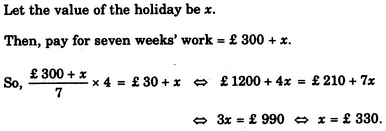
Mr. Johnson was to earn £ 300 and a free holiday for seven weeks' work. He worked for only 4 weeks and earned £ 30 and a free holiday. What was the value of the holiday?

A
£ 300
B
£ 330
C
£ 360
D
£ 420
Correct Answer: Option B

Question 37
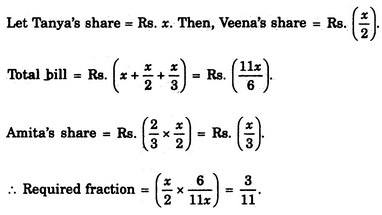
Three friends had dinner at a restaurant. When the bill was received, Amita paid 2/3 as much as Veena paid and Veena paid 1/2 as much as Tanya paid. What faction of the bill did Veena pay ?

A
1/3
B
3/11
C
12/13
D
5/8
Correct Answer: Option B

Question 38
In a family, the father took 1/4 of the cake and he had 3 times as much as each of the other members had. The total number of family members is

A
3
B
7
C
10
D
12
Correct Answer: Option C

Question 39
A, B, C, D and E play a game of cards. A says to B, "If you give me 3 cards, you will have as many as I have at this moment while if D takes 5 cards from you, he will have as many as E has." A and C together have twice as many cards as E has. B and D together also have the same number of cards as A and C taken together. If together they have 150 cards, how many cards has C got ?

A
28
B
29
C
31
D
35
Correct Answer: Option A

Clearly, we have :

A = B - 3 ...(i)

D + 5 = E ...(ii)

A+C = 2E ...(iii)

B + D = A+C = 2E ...(iv)

A+B + C + D + E=150 ...(v)

From (iii), (iv) and (v), we get: 5E = 150 or E = 30.

Putting E = 30 in (ii), we get: D = 25.

Putting E = 30 and D = 25 in (iv), we get: B = 35.

Putting B = 35 in (i), we get: A = 32.

Putting A = 32 and E = 30 in (iii), we get: C = 28.
Question 40
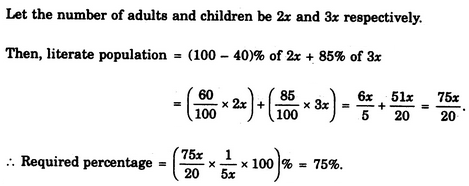
In a city, 40% of the adults are illiterate while 85% of the children are literate. If the ratio of the adults to that of the children is 2 : 3, then what percent of the population is literate ?

A
20%
B
25%
C
50%
D
75%
Correct Answer: Option D