Completion of Series
✏️ Practice with curated questions covering all difficulty levels. Detailed solutions and expert tips help you master each question type.
Sample Questions
Study MaterialSample Questions – Completion of Series
Sample Questions help candidates understand how different concepts of Completion of Series are applied in Non Verbal Reasoning. These questions improve observation skills, logical deduction, visual analysis, and strategic thinking ability.
The following examples cover important concepts such as rotation, movement, angles, symbol shifting, alternate patterns, addition-deletion logic, and mirror transformations frequently asked in competitive examinations.
Sample Question 1
DIRECTIONS (Q.1) : There are two sets of figures namely the Problem figures containing five figures 1, 2, 3, 4, 5 and the Answer figures (а), (b), (c), (d), (e). You have to select one figure from the Answer figures which will continue the same series as given in the Problem figures.
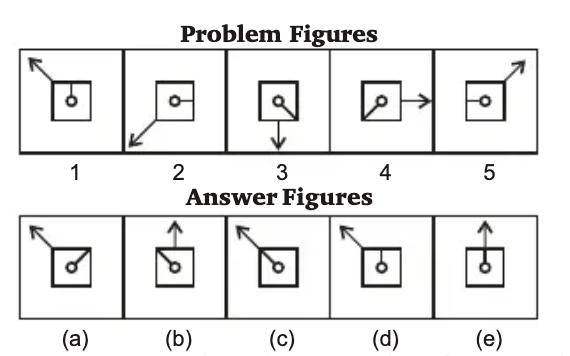
Pattern Identified: Alternate Rotations of Outer and Inner Components
🔍 Analysis
The outer arrow rotates alternately through 90° and 45° anticlockwise. Therefore, after the north-east arrow in Figure 5, the next arrow points north-west.
The inner line rotates alternately through 90° and 45° clockwise. Applying the next 90° clockwise rotation places the line at the top position inside the square.
Correct Answer: Option (d)
Sample Question 2
DIRECTIONS (Q.2) : There are two sets of figures namely the Problem figures containing five figures 1, 2, 3, 4, 5 and the Answer figures (а), (b), (c), (d), (e). You have to select one figure from the Answer figures which will continue the same series as given in the Problem figures.
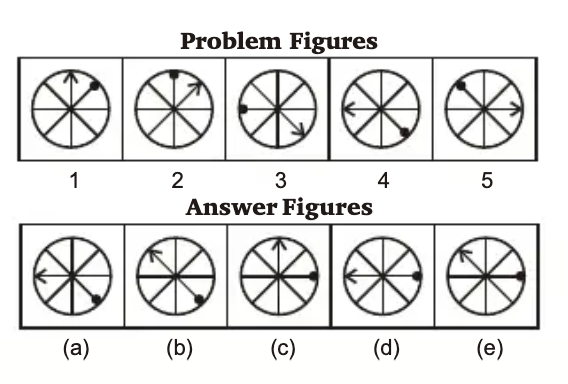
Pattern Identified: Increasing Rotational Movement of Arrow and Dot
🔍 Analysis
The arrow rotates clockwise by increasing angles: 45°, 90°, 135°, and 180°. Therefore, the next rotation is 225°, placing the arrow in the upper-left position.
The black dot moves anticlockwise by an increasing number of sectors. Applying the next movement places the dot on the right side of the circle.
Correct Answer: Option (e)
Sample Question 3
DIRECTIONS (Q.3) : There are two sets of figures namely the Problem figures containing five figures 1, 2, 3, 4, 5 and the Answer figures (а), (b), (c), (d), (e). You have to select one figure from the Answer figures which will continue the same series as given in the Problem figures.
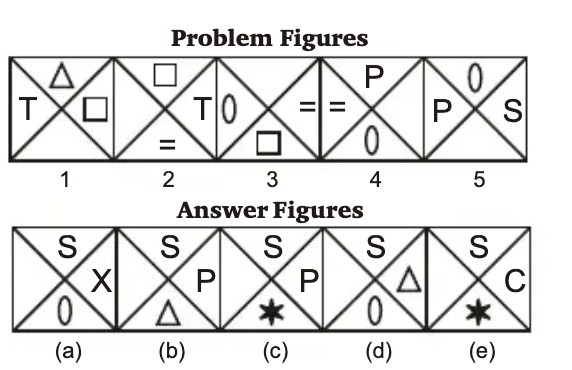
Pattern Identified: Positional Shift with Symbol Replacement
🔍 Analysis
Problem figure (1) is identical to figure (5) but with the different symbols. Problem figure (2) is obtained by moving ▢ to the top, T to the opposite side and △ to the bottom (replacing by =). Similarly, answer figure will be obtained from problem figure (5) by moving symbols S to the top, P to the opposite side and 0 to the bottom (replacing by *). Hence, the correct answer figure is (c).
Figure (b) cannot be the correct answer as symbol △ is not a new symbol.
Correct Answer: Option (c)
Sample Question 4
DIRECTIONS (Q.4) : There are two sets of figures namely the Problem figures containing five figures 1, 2, 3, 4, 5 and the Answer figures (а), (b), (c), (d), (e). You have to select one figure from the Answer figures which will continue the same series as given in the Problem figures.
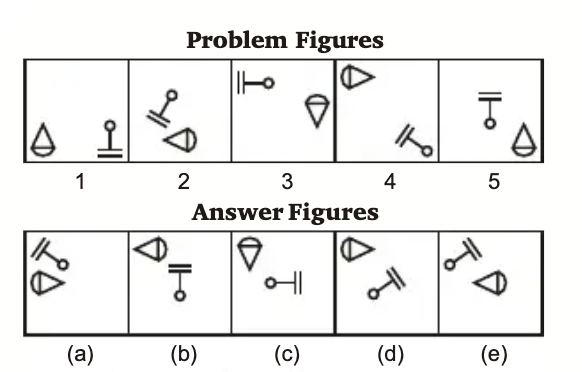
Pattern Identified: Simultaneous Symbol Movement and Rotation
🔍 Analysis
The triangle moves by increasing anti-clockwise steps of ½, 1, 1½ and 2 sides, producing a 90° anti-clockwise rotational effect.
The key-like symbol rotates 45° clockwise at each stage and shifts through middle, top and bottom positions in a straight line.
Applying both rules to the next figure gives the configuration shown in Option (e).
Correct Answer: Option (e)
Sample Question 5
DIRECTIONS (Q.5) : There are two sets of figures namely the Problem figures containing five figures 1, 2, 3, 4, 5 and the Answer figures (а), (b), (c), (d), (e). You have to select one figure from the Answer figures which will continue the same series as given in the Problem figures.
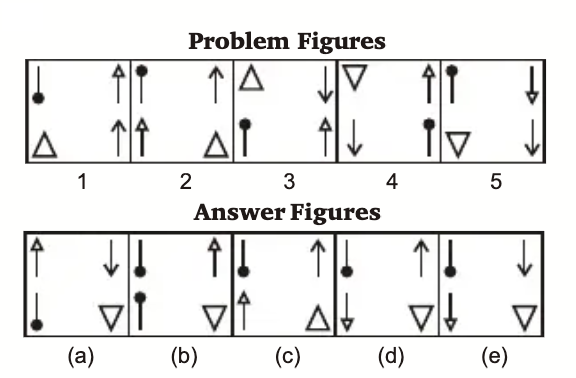
Pattern Identified: Cyclic Position Shift of Symbols Within Each Block
🔍 Analysis
The symbols move according to a fixed positional cycle. The figure at the top-right position shifts diagonally opposite, the figure at the bottom-right moves to the top-right position, the figure at the bottom-left shifts to the bottom-right position, and the figure at the top-left remains at the same position with reversal where applicable.
The same transformation is observed from Problem Figure (1) to (2) and again from Problem Figure (3) to (4). Applying it to Problem Figure (5) produces the arrangement shown in Option (e).
Correct Answer: Option (e)
Sample Question 6
DIRECTIONS (Q.6) : There are two sets of figures namely the Problem figures containing five figures 1, 2, 3, 4, 5 and the Answer figures (а), (b), (c), (d), (e). You have to select one figure from the Answer figures which will continue the same series as given in the Problem figures.
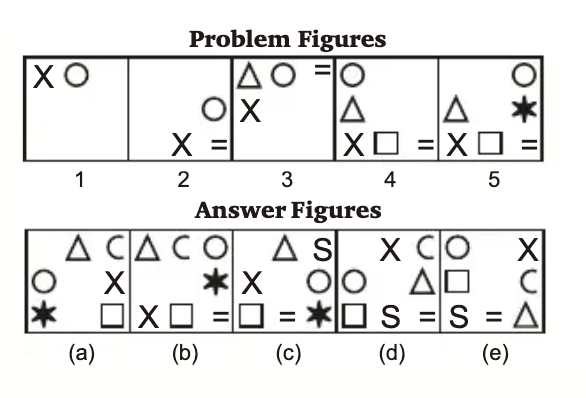
Pattern Identified: Progressive Addition of New Symbols
🔍 Analysis
Each successive figure introduces one new symbol while retaining all symbols from the previous figure. The symbols are arranged systematically around the figure.
After Figure (5), a new symbol must be added while preserving the existing pattern. Option (c) contains all previous symbols and introduces the next new symbol in the correct position.
Correct Answer: Option (c)
Sample Question 7
DIRECTIONS (Q.7) : There are two sets of figures namely the Problem figures containing five figures 1, 2, 3, 4, 5 and the Answer figures (а), (b), (c), (d), (e). You have to select one figure from the Answer figures which will continue the same series as given in the Problem figures.
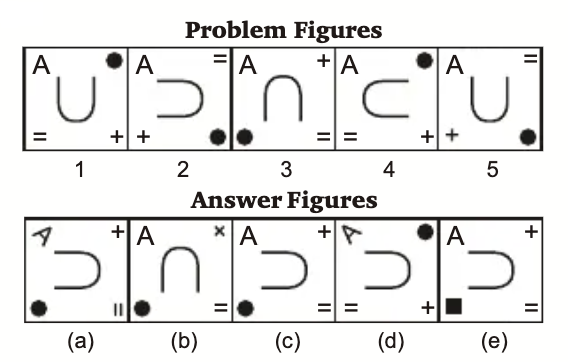
Pattern Identified: Two Independent Alternating Series
🔍 Analysis
The odd-position figures (1, 3, 5) form one series, while the even-position figures (2, 4, 6) form another. In the even series, the central shape alternates its orientation and the corner symbols follow a cyclic interchange pattern.
Applying the same transformation from Figure 2 to Figure 4 and then to the next figure gives the arrangement shown in Option (c).
Correct Answer: Option (c)
Sample Question 8
DIRECTIONS (Q.8) : There are two sets of figures namely the Problem figures containing five figures 1, 2, 3, 4, 5 and the Answer figures (а), (b), (c), (d), (e). You have to select one figure from the Answer figures which will continue the same series as given in the Problem figures.
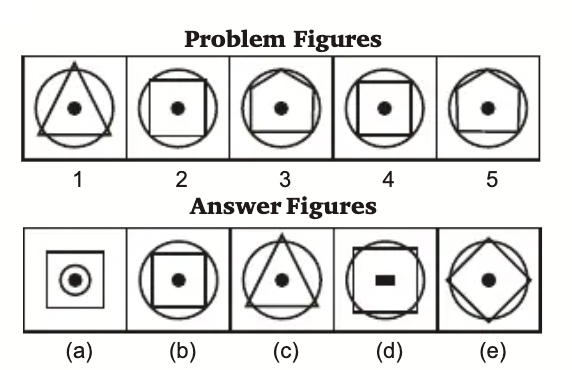
Pattern Identified: Repetition of Earlier Figures in the Series
🔍 Analysis
Problem Figure (3) is identical to Problem Figure (5), indicating that the series has entered a repeating cycle.
Therefore, the figure following Problem Figure (5) should be identical to Problem Figure (2). Among the answer figures, Option (b) exactly matches Problem Figure (2).
Correct Answer: Option (b)
Sample Question 9
DIRECTIONS (Q.9) : There are two sets of figures namely the Problem figures containing five figures 1, 2, 3, 4, 5 and the Answer figures (а), (b), (c), (d), (e). You have to select one figure from the Answer figures which will continue the same series as given in the Problem figures.
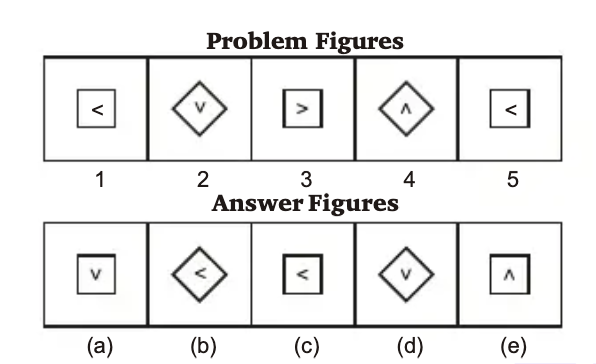
Pattern Identified: Simultaneous Rotation of Outer and Inner Figures
🔍 Analysis
The outer figure rotates through 45° in each subsequent block, causing the square and diamond to appear alternately.
The inner symbol rotates through 90° in each subsequent block following the sequence: < → ∨ → > → ∧ → <.
Applying both transformations to Figure (5) gives a diamond containing the symbol ∨.
Correct Answer: Option (d)
Sample Question 10
DIRECTIONS (Q.10) : There are two sets of figures namely the Problem figures containing five figures 1, 2, 3, 4, 5 and the Answer figures (а), (b), (c), (d), (e). You have to select one figure from the Answer figures which will continue the same series as given in the Problem figures.
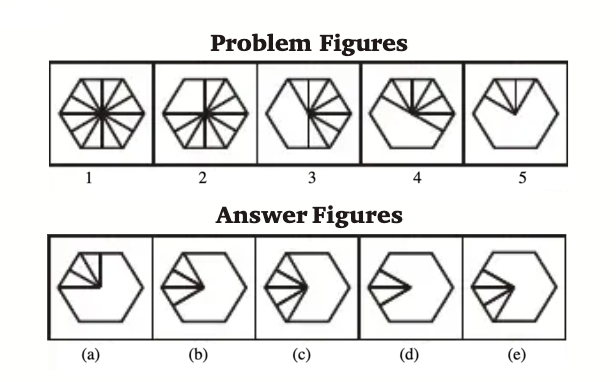
Pattern Identified: Progressive Removal of Triangular Sectors
🔍 Analysis
The triangular sectors inside the hexagon are removed progressively from one figure to the next. The remaining sectors form a shrinking cluster that moves clockwise around the figure.
After Figure (5), one more sector is removed, leaving the triangular cluster shown in Option (d).
Correct Answer: Option (d)
Sample Question 11
DIRECTIONS (Q.11) : There are two sets of figures namely the Problem figures containing five figures 1, 2, 3, 4, 5 and the Answer figures (а), (b), (c), (d), (e). You have to select one figure from the Answer figures which will continue the same series as given in the Problem figures.
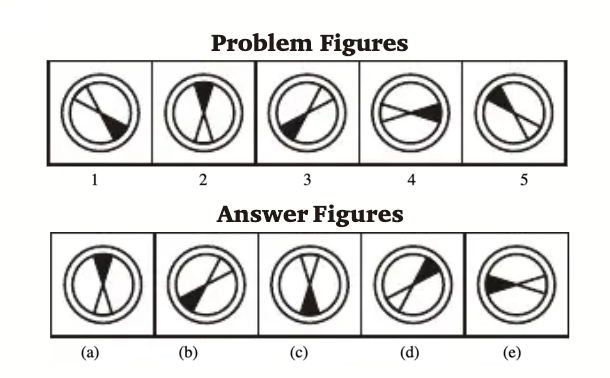
Pattern Identified: Two Interleaved Rotational Series
🔍 Analysis
The odd-numbered figures and even-numbered figures form two independent rotational sequences. In the even series (Figures 2, 4, and 6), the black sector moves from top to right and then to bottom.
Therefore, the next figure must contain the black sector at the bottom position, which matches Option (c).
Correct Answer: Option (c)
Approach to Solve Sample Questions
- Observe all figures carefully.
- Identify rotation or movement.
- Check angle and direction changes.
- Look for alternate or repeated patterns.
- Observe addition or deletion of elements.
- Apply logical deduction systematically.
- Use elimination method if necessary.
Important Concepts Covered in Sample Questions
| Concept | Application |
|---|---|
| Rotation | Clockwise & Anti-clockwise Movement |
| Angles | 90°, 180°, 270° Rotation |
| Alternate Pattern | Every Second Figure Logic |
| Movement | Directional Symbol Shifting |
| Addition/Deletion | Increasing or Decreasing Elements |
| Mirror Logic | Reflection-Based Series |
Common Mistakes Students Make
- Ignoring hidden rotation patterns
- Confusing clockwise and anti-clockwise movement
- Missing alternate figure logic
- Ignoring small symbol changes
- Rushing without complete observation
- Not comparing all figures properly
Expert Tips for Solving Series Questions
- Check rotation first in every question.
- Track symbol movement carefully.
- Compare alternate figures if confused.
- Separate outer and inner figure logic.
- Use elimination method smartly.
- Practice visual reasoning daily.
- Improve observation speed through practice.
Quick Learning Framework
Observe the Figures Carefully
↓
Identify Rotation & Movement
↓
Check Angles & Direction
↓
Find Hidden Pattern Logic
↓
Apply Logical Deduction
↓
Solve Non Verbal Reasoning Faster
Final Takeaway
Sample Questions in Completion of Series help candidates understand practical applications of rotation, movement, alternate patterns, addition-deletion logic, and visual transformations.
Regular practice of different types of series questions improves observation skills, logical reasoning ability, speed, and accuracy in competitive examinations.