Let us Practice - All Latest Questions
Practice and master this topic with our carefully crafted questions.
In such problems, a figure following a particular sequence or pattern is given, in which a part, usually one-fourth, is left blank. This problem figure is followed by four alternative figures. One is required to choose the one which best fits into the blank space of problem figure so as to complete the original pattern.
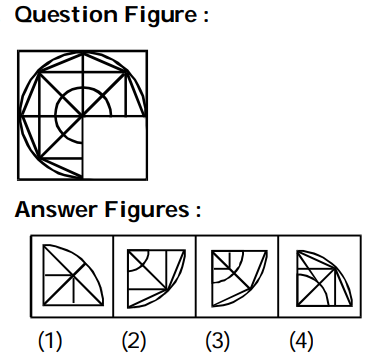
Which one of the answer figures shall complete the given question figure?
🔍 Analyze the Pattern
The missing portion lies in the bottom-right quadrant of the question figure.
Step 1: Follow the Central Circular Arc
A circular pattern is formed around the centre of the figure. The curved line entering the blank region must continue smoothly to complete the circular design.
Step 2: Trace the Diagonal Line
A diagonal line extends from the central point towards the lower-right section. The missing piece must continue this diagonal in the correct direction.
Step 3: Match the Outer Curved Bands
The outer part of the figure contains closely spaced curved lines. These curves must continue through the missing quadrant and join the existing lower and right-side boundaries.
Step 4: Compare the Options
- Figure (1) does not continue the outer curved bands correctly.
- Figure (2) correctly aligns the central arc, diagonal line and outer curved bands.
- Figure (3) changes the arrangement of the inner curved lines.
- Figure (4) contains extra intersecting lines that do not match the blank region.
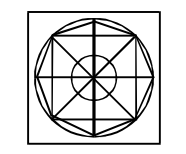
Correct Answer: Option (B)
⚡ Quick Exam Shortcut
For figure completion questions with several curves and diagonals:
- Trace the central curve first.
- Follow the diagonal entering the blank space.
- Match the outer boundary curves.
- Reject options that add extra lines or intersections.
Only Option (B) continues all the visible lines naturally.
Shortcut Answer: Central arc + diagonal + outer curved bands → Option (B).
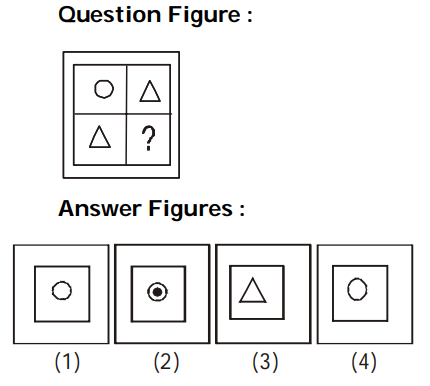
Which one of the answer figures shall complete the given question figure?
🔍 Analyze the Pattern
The question figure is divided into four equal sections. Each section contains either a circle or a triangle.
Step 1: Observe the Diagonal Arrangement
The two triangles are placed diagonally opposite to each other:
- Top-right section → Triangle
- Bottom-left section → Triangle
Step 2: Complete the Other Diagonal
Since the two triangles form one diagonal pair, the two circles must form the other diagonal pair.
The top-left section already contains a circle. Therefore, the missing bottom-right section must also contain a circle.
Step 3: Compare the Options
- Figure (1) contains the required plain circle.
- Figure (2) contains an additional inner dot.
- Figure (3) contains a triangle.
- Figure (4) does not match the given circle shape as closely.
Correct Answer: Option (A)
⚡ Quick Exam Shortcut
Check the diagonally opposite sections.
- Triangle is diagonally opposite to Triangle.
- Therefore, Circle must be diagonally opposite to Circle.
- Select the plain circle matching the given figure.
Only Figure (1) completes the diagonal arrangement correctly.
Shortcut Answer: Triangle ↔ Triangle and Circle ↔ Circle → Option (A).
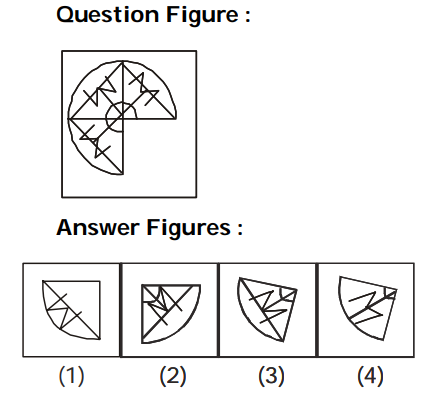
Which one of the answer figures shall complete the given question figure?
🔍 Analyze the Pattern
The missing portion lies in the bottom-right section of the circular figure.
Step 1: Observe the Internal Design
The visible sections contain a combination of intersecting lines, angular shapes and a zig-zag pattern arranged around the central circle.
The missing piece must continue the same complex line arrangement.
Step 2: Trace the Lines from the Centre
Several lines meet near the central circular region and extend towards the outer curved boundary.
The required answer figure must preserve these line continuations and intersections.
Step 3: Match the Zig-Zag Pattern
The angular zig-zag design repeats around the circular figure. Its direction and intersections must continue in the missing section.
Step 4: Compare the Options
- Figure (1) does not contain all the required internal lines.
- Figure (2) correctly matches the intersecting lines, zig-zag structure and curved boundary.
- Figure (3) changes the arrangement of the internal angular lines.
- Figure (4) omits some of the required line intersections.
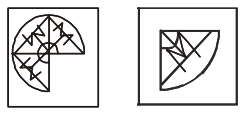
Correct Answer: Option (B)
⚡ Quick Exam Shortcut
In a complex figure completion question, trace the lines that touch the blank region before comparing the complete designs.
- Follow the lines from the central circle.
- Match the number of intersecting lines.
- Check the zig-zag orientation.
- Finally, verify the curved outer boundary.
Only Figure (2) continues the complete internal line pattern correctly.
Shortcut Answer: Correct intersections + zig-zag continuation + curved boundary → Option (B).
Which one of the answer figures shall complete the given question figure?
🔍 Analyze the Pattern
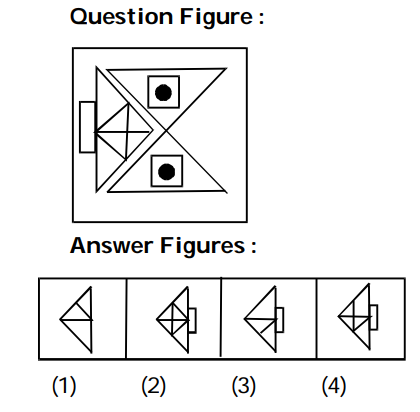
The missing portion lies on the left side of the question figure.
Step 1: Observe the Outer Shape
The missing piece must fit the triangular or arrow-like outline formed by the slanting lines on the left side.
Step 2: Check the Small Rectangle
A rectangular projection is visible outside the left side of the angular figure.
Therefore, the correct answer piece must contain the corresponding rectangular extension.
Step 3: Trace the Internal Lines
The internal lines form a diamond-like arrangement divided into smaller triangular sections.
The missing piece must contain both the horizontal and vertical divisions required to complete this internal pattern.
Step 4: Compare the Options
- Figure (1) does not contain the rectangular projection and lacks some internal divisions.
- Figure (2) contains the correct rectangular projection and completes all internal line divisions.
- Figure (3) is missing the required upper internal division.
- Figure (4) does not match the complete internal line arrangement.
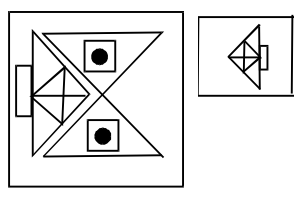
Correct Answer: Option (B)
⚡ Quick Exam Shortcut
First match the unique rectangular projection, then compare the internal lines.
- Reject the option without the rectangle.
- Check the horizontal division.
- Check the vertical division.
- Select the piece that completes the diamond-like pattern.
Only Figure (2) matches all the required details.
Shortcut Answer: Rectangle + complete internal divisions → Option (B).
Which answer figure will complete the question figure?
🔍 Analyze the Pattern
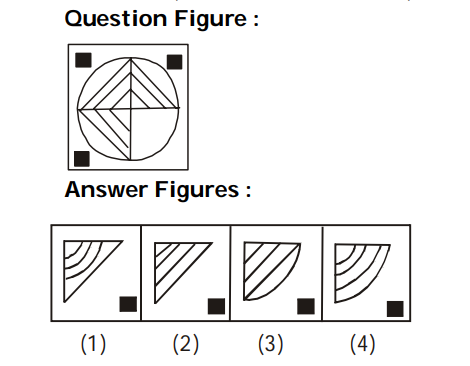
The missing portion lies in the bottom-right quadrant of the circular figure.
Step 1: Complete the Circular Boundary
The outer design forms a circle. Therefore, the missing piece must contain a curved outer edge to complete the bottom-right part of the circle.
This immediately eliminates the options with a straight triangular outer boundary.
Step 2: Observe the Internal Lines
The figure contains straight parallel diagonal lines arranged inside the circular sections.
The missing portion must continue the same straight diagonal-line pattern.
Step 3: Check the Black Square
Black squares are already present at the top-left, top-right and bottom-left corners of the main figure.
Therefore, the missing section must contain a black square at the bottom-right corner.
Step 4: Compare the Options
- Figure (1) contains curved internal lines.
- Figure (2) has a straight outer boundary and does not complete the circle.
- Figure (3) has the correct curved outer edge, straight diagonal lines and bottom-right black square.
- Figure (4) contains curved internal lines instead of straight diagonal lines.
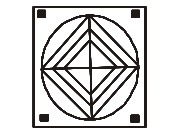
Correct Answer: Option (C)
⚡ Quick Exam Shortcut
Check three features in order:
- Complete the outer circle with a curved boundary.
- Match the straight parallel diagonal lines.
- Place the black square at the bottom-right corner.
Only Figure (3) matches all three features.
Shortcut Answer: Curved circular edge + straight diagonal lines + black square → Option (C).
Which answer figure will complete the question figure?
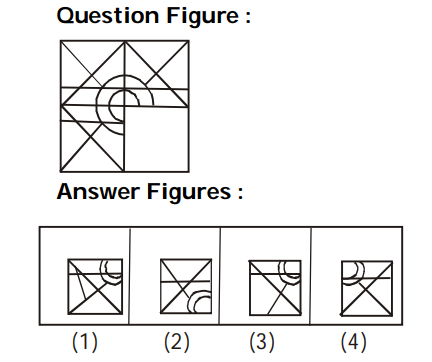
🔍 Analyze the Pattern
The missing portion lies in the bottom-right quadrant of the question figure.
Step 1: Follow the Circular Arcs
The central part of the figure contains concentric circular arcs.
These curved lines enter the missing region near its top-left corner. Therefore, the correct answer must continue the circular arcs from this position.
Step 2: Trace the Straight Lines
The figure also contains horizontal and diagonal lines that extend into the blank region.
The missing piece must continue these lines smoothly and preserve the intersecting line pattern.
Step 3: Compare the Options
- Figure (1) places the circular arcs in the wrong position.
- Figure (2) places the arcs near the bottom-right corner.
- Figure (3) places the arcs near the top-right corner.
- Figure (4) correctly places the circular arcs at the top-left and continues the straight lines.
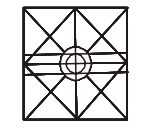
Correct Answer: Option (D)
⚡ Quick Exam Shortcut
First locate the centre of the circular pattern and check where the arcs must enter the missing piece.
- The circular arcs must appear at the top-left corner.
- Match the horizontal line.
- Continue the intersecting diagonal lines.
Only Figure (4) satisfies all these conditions.
Shortcut Answer: Top-left circular arcs + correct diagonal continuation → Option (D).
Which one of the answer figures shall complete the given question figure?
🔍 Analyze the Pattern
The missing portion must complete the triangular design and continue the internal lines of the question figure.
Step 1: Observe the Outer Shape
The incomplete figure is made of overlapping triangular sections.
Therefore, the missing piece must have a triangular boundary that fits naturally with the visible outline.
Step 2: Trace the Internal Lines
Several lines meet at the central junction of the figure. The missing piece must continue:
- The vertical line.
- The horizontal line.
- The diagonal line extending towards the lower-right side.
Step 3: Compare the Options
- Figure (1) has the wrong orientation of the triangular section.
- Figure (2) correctly matches the vertical, horizontal and diagonal line arrangement.
- Figure (3) does not contain the required vertical division.
- Figure (4) has a different diamond-like structure and cannot complete the figure.
Step 4: Complete the Figure
When Figure (2) is placed in the missing portion, all the internal lines join naturally and the triangular pattern becomes complete.
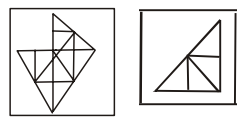
Correct Answer: Option (B)
⚡ Quick Exam Shortcut
For overlapping line figures, focus on the lines touching the missing portion.
- Match the triangular outer boundary.
- Trace the vertical line.
- Check the horizontal line.
- Verify the diagonal continuation.
Only Figure (2) matches all the required line connections.
Shortcut Answer: Correct triangle + vertical, horizontal and diagonal continuation → Option (B).
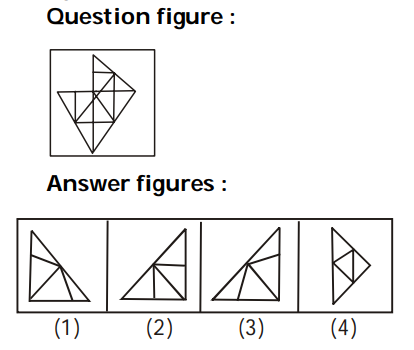
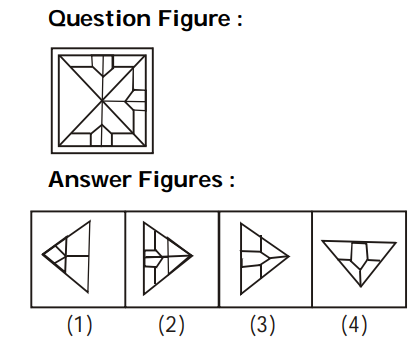
In the given question, a part of the figure is missing. Select one of the response figures which exactly fits into the missing part of the question figure.
🔍 Analyze the Pattern
The missing portion lies on the left side of the question figure.
Step 1: Observe the Repeating Design
The figure contains similar divided triangular sections arranged around a common central point.
The same basic pattern is visible at the top, right and bottom of the figure.
Step 2: Check the Direction of the Missing Piece
Although the blank portion is on the left side, the pointed end of the triangular section must face towards the central point.
Therefore, the required triangular piece must point towards the right.
Step 3: Match the Internal Divisions
The missing piece must also preserve the horizontal and diagonal divisions found in the other repeated sections.
Option (2) contains the correct internal arrangement and fits the rotational pattern of the complete figure.
Step 4: Compare the Options
- Figure (1) points in the wrong direction.
- Figure (2) has the correct right-facing orientation and complete internal divisions.
- Figure (3) is missing part of the required internal pattern.
- Figure (4) has an incorrect downward-facing orientation.
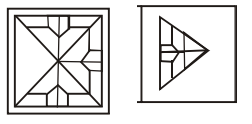
Correct Answer: Option (B)
⚡ Quick Exam Shortcut
Do not confuse the position of the blank with the direction of the missing shape.
- Locate the missing section on the left.
- Check where the pointed end must meet.
- The point must face the centre of the figure.
- Match the internal divisions.
Only Figure (2) points towards the centre and preserves the complete line pattern.
Shortcut Answer: Left-side blank + triangle pointing towards centre → Option (B).
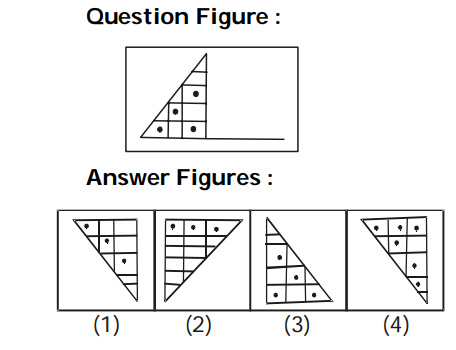
Which one of the answer figures shall complete the given question figure?
🔍 Analyze the Pattern
The given figure shows an incomplete triangular design. The missing portion must join the visible vertical edge and complete the triangular structure.
Step 1: Observe the Triangular Shape
The visible part has a slanting left boundary, a vertical side and several horizontal divisions.
The missing piece must fit against the vertical side and continue the figure in the correct direction.
Step 2: Match the Orientation
The required answer figure must have its vertical side on the left and its slanting boundary extending towards the lower-right.
This orientation matches Option (3).
Step 3: Check the Horizontal Divisions
The horizontal lines divide the triangle into different sections. These divisions must continue the pattern of the given figure.
Option (3) contains the required horizontal divisions in the correct arrangement.
Step 4: Check the Black Dots
The black dots are placed in selected sections of the triangular design.
The dot positions in Option (3) correctly continue the arrangement while completing the missing part.
Step 5: Compare the Options
- Figure (1) has the wrong triangular orientation.
- Figure (2) contains extra horizontal divisions and does not fit the given edge.
- Figure (3) correctly matches the orientation, divisions and dot arrangement.
- Figure (4) faces in the wrong direction and cannot join the given figure correctly.
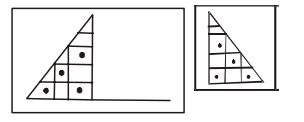
Correct Answer: Option (C)
⚡ Quick Exam Shortcut
In figure completion questions, check the joining edge and orientation first.
- Locate the open vertical edge.
- Find the option with the matching vertical joining side.
- Continue the horizontal divisions.
- Finally, verify the dot positions.
Only Figure (3) fits the given triangular figure correctly.
Shortcut Answer: Correct joining edge + triangular orientation + matching dots → Option (C).
Which answer figure will complete the question figure?
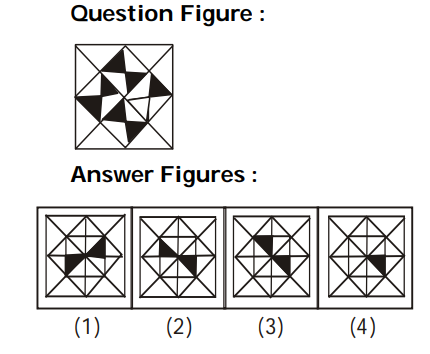
🔍 Analyze the Pattern
The question figure contains a square divided into several small triangular sections. Some of these triangles are already shaded black.
Step 1: Observe the Shaded Triangles
The black triangular portions are placed at different positions around the centre of the figure.
The missing figure must complete the pattern by filling the corresponding unshaded triangular sections.
Step 2: Superimpose the Answer Figure
Imagine placing each answer figure over the question figure.
The correct answer should complete the triangular arrangement without placing the new shaded portions incorrectly over the existing black triangles.
Step 3: Match the Remaining Triangular Sections
The shaded portions required to complete the design are positioned in the corresponding empty triangular regions.
This exact arrangement is found in Option (4).
Step 4: Compare the Options
- Figure (1) places a shaded triangle in an incorrect section.
- Figure (2) does not match the required complementary arrangement.
- Figure (3) shades the wrong central triangular section.
- Figure (4) correctly completes the triangular pattern.
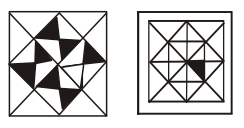
Correct Answer: Option (D)
⚡ Quick Exam Shortcut
For this type of figure completion question, use the superimposition method.
- Mark the black triangles already present.
- Identify the corresponding empty triangular sections.
- Mentally place each answer figure over the question figure.
- Select the option that completes the pattern without incorrect overlap.
Only Figure (4) gives the required complementary arrangement.
Shortcut Answer: Match the remaining triangular sections by superimposition → Option (D).