Let us Practice - All Latest Questions
Practice and master this topic with our carefully crafted questions.
In such problems, a figure following a particular sequence or pattern is given, in which a part, usually one-fourth, is left blank. This problem figure is followed by four alternative figures. One is required to choose the one which best fits into the blank space of problem figure so as to complete the original pattern.
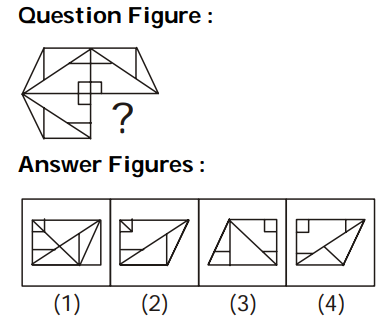
Which answer figure will complete the question figure?
🔍 Analyze the Pattern
The missing portion lies in the lower-right section of the figure.
Step 1: Observe the Central Square
A small square appears near the centre of the figure. The missing piece must contain the continuation of this square.
Step 2: Follow the Incoming Diagonal
A diagonal line enters the blank region from the left side and must continue smoothly through the missing piece.
Step 3: Match the Outer Shape
The missing part must fit the slanting outer boundaries of the figure while preserving all existing line continuations.
Step 4: Compare the Answer Figures
- Fig. (1) introduces extra internal lines.
- Fig. (3) places the square continuation incorrectly.
- Fig. (4) misaligns the diagonal structure.
- Fig. (2) correctly completes the square, diagonal and outer boundary.

Correct Answer: Option (B)
⚡ Quick Exam Shortcut
For figure completion questions:
- Locate any unique shape such as a square.
- Trace the incoming diagonals.
- Check whether the outer boundary fits correctly.
- Select the option that continues all lines naturally.
Only Fig. (2) satisfies all these conditions.
Shortcut Answer: Correct square continuation + diagonal alignment → Option (B).
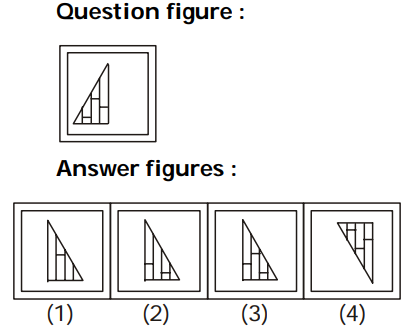
Which answer figure will complete the question figure?
🔍 Analyze the Pattern
The figure consists of a right-angled triangular shape divided into several rectangular sections.
Step 1: Observe the Existing Structure
The visible part contains:
- A vertical left boundary.
- A slanting right boundary.
- Multiple vertical partitions.
- Horizontal partitions forming rectangular blocks.
Step 2: Complete the Grid
The missing part must continue all the internal partitions without changing their spacing or orientation.
Step 3: Compare the Answer Figures
- Fig. (1) lacks some internal divisions.
- Fig. (2) does not complete all rectangular sections.
- Fig. (4) is rotated and does not fit the figure.
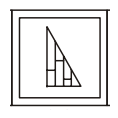
- Fig. (3) correctly continues every vertical and horizontal partition.
Correct Answer: Option (C)
⚡ Quick Exam Shortcut
For figure completion involving grids:
- Count the vertical partitions.
- Count the horizontal partitions.
- Match the exact triangular orientation.
- Reject rotated versions.
Only Figure (3) preserves the complete partition pattern.
Shortcut Answer: Correct triangular grid continuation → Option (C).
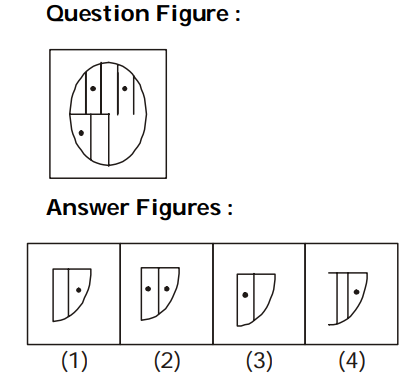
Which answer figure will complete the question figure?
🔍 Analyze the Pattern
The missing portion lies in the lower-left section of the oval figure.
Step 1: Follow the Boundary
The curved edge of the oval continues through the missing region and must join smoothly with the visible portion.
Step 2: Match the Internal Lines
The missing piece must align with:
- The vertical partition line.
- The horizontal segment at the top of the missing region.
Step 3: Check the Dots
The visible figure already contains three dots. The missing piece should not introduce an extra dot arrangement that breaks the pattern.
Only one additional dot is required in the missing region.
Step 4: Compare the Answer Figures
- Fig. (2) contains an unnecessary extra dot.
- Fig. (3) does not match the internal structure.
- Fig. (4) introduces extra line extensions.
- Fig. (1) correctly completes the boundary, partition and dot arrangement.
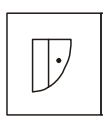
Correct Answer: Option (A)
⚡ Quick Exam Shortcut
For figure completion questions:
- Trace the outer boundary first.
- Match the internal partitions.
- Count only the symbols actually required in the missing region.
- Reject options that add unnecessary elements.
Only Fig. (1) completes the figure naturally.
Shortcut Answer: Correct boundary + correct dot count → Option (A).
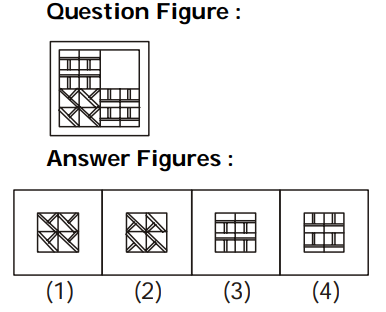
Which answer figure will complete the pattern in the question figure?
🔍 Analyze the Pattern
The top-right quadrant of the large square is missing.
Step 1: Observe the Pattern Types
Two different patterns appear in the figure:
- Grid pattern (horizontal and vertical divisions).
- Diagonal X-pattern.
Since the top-left and bottom-right quadrants contain grid patterns, the missing quadrant must contain the diagonal X-pattern.
Step 2: Check the Orientation
The missing quadrant is not an exact copy of the bottom-left quadrant.
The diagonal blocks must align correctly along the central boundaries of the large square.
Step 3: Compare the Answer Figures
- Figs. (3) and (4) contain grid patterns and are eliminated.
- Fig. (1) repeats the diagonal pattern without the required orientation change.
- Fig. (2) correctly aligns the diagonal blocks with the surrounding figure.
Correct Answer: Option (B)
⚡ Quick Exam Shortcut
When two options contain the same pattern type:
- Ignore the overall shape.
- Check the orientation of the smallest units.
- Match the lines touching the central boundaries.
- Select the option with perfect line continuity.
Only answer figure (2) satisfies the required orientation.
Shortcut Answer: Correct X-pattern orientation → Option (B).
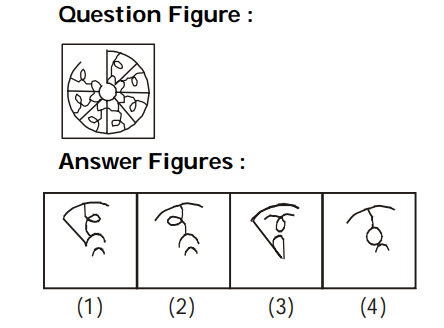
In each of the following questions which one of the answer figures shall complete the given question figure.
🔍 Analyze the Pattern
The circular figure is divided into eight sectors around a central flower-like shape. One sector is missing.
Step 1: Observe the Repeating Design
Each sector contains a combination of:
- An outer circular arc.
- A curved hook-like line.
- An oval-shaped element.
- Occasionally, a small rectangular element.
Step 2: Examine the Adjacent Sectors
The missing sector must continue the curved lines and maintain the arrangement of the neighboring sectors.
The oval should appear near the centre while the curved hook continues smoothly across the gap.
Step 3: Compare the Answer Figures
- Fig. (2) misplaces the internal shapes.
- Fig. (3) introduces an unnecessary rectangular element.
- Fig. (4) does not complete the pattern correctly.
- Fig. (1) matches the arc, oval and curved-line continuation perfectly.
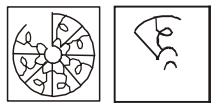
Correct Answer: Option (A)
⚡ Quick Exam Shortcut
For circular figure completion:
- Trace the outer arc first.
- Match the curved internal line.
- Check the position of the oval shape.
- Avoid options that introduce extra elements.
Only Fig. (1) completes the sector naturally.
Shortcut Answer: Correct arc + oval + curve continuation → Option (A).
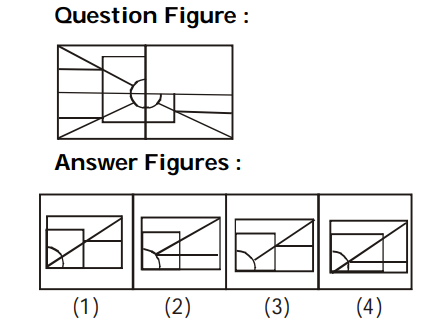
Which answer figure will complete the question figure?
🔍 Analyze the Pattern
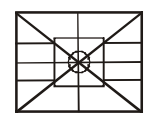
Answer figure (3) would complete the given figural pattern.
The complete pattern would appear as:
Correct Answer: Option (C)
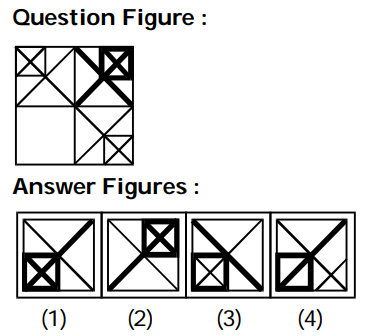
Which answer figure will complete the question figure?
🔍 Analyze the Pattern
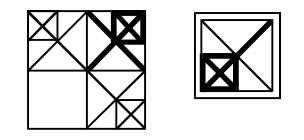
The Answer figure (1) would complete the given figural pattern.
Correct Answer: Option (A)
Which answer figure will complete the question figure?
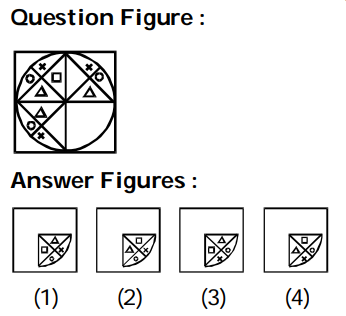
🔍 Analyze the Pattern
The bottom-right quadrant of the circular figure is missing.
Step 1: Observe the Symbol Arrangement
The figure contains four symbols:
- Circle (○)
- Cross (✕)
- Square (□)
- Triangle (△)
These symbols follow a fixed arrangement around the circle.
Step 2: Compare the Upper Quadrants
The top-right quadrant is obtained from the top-left quadrant by changing the positions of the symbols while maintaining the overall structure.
Step 3: Apply the Same Relation to the Lower Half
The bottom-right quadrant must be the corresponding counterpart of the bottom-left quadrant.
The diagonal divider and symbol sequence must remain consistent.
Step 4: Compare the Answer Figures
- Fig. (2) misplaces the square and triangle.
- Figs. (1) and (3) disturb the symbol order.
- Fig. (4) correctly preserves both the symbol arrangement and the geometric pattern.
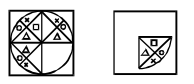
Correct Answer: Option (D)
⚡ Quick Exam Shortcut
For symbol-based figure completion:
- Track the position of each symbol.
- Compare corresponding quadrants.
- Verify the continuation of the diagonal divider.
- Select the option that preserves the complete arrangement.
Only Figure (4) satisfies all conditions.
Shortcut Answer: Correct symbol sequence + correct quadrant symmetry → Option (D).
Which answer figure will complete the question figure?
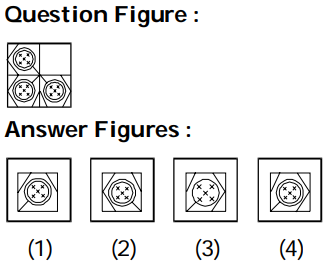
🔍 Analyze the Pattern
The top-right quadrant of the large square is missing.
Step 1: Observe the Common Structure
Each quadrant contains:
- A central circle with four X-marks.
- Two curved arrow-like segments around the circle.
The central circle remains unchanged in every quadrant.
Step 2: Track the Curved Segments
The curved segments rotate systematically around the large square.
The missing quadrant must continue this rotational arrangement.
Step 3: Compare the Answer Figures
- Fig. (1) does not align with the neighboring quadrants.
- Fig. (2) reverses the required orientation of the curved segments.
- Fig. (3) alters the internal arrangement.
- Fig. (4) correctly continues the curved-segment pattern.
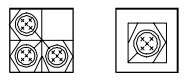
Correct Answer: Option (D)
⚡ Quick Exam Shortcut
Ignore the central circle because it is identical in all options.
- Focus on the curved arrow-like segments.
- Follow their rotation around the large square.
- Select the option that continues the sequence.
Only Figure (4) maintains the correct rotational pattern.
Shortcut Answer: Correct orientation of curved segments → Option (D).
Which answer figure will complete the question figure?
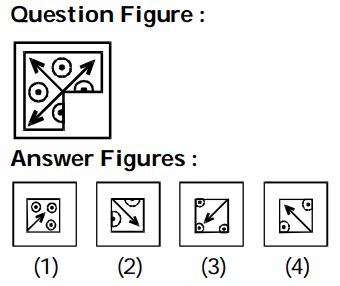
🔍 Analyze the Pattern
The missing portion lies in the bottom-right quadrant of the figure.
Step 1: Observe the Arrows
The arrows point away from the centre in four directions:
- Top-left → ↖
- Top-right → ↗
- Bottom-left → ↙
Therefore, the missing quadrant must contain an arrow pointing ↘.
Step 2: Continue the Circular Pattern
The circles with dots are distributed around the centre and continue across quadrant boundaries.
The missing piece must complete the visible circular arc.
Step 3: Compare the Answer Figures
- Figure (1) has the wrong arrow direction.
- Figures (3) and (4) introduce different symbols.
- Figure (2) correctly continues both the arrow and the circular pattern.
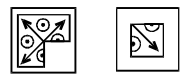
Correct Answer: Option (B)
⚡ Quick Exam Shortcut
For figure completion questions:
- Identify directional patterns.
- Track repeating symbols.
- Check line and arc continuation.
- Select the option matching all three.
Only Figure (2) satisfies every condition.
Shortcut Answer: ↘ arrow + correct circle continuation → Option (B).