
A few years ago, the idea of machines writing articles, creating artwork, or helping programmers write code seemed like something out of a science fiction movie. Today, it has become a reality.
AI tools such as ChatGPT, Gemini, and GitHub Copilot are now being used by millions of people for learning, coding, writing, research, and everyday work. Tasks that once required hours of human effort can sometimes be completed in just a few minutes.
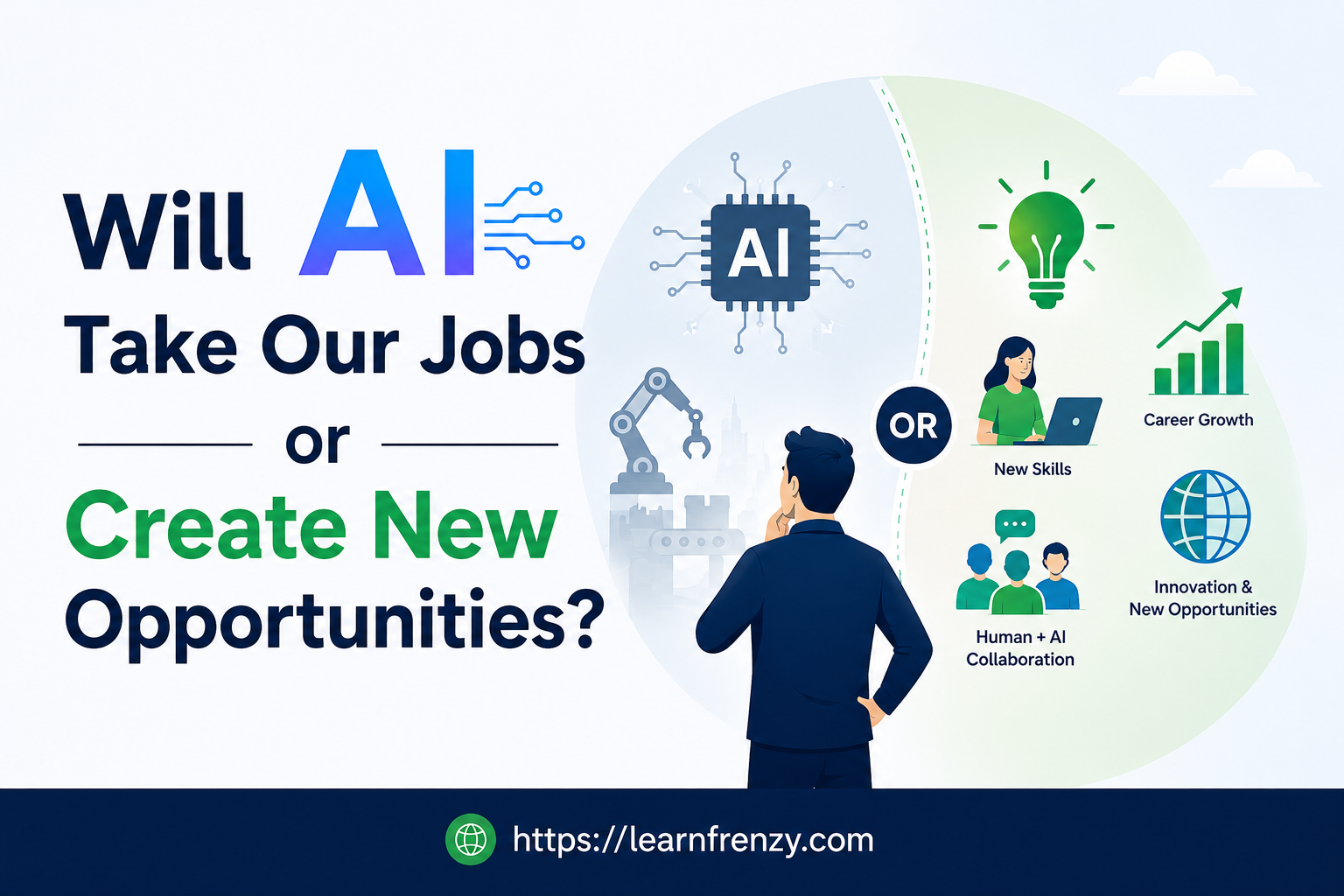
As AI continues to improve, one question keeps coming up: Will AI take our jobs?
Some people worry that automation will replace workers and reduce job opportunities. Others believe that AI will create new careers and help people work more efficiently. The truth is that AI is already changing the way we work, learn, and do business.
As a student, I have also wondered what the future job market will look like. When I first started using AI tools for learning and coding, I was amazed by how quickly they could complete certain tasks. At the same time, it made me think about how these technologies might affect future careers.
In this blog, I want to explore whether AI is really a threat to employment or a technology that could create new opportunities, and how students and professionals can prepare for the changes ahead.
The big question is not only whether AI can do our work. It is also how AI will change the type of work humans do in the future.
Why Are People Worried About AI?
One of the main reasons people are worried about AI is its ability to perform tasks that were once done only by humans.
Today, AI can write articles, answer questions, generate computer code, analyze large amounts of data, create images, summarize documents, and even automate customer support.
Tasks that might take a person several hours to complete can sometimes be finished by AI in just a few seconds.
Imagine spending years studying for a career and then discovering that some of the work you trained for can now be completed by a machine. This naturally creates concern about job security.
As AI becomes smarter and more capable, many people fear that companies may use technology to reduce costs by replacing employees with automated systems.
I think this fear is understandable. Whenever a major technology appears, people naturally wonder how it will affect their future.
However, this is not the first time technology has changed the way people work.
Technology Has Changed Jobs Before
If we look at history, almost every major technological change has affected jobs.
Machines transformed factories. Computers changed office work. The internet changed communication, shopping, banking, and business. Smartphones created completely new industries that barely existed before.
| Technology | How Work Changed |
|---|---|
| Industrial Machines | Automated many manual manufacturing tasks |
| Computers | Reduced paper-based and repetitive office work |
| Internet | Changed communication, shopping, and business |
| Smartphones | Created mobile apps and digital services |
| Artificial Intelligence | Automating repetitive knowledge-based tasks |
Some jobs disappeared or became less common, but new jobs were also created.
For example, the growth of the internet created careers in web development, digital marketing, cybersecurity, e-commerce, and social media management.
AI may follow a similar pattern. It could reduce the demand for certain tasks while creating opportunities in areas we are only beginning to understand.
Which Jobs Are Most Likely to Be Affected?
Some jobs are more vulnerable to automation than others, especially those that involve repetitive and predictable tasks.
Examples include:
- Data Entry Operators
- Basic Customer Support Roles
- Repetitive Manufacturing Jobs
- Basic Content Writing
- Simple Accounting Tasks
- Routine Administrative Work
These jobs are not disappearing overnight, but many of their routine tasks are already being automated.
For example, customer support chatbots can answer common questions without human intervention. Accounting software can automatically perform calculations and prepare basic reports. AI writing tools can generate product descriptions, short emails, and simple marketing content.
This does not always mean that the entire job disappears. In many cases, the job itself changes.
For example: A customer support employee may spend less time answering repeated questions and more time solving difficult customer problems that require human judgment.
Employees who rely only on repetitive work may need to learn new skills to stay competitive in the job market.
The important question may not be, "Can AI do my job?"
A better question is:
Which parts of my job can AI automate, and what new skills can make me more valuable?
Can AI Create New Opportunities?
While AI may replace certain tasks, it is also creating entirely new career opportunities.
The growing demand for AI technology has created roles such as AI Engineers, Machine Learning Engineers, Data Scientists, AI Researchers, AI Product Managers, and AI Automation Specialists.
Some of these careers were far less common just a few years ago.
AI is also creating opportunities for people who are not AI engineers.
A software developer can use AI to write code faster. A teacher can use AI to create learning materials. A marketing professional can use AI to research ideas and understand audiences. A designer can use AI to explore visual concepts.
| Profession | How AI Can Help |
|---|---|
| Software Developer | Generate code, explain errors, and speed up development |
| Teacher | Create learning materials and practice exercises |
| Doctor | Assist with medical data analysis |
| Designer | Explore ideas and create early visual concepts |
| Marketing Professional | Research audiences and generate campaign ideas |
When I look at how companies are using AI today, I do not see technology completely replacing people in every profession.
Instead, I see people using AI to complete routine work faster and spend more time on important decisions.
This makes me think that the future may belong to people who understand how to work with AI rather than those who completely ignore it.
AI May Change Jobs More Than It Replaces Them
One thing I have noticed while using AI tools is that getting an answer from AI does not always mean the work is finished.
For example, AI can generate code, but a developer still needs to understand the requirement, review the logic, test the solution, check security, and identify possible problems.
AI can write an article, but someone still needs to check whether the information is correct, whether the writing sounds natural, and whether the content is actually useful to readers.
In many situations, AI gives us a starting point. Human knowledge and judgment are still needed to turn that output into something reliable.
My view: AI may remove some repetitive tasks, but it can also give people more time to focus on creativity, decisions, and difficult problems.
Can AI Replace Humans Completely?
Although AI has become very advanced, it still has limitations.
AI can process information quickly, recognize patterns, and perform repetitive tasks efficiently. However, completely replacing human abilities is much more complicated.
Human qualities such as creativity, emotional intelligence, empathy, critical thinking, leadership, and ethical judgment remain important.
For example, a teacher does more than explain a lesson. A good teacher motivates students, understands when someone is struggling, and changes the teaching approach based on individual needs.
Similarly, doctors do more than analyze medical reports. Patients often need communication, trust, and emotional support during difficult situations.
Leaders also need to inspire teams, manage conflict, and make decisions when the available information is incomplete.
These situations require more than simply processing data.
AI and Humans Have Different Strengths
| AI Strengths | Human Strengths |
|---|---|
| Fast Data Processing | Creativity |
| Pattern Recognition | Empathy |
| Automation | Critical Thinking |
| Handling Large Amounts of Data | Leadership |
| Performing Repetitive Tasks | Ethical Judgment |
Instead of thinking about humans and AI as competitors, it may be better to think about how their strengths can work together.
AI can handle speed and scale. Humans can provide context, judgment, creativity, and responsibility.
What Should Students Do?
Instead of worrying constantly about whether AI will take jobs, students should focus on preparing themselves for a future where AI is part of everyday work.
Technology has always changed the way people work, and AI is no different. The key is to adapt and learn how to use it effectively.
Learn AI Tools
AI tools are becoming common in many industries. Students should take the time to understand tools such as ChatGPT, Gemini, GitHub Copilot, and other AI-powered applications related to their field.
However, learning AI tools does not mean depending on them for everything.
Students should understand where AI is useful, where it can make mistakes, and how to verify the information it provides.
A simple approach: Use AI to understand concepts, explore ideas, review your work, and improve productivity. Do not use it as a replacement for learning.
Build Projects and Gain Practical Experience
Having theoretical knowledge alone is often not enough.
Employers increasingly look for practical skills and real-world problem-solving ability. Building projects allows students to apply what they learn in the classroom and understand how things actually work.
Projects also help students develop confidence.
Even a small project can be valuable if you can clearly explain the problem you were trying to solve, the approach you followed, the challenges you faced, and what you learned.
AI can help during the project, but students should make sure they understand the final solution.
Improve Communication Skills
No matter how advanced AI becomes, communication will remain important in almost every profession.
Being able to explain ideas clearly, work with others, ask the right questions, and present solutions effectively can make a major difference in a career.
Good communication skills help during interviews, team discussions, client meetings, presentations, and leadership roles.
AI may help us write an email or prepare a presentation, but real human communication still requires confidence, understanding, and the ability to respond to people.
Develop Problem-Solving Skills
AI can assist with tasks, but humans still need to identify the right problems.
This is why students should focus on understanding why a problem exists instead of only memorizing the solution.
When using AI, instead of simply asking for the final answer, students can ask questions such as:
- Why does this solution work?
- Are there other ways to solve this problem?
- What are the limitations of this approach?
- What edge cases should I consider?
- How can this solution be improved?
Using AI in this way can make it a learning partner instead of just an answer generator.
Commit to Continuous Learning
Technology changes very quickly, and learning should not stop after graduation.
The tools we use today may look very different five years from now.
Students who stay curious and continue developing new skills will be better prepared for future opportunities.
Taking online courses, building personal projects, attending workshops, reading technology blogs, and exploring new tools can help students remain competitive.
In my opinion, the best way for students to prepare for the future is not to fear AI but to understand it.
Those who continue learning and adapting will have a better chance of finding new opportunities as technology evolves.
Will AI Take Our Jobs? My Perspective
I do not think there is a simple yes or no answer.
AI will probably automate some jobs and reduce the need for certain repetitive tasks. At the same time, it will change existing careers and create completely new opportunities.
The same job may look very different in the future.
A developer may spend less time writing basic code and more time reviewing AI-generated solutions and designing systems. A teacher may use AI to prepare lessons but spend more time helping individual students. A business professional may automate reports and focus more on strategy.
The bigger risk may not be AI itself. The bigger risk could be refusing to learn how technology is changing your industry.
Maybe the future is not AI vs Humans.
Maybe it is about humans learning how to work effectively with AI.
Conclusion
AI is growing very quickly, and this has made many people think seriously about what the future of jobs will look like.
While AI can automate certain tasks and change the way some jobs are performed, it is also creating new opportunities and helping people become more productive.
Instead of seeing AI only as a threat, we should also understand how it can be used as a tool to work smarter.
The skills that will continue to matter are creativity, communication, problem-solving, adaptability, and a willingness to keep learning.
As a student, I believe that learning how to use AI is more useful than simply fearing it. Technology will continue to evolve, and those who are willing to learn and adapt will be better prepared for the future.
In the end, AI is changing the way people work, but it is still up to us to decide how we learn, adapt, and use technology to create new opportunities.
💬 What Do You Think?
Do you think AI will replace more jobs, or will it create better career opportunities? Share your thoughts and experiences in the comments.
Comments (0)
What others are saying about this article
No Comments Yet
Be the first to share your thoughts on this article.
Leave a Comment
Share your thoughts and join the discussion