
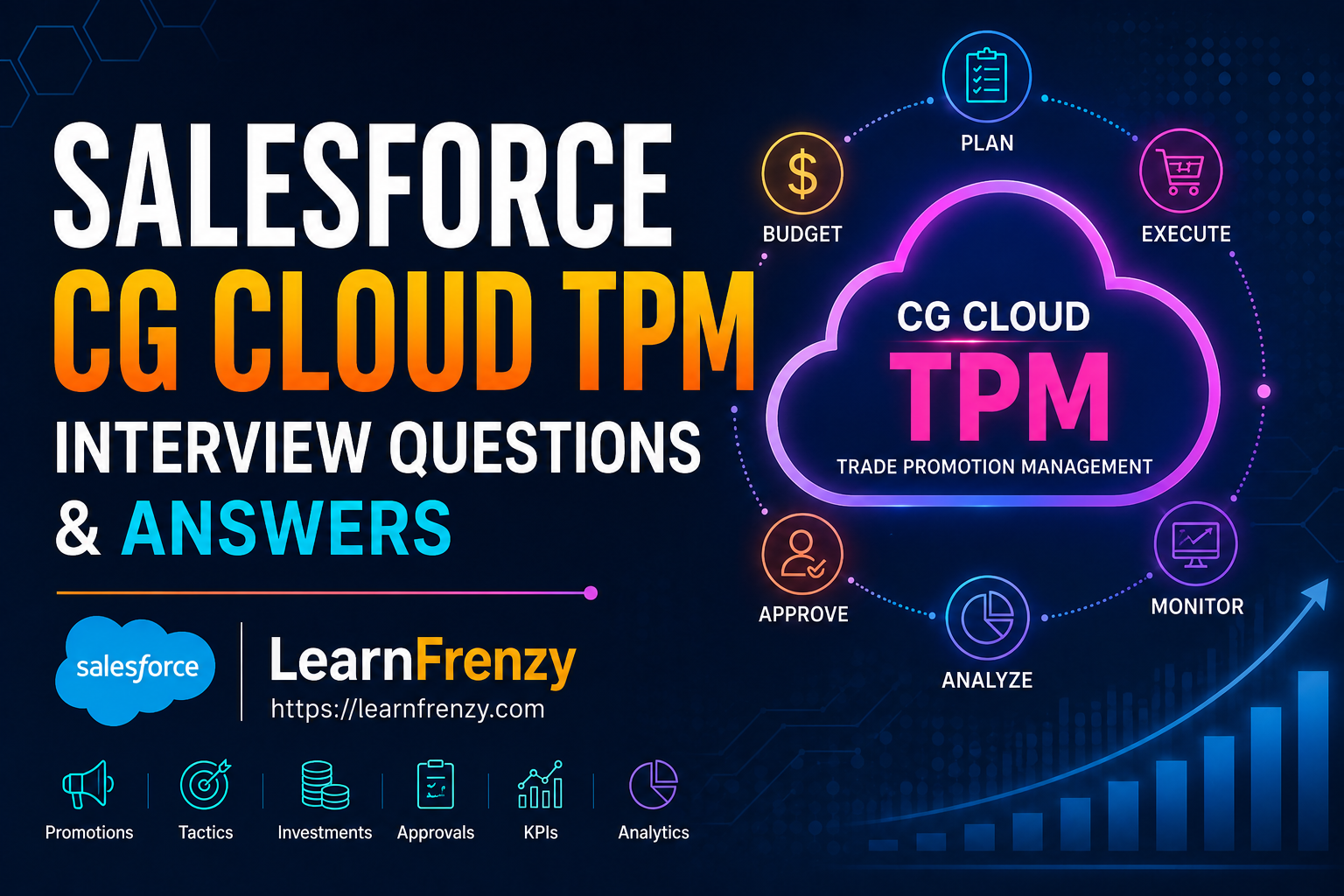
Salesforce Consumer Goods Cloud Trade Promotion Management (CG Cloud TPM) has become one of the fastest-growing specialisations in the Salesforce ecosystem, especially for organisations operating in the FMCG, Retail, Beverage, and Consumer Goods industries. Leading global brands such as Coca-Cola, PepsiCo, Nestlé, Unilever, Mondelez, and many international distributors rely on CG Cloud TPM to plan promotions, manage trade investments, forecast sales, improve retailer collaboration, and measure promotion performance.
As more organisations modernise their trade promotion processes, the demand for skilled Salesforce CG Cloud TPM Developers, Consultants, Technical Leads, and Solution Architects continues to grow. Companies are looking for professionals who not only understand Salesforce development but also have practical knowledge of trade promotion management and enterprise business processes.
Unlike traditional Salesforce interviews that focus mainly on Apex, Lightning Web Components, and platform fundamentals, CG Cloud TPM interviews are far more business-oriented. Interviewers expect candidates to explain the complete promotion lifecycle, promotion templates, tactics, trade investments, approval workflows, integrations, performance optimisation, and real-world implementation scenarios. For experienced professionals, interviews often include architecture discussions, troubleshooting production issues, and enterprise solution design.
In this comprehensive interview guide, you'll find 75+ carefully selected Salesforce CG Cloud TPM interview questions and detailed answers covering beginner, intermediate, and advanced topics. Every question is explained using practical examples, business scenarios, and interview-focused tips to help you prepare confidently for Salesforce CG Cloud TPM interviews in 2026 - 2027.
What You'll Learn
- CG Cloud TPM fundamentals
- Promotion lifecycle and business process
- Promotion Templates and Tactics
- Trade Investments and KPIs
- Group Promotions and Child Promotions
- Push Promotions
- Approval workflows
- Batch Apex and asynchronous processing
- Apex and Lightning Web Components (LWC)
- Enterprise integration architecture
- Performance optimisation techniques
- Enterprise best practices
- Scenario-based interview questions
💡 Who Should Read This Guide?
- Salesforce Developers preparing for CG Cloud TPM interviews
- Consumer Goods Cloud Consultants
- Salesforce Administrators moving into TPM projects
- Technical Leads and Solution Architects
- Freshers learning Salesforce Consumer Goods Cloud
- Experienced professionals preparing for enterprise-level interviews
Interview Question Categories
| Questions | Topic | Experience Level |
|---|---|---|
| Q1 – Q10 | CG Cloud TPM Fundamentals | Freshers |
| Q11 – Q20 | Functional & Technical Concepts | 1–4 Years |
| Q21 – Q30 | Enterprise & Scenario-Based Questions | Senior Developer / Technical Lead / Solution Architect |
Why These Interview Questions Matter
Many candidates spend weeks memorising definitions but struggle when interviewers ask practical implementation questions. Enterprise Salesforce interviews are designed to evaluate how you solve business problems, design scalable solutions, and customise CG Cloud TPM to meet complex organisational requirements.
Some of the most frequently asked questions include:
- How do Group Promotions generate Child Promotions?
- How does Push Promotion work?
- How do you customise Promotion Templates?
- How would you optimise performance when thousands of promotions are processed every day?
- How do you troubleshoot approval or integration issues in Production?
- When should you choose Flow over Apex?
- How do you secure promotion data across multiple Sales Organisations?
Throughout this guide, you'll learn not only the correct answers but also the reasoning behind them. Each question is explained with practical business examples, implementation insights, and interview tips that reflect the types of discussions commonly held during enterprise Salesforce CG Cloud TPM interviews.
Instead of memorising answers, focus on understanding why a feature exists, how it is implemented, and what business problem it solves. Interviewers consistently prefer candidates who can connect Salesforce technology with real business scenarios.
✨ Let's Begin
We'll start with CG Cloud TPM Fundamentals (Q1–Q10), covering the core concepts every Salesforce Consumer Goods Cloud professional should understand before moving on to advanced enterprise implementation topics.
1. What is Salesforce Consumer Goods Cloud Trade Promotion Management (CG Cloud TPM)?
Answer:
Salesforce Consumer Goods Cloud Trade Promotion Management (CG Cloud TPM) is a Salesforce solution designed specifically for Consumer Packaged Goods (CPG) companies to manage the complete lifecycle of trade promotions. It helps organisations plan, execute, fund, settle, and analyse promotional activities while improving collaboration between manufacturers and retailers.
CG Cloud TPM brings together budgeting, account planning, promotion execution, claims management, and post-promotion analytics into a single integrated platform, enabling organisations to maximise promotional ROI and improve decision-making.
Mention that TPM is not just a promotion management tool. It connects planning, funding, execution, settlement, and analytics within one end-to-end business process, which is exactly what interviewers expect to hear.
2. Explain the TPM Closed Loop Process.
Answer:
The TPM Closed Loop Process represents the complete lifecycle of a trade promotion, ensuring that budgets, promotions, execution, and business outcomes remain connected throughout the planning and settlement process.
| Step | Description |
|---|---|
| Strategic Planning | Define annual business goals and promotional strategy. |
| Funds Management | Allocate promotional budgets and manage available funds. |
| Account Planning | Create customer business plans and sales targets. |
| Promotion Planning | Create promotions, tactics, and promotional investments. |
| Promotion Execution | Execute promotions in the market. |
| Claims & Settlement | Process deductions, claims, and promotional payments. |
| Post Event Analysis | Measure promotion effectiveness using KPIs and ROI. |
The Closed Loop Process ensures every promotion can be planned, funded, executed, settled, and analysed using a single connected business workflow.
3. What is the difference between Fixed Funding and Rate-Based Funding (RBF)?
Answer:
CG Cloud TPM supports multiple funding models depending on business requirements. The two most commonly used are Fixed Funding and Rate-Based Funding (RBF).
| Fixed Funding | Rate-Based Funding (RBF) |
|---|---|
| Budget is allocated manually. | Budget grows automatically based on business performance. |
| Uses Initial Deposit, Adjustment, Transfer and Drawback transactions. | Funding is earned from sales volume or revenue. |
| Budget changes only through fund transactions. | Budget updates automatically. |
| Suitable for predefined promotional budgets. | Suitable for performance-based funding. |
Example:
- ₹5 per case sold
- 2% of total sales revenue
Explain that Rate-Based Funding automatically earns promotional funds based on actual business performance, while Fixed Funding depends on manually maintained budgets.
4. To what levels can a Fund be anchored?
Answer:
A Fund can be anchored at different business levels depending on how promotional budgets are managed within an organisation.
- Customer
- Category
- Brand
- Customer + Category
- Customer + Brand
This flexible anchoring enables organisations to control promotional spending across multiple business dimensions while maintaining accurate financial governance.
5. What is a Customer Business Plan (CBP)?
Answer:
A Customer Business Plan (CBP) is a planning workspace used to prepare long-term customer strategies before promotions are created. It enables business teams to forecast demand, align budgets, and define customer-specific objectives.
Key capabilities include:
- Baseline volume adjustments
- Account target planning
- Scenario planning
- Editable KPIs
CBP helps organisations prepare long-term account strategies before promotions are planned, ensuring budgets and sales objectives remain aligned.
6. What is the difference between Customer Business Plan (CBP) and Account Plan View?
Answer:
Although both are used for account planning, they serve different business purposes.
| Customer Business Plan (CBP) | Account Plan View |
|---|---|
| Editable KPIs | Mainly reporting and analysis |
| Baseline adjustments | Aggregated business results |
| Scenario planning | Account Profit & Loss review |
| Manual business inputs | Mostly calculated values |
In simple terms, CBP is used for planning, whereas Account Plan View provides visibility into business performance.
7. What is the Trade Calendar?
Answer:
The Trade Calendar is a visual planning console that enables Key Account Managers (KAMs) to manage promotional activities using a Gantt-style calendar interface.
Using the Trade Calendar, users can:
- View promotions
- Create promotions
- Copy promotions
- Derive promotions
- Analyse promotion KPIs
- Access Account Profit & Loss
Promotions can be grouped by customer, product, slogan, or group text, making it easier to manage multiple promotional activities across different business units.
8. What is the minimum and maximum timeframe supported in the Trade Calendar?
Answer:
The Trade Calendar supports flexible planning periods for both operational and strategic planning.
| Planning Window | Duration |
|---|---|
| Minimum | 3 Months |
| Maximum | 18 Months |
This allows business users to plan short-term campaigns while maintaining visibility into long-term promotional strategies.
9. What are KPI Definition Types in CG Cloud TPM?
Answer:
CG Cloud TPM provides multiple KPI Definition Types that support calculations, validations, manual input, and business analytics across promotions, funds, claims, and customer planning.
| KPI Type | Purpose |
|---|---|
| Read | Retrieves data from databases or external interfaces. |
| Calculated | Uses formulas to calculate values. |
| Editable | User enters values manually. |
| Editable Calculated | Formula with manual override capability. |
| Compound | Groups interdependent KPIs. |
| Validation | Applies business validation rules. |
Interviewers often ask about Compound KPIs because they demonstrate how multiple KPIs automatically update one another during planning.
10. What is a Claim in CG Cloud TPM?
Answer:
A Claim represents a payment request related to promotional activities. Claims are used during the financial settlement phase of the promotion lifecycle.
Common claim types include:
- Deductions
- Credit Memos
- Check Requests
Claims can be:
- Created manually
- Imported from external ERP systems
- Linked to promotion tactics and funds
- Approved through workflow processes
- Settled after validation
Claims complete the financial settlement process by ensuring promotional investments are accurately reimbursed and tracked.
11. What are the key TPM objects a consultant must understand?
Answer:
A Salesforce CG Cloud TPM Consultant should have a solid understanding of the core business objects that support planning, budgeting, promotions, claims, and reporting.
Core TPM Objects
- Sales Organization
- Customer
- Customer Extension
- Product
- Product Assortment
- Fund
- Rate-Based Funding
- Customer Business Plan (CBP)
- Account Plan View
- Promotion
- Tactic
- Claim
- KPI Definition
- KPI Set
- Trade Calendar
Together, these objects enable organisations to manage the complete trade promotion lifecycle from strategic planning through financial settlement and post-event analysis.
⭐ Bonus Interview Question
What is a Compound KPI and when would you use it?
Answer:
A Compound KPI acts as a container for multiple KPIs that are mathematically dependent on one another. When one KPI changes, the remaining KPIs are automatically recalculated to maintain consistency.
A common example is the Volume Planning Card, where the following KPIs are interrelated:
- Incremental Volume
- Uplift Percentage
- Total Volume
If a user updates one of these values, Salesforce automatically recalculates the remaining KPIs using the predefined business formulas.
For experienced-level interviews, always support your answers with a real business scenario. Interviewers value practical implementation knowledge more than memorised definitions.
Intermediate & Advanced CG Cloud TPM Interview Questions
The following interview questions focus on configuration, business processes, troubleshooting, KPI management, fund management, and enterprise implementation scenarios. These topics are frequently asked in interviews for Senior Salesforce Developers, CG Cloud TPM Consultants, Technical Leads, and Solution Architects.
12. How is an Account Product List (APL) generated in CG Cloud TPM?
Answer:
An Account Product List (APL) determines which products are available for planning and promotions for a particular customer. CG Cloud TPM supports two approaches for generating an APL depending on business requirements.
| APL Type | Description |
|---|---|
| Global Product List | Automatically generated using Baseline Data, Conditions, Actuals and Promotions. |
| Time-Dependent Product List | Generated from Planning Assortments with validity periods and optional manual product additions. |
Remember that Global APL is system generated, while Time-Dependent APL is driven by Planning Assortments and provides greater flexibility for changing product portfolios.
13. What is the difference between a Global and Time-Dependent Account Product List?
Answer:
Although both Account Product Lists serve the same purpose, they differ significantly in how products are maintained and managed.
| Global APL | Time-Dependent APL |
|---|---|
| System generated | Driven by Planning Assortments |
| Manual product additions are not supported | Manual product additions are allowed |
| Based on Processing Engine data | Based on Planning Assortments |
| Simpler to maintain | More flexible for changing product portfolios |
Global APL is ideal when product assortments remain relatively stable, whereas Time-Dependent APL is preferred for businesses where products change frequently throughout the year.
14. Explain the different Fund Transaction Types.
Answer:
Fund Transactions are used to manage promotional budgets throughout their lifecycle. CG Cloud TPM supports four primary transaction types.
| Transaction Type | Purpose |
|---|---|
| Initial | Creates the initial promotional budget. |
| Transfer | Moves available budget between funds. |
| Adjustment | Corrects fund balances by increasing or decreasing available budget. |
| Drawback | Removes previously allocated funds. |
Each transaction updates the current fund balance and ensures accurate tracking of promotional investments.
15. How can a company allow Fund Overspending?
Answer:
CG Cloud TPM allows organisations to configure controlled fund overspending through the Customer Extension.
A customer can be assigned an Overdraw Threshold, allowing promotions to exceed the currently available budget by a predefined amount.
Fund overspending is commonly enabled when the business expects future Rate-Based Funding (RBF) earnings that will replenish promotional budgets after sales are completed.
16. What are KPI Sets and KPI Definitions?
Answer:
KPIs are central to reporting and business planning within CG Cloud TPM. They are organised using KPI Definitions and KPI Sets.
KPI Definition
A KPI Definition specifies the behaviour of an individual KPI, including:
- Formula
- Display behaviour
- Aggregation logic
- Data source
- Editability
KPI Set
A KPI Set is a collection of related KPI Definitions assigned to a specific business process.
Examples include:
- Promotion KPI Set
- Account Plan KPI Set
- Rate-Based Funding KPI Set
- Claims KPI Set
Templates reference KPI Sets to determine which KPIs appear within different business processes.
17. Which KPI Set usages are available in CG Cloud TPM?
Answer:
Each business process uses a dedicated KPI Set. Supported usages include:
- Promotion
- Plan
- Funding
- Rate-Based Funding
- Payment (Claims)
- Reporting
Whenever you configure Promotion Templates or Account Plans, ensure the correct KPI Set is associated with that business process.
18. What is a KPI Writeback?
Answer:
A KPI Writeback stores calculated KPI values back into Salesforce or Processing Services tables so they can be reused by other business processes.
Common examples include:
- Promotion results becoming available in the Account Plan.
- Customer Business Plan (CBP) adjustments appearing within Promotions.
- Promotion KPIs exported for Reporting and Analytics.
Without KPI Writebacks, downstream processes cannot access or reuse calculated KPI values.
19. What is a KPI Map and why is it used?
Answer:
A KPI Map connects a KPI Definition with a Salesforce field, allowing calculated KPI values to be written back into Salesforce records.
KPI Maps are commonly used for:
- Reporting
- List Views
- Dashboards
- Integrations
Whenever KPI Maps are modified, execute SF Data Sync to ensure Processing Services and Salesforce remain synchronised.
20. Explain Promotion Copy, Derive, and Push.
Answer:
CG Cloud TPM provides several methods for creating related promotions.
| Feature | Description |
|---|---|
| Copy | Creates a completely new and independent promotion. |
| Derive | Creates a new promotion while maintaining a relationship with the original promotion. |
| Push | Distributes promotion information from a higher-level promotion to lower-level promotions. |
These capabilities simplify promotion planning across multiple customers, regions and sales organisations.
21. What is Sub-Account Planning?
Answer:
Sub-Account Planning enables a Key Account Manager (KAM) to distribute promotion volumes across multiple sub-accounts belonging to the same customer.
Prerequisites include:
- Sub-Account Planning enabled on the Promotion Template.
- Sub-accounts assigned to the customer.
- Volume distribution percentages configured.
KPI formulas use these percentage allocations to calculate promotion volumes for each individual sub-account.
22. What happens during Claim Approval?
Answer:
Before approving a Claim, CG Cloud TPM validates several business rules to ensure financial accuracy.
The system verifies:
- Claim balance equals zero.
- Tactic allocations are complete.
- Required fund assignments exist.
- The Claim is currently in the correct status.
Typical Claim Lifecycle
| Open | Submitted for Approval | Approved | To Be Closed | Closed |
Claims may also be Rejected, Recalled, or Adjusted depending on business requirements and approval workflows.
⭐ Expert-Level Scenario Interview Question
23. A customer says Customer Business Plan (CBP) adjustments are not visible in the Account Plan. What would you check?
Answer:
This is a common production support and troubleshooting scenario that tests both functional and technical knowledge.
I would verify the following:
- Customer Business Plan adjustments have been saved successfully.
- The Editable KPI is configured correctly.
- The required KPI Writeback exists.
- The KPI is included in the assigned KPI Set.
- The KPI calculation batch has completed successfully.
- Processing Services and Salesforce Data Synchronisation have completed.
- The correct Business Year and Customer filters are selected.
- The Account Plan references the appropriate Plan KPI Set.
In many production environments, the issue occurs because the KPI calculation or writeback process has not executed after the Customer Business Plan adjustment was saved.
Senior Consultant & Solution Architect Interview Questions
The following questions are commonly asked in interviews for CG Cloud TPM Technical Lead, Solution Architect, Enterprise Consultant, and Subject Matter Expert (SME) roles. These questions evaluate your ability to design scalable TPM solutions, troubleshoot enterprise implementations, optimise performance, and align Salesforce technology with complex business processes.
24. How would you design a TPM solution for a customer that plans promotions at National level but executes at Store level?
Answer:
For enterprise organisations, promotion planning is often centralised while execution happens across multiple regions or stores. The recommended architecture should support both central governance and local flexibility.
I would use the following components:
- Parent Promotions at the National level
- Child Promotions for Regional or Store execution
- Multi-Level Promotion Planning
- Push and Derive functionality
- Customer Hierarchies
- Sub-Account Planning
The National team creates the master promotion, while Regional teams derive Child Promotions for local execution. Future updates can be distributed using Push, ensuring consistency while still allowing region-specific changes where required.
25. A customer wants different KPI visibility for Finance, KAM, and Sales Director. How would you design it?
Answer:
Different business users require different KPI views even though they use the same promotion data. Rather than creating separate calculations, CG Cloud TPM provides configurable KPI visibility.
I would configure:
- KPI Subsets
- User Settings
- KPI Sets
| User Role | Visible KPIs |
|---|---|
| Key Account Manager (KAM) | Volume, Revenue, ROI |
| Finance | Spend, Claims, Margin |
| Sales Director | Revenue, Profit, Gap-to-Target |
KPI Subsets control visibility only. They do not change KPI calculations, making them ideal for role-based dashboards and user experiences.
26. How would you determine whether a KPI should be Read, Editable, or Calculated?
Answer:
Choosing the correct KPI type is an important design decision because it directly affects usability, maintenance, and system performance.
| KPI Type | When to Use | Example |
|---|---|---|
| Read | Data originates from SAP, Nielsen or another external system. | Actual Volume |
| Editable | Business users manually enter values. | Planned Display Cost |
| Calculated | Values are generated through formulas. | ROI |
| Editable Calculated | Formula-generated value with manual override capability. | Forecast Sales |
Selecting the wrong KPI type can introduce unnecessary maintenance, inaccurate reporting, and poor application performance.
27. Explain the complete Promotion Calculation Flow.
Answer:
Promotion calculations follow a structured process where user inputs, external data, formulas, and writebacks work together to generate business results.
Promotion Calculation Flow
- User enters promotion inputs.
- Editable KPIs store planning values.
- Read KPIs retrieve Baseline, Conditions and Actual Sales.
- Processing Engine executes business formulas.
- Calculated KPIs generate promotion results.
- KPI Writebacks store calculated values.
- Account Plan and Reporting consume the results.
The Processing Engine acts as the central calculation service responsible for executing all KPI calculations across the TPM platform.
28. What would you review if Promotion ROI is incorrect?
Answer:
Incorrect ROI values usually indicate issues with the underlying data rather than the ROI formula itself.
I would validate the following:
- KPI Formula
- KPI Set Assignment
- Product Assortment
- Baseline Data
- Price Conditions
- Spend Planning Data
- KPI Writebacks
- Batch Calculation Status
- Processing Engine Synchronisation
Most Promotion ROI issues originate from incorrect source KPIs or missing calculation batches, not from errors in the ROI formula itself.
29. How would you handle a customer with 500+ planning accounts requiring Rate-Based Funding?
Answer:
Managing hundreds of individual Rate-Based Funding (RBF) records quickly becomes difficult and increases maintenance effort.
A scalable solution would include:
- Create a Parent Rate-Based Funding record.
- Use RBF Distribution.
- Push rates through the Customer Hierarchy.
- Allow protected overrides for selected accounts.
This architecture significantly reduces administration while still supporting customer-specific exceptions where necessary.
30. How would you design Baseline Adjustment Management?
Answer:
Baseline adjustments should be managed before promotions are planned to ensure forecasting and KPI calculations remain accurate.
I would use:
- Customer Business Plan (CBP)
- Editable KPIs
- KPI Writebacks
- Account Plan Integration
Typical baseline adjustments include:
- New Store Openings
- Product Delistings
- Seasonality Changes
- Distribution Gains or Losses
Customer Business Plan (CBP) should serve as the controlled planning layer before any promotion is created, ensuring that baseline assumptions remain consistent throughout the planning cycle.
31. A customer wants Actual Sales from SAP available in Promotions and Account P&L. What would you design?
Answer:
The recommended architecture integrates SAP sales data into Processing Services, making it available for Promotion KPIs, Account Planning and Reporting.
Recommended Integration Architecture
SAP
   ↓
Integration API
   ↓
Processing Services
   ↓
Read KPI
   ↓
Promotion P&L
   ↓
Account Plan
   ↓
Reporting
Actual Sales are loaded into Processing Services Measure Tables and consumed through Read KPIs, allowing the same data to be reused across multiple TPM processes.
32. What are the most common performance issues in TPM projects?
Answer:
Performance challenges typically arise from design decisions rather than platform limitations.
Common causes include:
- Too many KPI Definitions
- Excessive KPI Writebacks
- Large Product Assortments
- Complex Customer Hierarchies
- Unnecessary KPI Visibility
- Large Promotion Product Counts
- Poor Integration Design
One of the most valuable activities during a TPM implementation workshop is KPI Rationalisation, ensuring that only business-critical KPIs are configured and calculated.
33. Explain the complete Claims Settlement Process.
Answer:
Claims Settlement represents the financial closure of promotional activities and ensures trade investments are correctly reimbursed.
Claims Settlement Flow
Promotion Execution
        ↓
Claim Creation
        ↓
Link Tactics
        ↓
Fund Validation
        ↓
Approval Workflow
        ↓
To Be Closed
        ↓
Closed
        ↓
ERP Settlement
A Claim may contain:
- One Tactic
- Multiple Tactics
- Multiple Funds
Multiple Claims may also be combined to simplify settlement and financial processing.
34. Design Question: A customer wants to track Promotion Effectiveness. What KPIs would you recommend?
Answer:
An effective Promotion Performance Dashboard should measure sales impact, promotional spending, profitability, retailer performance, and overall business success.
| KPI Category | Recommended KPIs |
|---|---|
| Volume KPIs | Base Volume, Incremental Volume, Total Volume |
| Revenue KPIs | Gross Revenue, Net Revenue |
| Spend KPIs | Fixed Spend, Variable Spend, Total Spend |
| Profitability KPIs | Gross Profit, Margin %, ROI |
| Retail KPIs | Scan Sales, Lift %, Distribution |
| Management KPIs | Gap-to-Target, Customer Profitability, Fund Utilisation |
This KPI framework provides complete visibility across strategic planning, promotion execution, financial performance, and post-event analysis.
⭐ Architect-Level Interview Question
35. If you were starting a CG Cloud TPM implementation from scratch, what would be your design sequence?
Answer:
A successful enterprise implementation begins with business foundations before moving into configuration and development.
Recommended Implementation Sequence
- Sales Organisation Design
- Master Data Design
- Customer Hierarchy Design
- Product Hierarchy Design
- Assortment Strategy
- Fund Strategy
- KPI Design Workshop
- Account Planning Design
- Promotion Design
- Claims Design
- Integration Design
- Reporting Design
- Security Model
- Performance Testing
- User Acceptance Testing (UAT)
Most TPM implementation failures occur because KPI design, Master Data strategy, and Integration Architecture are finalised too late. These foundational components should always be completed before Promotion configuration and development begin.
Architect-Level CG Cloud TPM Interview Questions
These interview questions focus on enterprise solution architecture, implementation strategy, discovery workshops, performance optimisation, governance, and real-world production scenarios. They are commonly asked during interviews for CG Cloud TPM Solution Architect, Enterprise Consultant, TPM Lead, and Technical SME roles.
36. A customer wants promotion funding to come from multiple budgets. How would you design it?
Answer:
Many enterprise promotions require investments from different budget sources. Instead of creating separate promotions, CG Cloud TPM supports allocating multiple funds within a single promotion while maintaining financial visibility and governance.
I would leverage the following capabilities:
- Multiple Funds
- Fund Assignment Rules
- Multi-Fund Transactions
- Tactic-Level Fund Assignment
| Fund | Purpose |
|---|---|
| MDF Fund | Display and merchandising activities. |
| TPR Fund | Price discounts and promotional pricing. |
| Innovation Fund | New product launches and innovation campaigns. |
A single promotion should be capable of consuming budgets from multiple funds while preserving complete spend visibility, financial control, and auditability.
37. How would you design a TPM model for annual planning and weekly execution?
Answer:
An effective TPM implementation separates long-term planning from operational execution. This allows strategic planning to remain stable while supporting frequent promotional activities throughout the year.
| Annual Planning Layer | Execution Layer |
|---|---|
| Strategic Targets | Promotions |
| Account Plans | Tactics |
| Customer Business Plans (CBP) | Claims |
| Fund Budgets | Post Event Analysis |
This layered approach enables organisations to maintain long-term business objectives while providing flexibility for weekly promotional execution.
38. When would you use Global APL versus Time-Dependent APL?
Answer:
The choice between Global APL and Time-Dependent APL depends primarily on how frequently product assortments change.
| Global APL | Time-Dependent APL |
|---|---|
| Stable product portfolio. | Seasonal product ranges. |
| Minimal assortment changes. | New product launches. |
| Simpler administration. | Retailer-specific product listings. |
| Suitable for predictable catalogues. | Frequent assortment updates. |
Most enterprise CG Cloud TPM implementations prefer Time-Dependent APL because retailer assortments and product availability change frequently throughout the year.
39. A customer asks, "Can we load five years of historical actuals?" What would you discuss?
Answer:
Rather than immediately agreeing, an architect should first understand how the historical data will be used and assess its impact on performance and storage.
I would review the following:
- Processing Services storage requirements.
- Reporting requirements.
- KPI calculation performance.
- Historical data usage within planning.
Discovery Questions:
- Will the historical data be used for planning?
- Is it required only for reporting?
- Is weekly or monthly granularity required?
Many organisations use only recent historical data for planning while retaining older data in reporting platforms or data warehouses.
40. How would you design a Promotion Approval Process?
Answer:
Promotion approvals should reflect business governance policies rather than technical limitations.
Typical approval criteria include:
- Promotion Spend
- ROI Threshold
- Promotion Type
- Customer
- Funding Availability
Example Approval Flow
ROI > 20%
      ↓
Automatic Approval

ROI < 20%
      ↓
Sales Manager Approval

Spend > £100K
      ↓
Finance Approval
The workflow should always align with the customer's approval hierarchy and financial governance model.
41. How would you troubleshoot missing products in a Promotion?
Answer:
Missing products generally indicate an issue with product availability, master data, or Account Product List generation.
I would verify:
- Account Product List (APL)
- Planning Assortments
- Product Hierarchy
- Product Validity Dates
- Customer Access
- Sales Organisation Assignment
- User Permissions
In most production environments, the product was never included during the Account Product List generation process.
42. How would you design KPI architecture for a large global TPM implementation?
Answer:
A scalable KPI architecture promotes reuse, simplifies maintenance, and supports both global and regional business requirements.
| KPI Category | Examples |
|---|---|
| Core Global KPIs | Revenue, Volume, Spend, ROI |
| Regional KPIs | Country-specific calculations and local business metrics |
| Reporting KPIs | RTR Exports and Executive Reporting |
| Planning KPIs | Customer Business Plan (CBP) and Account Planning |
Avoid creating duplicate KPI Definitions. Instead, reuse existing KPI Definitions through multiple KPI Sets whenever possible.
43. Explain the difference between KPI Set and KPI Subset.
Answer:
Although both are related to KPI management, they serve completely different purposes within CG Cloud TPM.
| KPI Set | KPI Subset |
|---|---|
| Determines which KPIs belong to a business process. | Determines which KPIs are visible to different users. |
| Example: Promotion KPI Set. | Example: Finance KPI Subset. |
| Controls calculations. | Controls visibility only. |
KPI Sets define business functionality, while KPI Subsets personalise the user experience without changing calculations.
44. What discovery questions would you ask for Funds Management?
Answer:
During the discovery phase, understanding the customer's budgeting strategy is essential before configuring Funds Management.
| Discovery Area | Typical Questions |
|---|---|
| Budget Strategy | Will budgets use Fixed Funding or Rate-Based Funding? |
| Fund Anchoring | Should funds be anchored by Customer, Brand or Category? |
| Overspending | Is overspending allowed? What is the threshold? |
| Fund Transfers | Can funds be transferred between budgets? |
| Approval Process | How are budgets approved? |
| Integration | Where does funding originate? ERP or another financial system? |
The answers to these questions directly influence Fund configuration, templates, approval workflows, and transaction processing.
45. If a customer wants to measure Promotion Success, which business process would you focus on most?
Answer:
The primary focus should be Promotion Execution and Post Event Analysis, because this is where actual business performance can be measured.
Key data required includes:
- Actual Volume
- Actual Revenue
- Claims
- Promotion Spend
- Return on Investment (ROI)
- Lift Analysis
Without accurate Actual Sales and Claims Settlement data, it is impossible to measure true promotion effectiveness or calculate reliable ROI.
46. Architect Scenario: A customer wants "What-If" Planning. How would you design it?
Answer:
"What-If" Planning enables business users to compare multiple promotional scenarios before committing budgets or launching promotions.
I would leverage:
- Account Planning
- Customer Business Plans (CBP)
- Scenario Planning
- Promotion Planning
- Promotion Scenarios
- Volume Planning Cards
- Spend Planning Cards
The KPI framework should include:
- ROI
- Revenue
- Margin
- Profit
This approach enables decision-makers to compare multiple business scenarios before approving budgets or promotions.
⭐ Bonus TPM Lead Interview Question
47. What are the biggest TPM design mistakes you have seen?
Answer:
Successful TPM implementations are built on strong business design rather than excessive technical customisation. The following are some of the most common mistakes seen in enterprise projects:
- Designing KPIs before understanding business processes.
- Over-engineering KPI formulas.
- Poor Product Hierarchy design.
- Weak Customer Hierarchy strategy.
- Excessive KPI Writebacks.
- Insufficient Integration Design.
- No clear ownership of Master Data.
- Ignoring Performance Testing.
- Copying legacy TPM processes without challenging business requirements.
- Starting Promotion configuration before completing Fund Strategy and KPI Design.
A successful CG Cloud TPM implementation should follow a structured sequence: Master Data Design → KPI Design → Funding Strategy → Planning Process → Promotion Process. Following this order reduces implementation risk, improves scalability, and creates a solution that is easier to maintain over the long term.
CG Cloud TPM Integration Interview Questions
Integration is one of the most important areas of Salesforce Consumer Goods Cloud Trade Promotion Management (CG Cloud TPM). Enterprise TPM implementations rely heavily on external ERP, POS, Demand Planning, and Reporting systems for master data, transactional data, KPI calculations, and financial settlement. These questions are frequently asked during interviews for TPM Solution Architect, Technical Lead, Integration Consultant, and TPM SME roles.
48. What systems typically integrate with CG Cloud TPM?
Answer:
A typical CG Cloud TPM implementation integrates with multiple enterprise systems, each responsible for different business functions.
| System | Purpose |
|---|---|
| SAP ECC / SAP S/4HANA | Orders, Invoices, Claims, Funds and Financial Settlement. |
| Nielsen / Circana | Point-of-Sale (POS) and Market Data. |
| Demand Planning Systems | Baseline Volumes and Forecast Data. |
| Enterprise Data Warehouse | Business Intelligence and Reporting. |
| Middleware (MuleSoft, SAP CPI, Boomi) | Data Transformation, Routing and Orchestration. |
| CG Cloud TPM Processing Services | KPI Calculations and Data Processing. |
CG Cloud TPM manages promotion planning and execution, while the ERP system continues to serve as the financial system of record.
49. What master data should be integrated before TPM can work?
Answer:
Successful TPM implementations depend on accurate and synchronised master data. Without it, promotions, funds, account plans, and KPI calculations cannot function correctly.
The essential master data includes:
- Sales Organisations
- Customers
- Customer Hierarchies
- Products
- Product Hierarchies
- Prices
- Costs
- Users
Master Data should always originate from the enterprise source system and remain synchronised with Salesforce to ensure accurate planning and reporting.
50. What kinds of transactional data are commonly integrated into TPM?
Answer:
Besides master data, TPM continuously exchanges transactional information with ERP and analytical systems.
| Inbound Data | Outbound Data |
|---|---|
| Baseline Volumes | Promotions |
| Actual Sales | Promotion Volume Forecasts |
| Product Costs | Funding Information |
| Prices | Settlement Information |
| Shipments | Reporting Exports |
| Claims | KPI Exports |
Processing Services stores and processes this information to support planning, forecasting, analytics, and financial reporting.
51. How are Actual Volumes loaded into CG Cloud TPM?
Answer:
Actual Sales or shipment volumes normally flow through an enterprise integration architecture before becoming available to business users.
Typical Data Flow
ERP / POS System
        ↓
Middleware
        ↓
Integration API
        ↓
Processing Services
        ↓
Read KPI
        ↓
Promotion / Account Plan
The KPI framework retrieves Actual Volume data from Processing Services through Read KPIs, making it available for ROI calculations, reporting, and business planning.
52. Why does TPM use Processing Services instead of Salesforce tables for calculations?
Answer:
Enterprise TPM calculations involve very large datasets that exceed the practical limits of standard Salesforce processing.
Typical calculation challenges include:
- Large data volumes
- Weekly and monthly calculations
- Product-level aggregations
- Multi-year planning horizons
Processing Services provides:
- Reliable batch processing
- Parallel KPI calculations
- High-volume data storage
- Advanced KPI aggregation
Separating calculations from Salesforce improves scalability, reduces processing time, and enables enterprise-level performance.
53. What data is typically exported from TPM to ERP?
Answer:
After planning and approval, TPM sends financial and operational information back to enterprise systems.
Typical outbound integrations include:
- Promotion Dates
- Promotion Products
- Promotion Volume Forecasts
- Claims
- Funding Information
- Settlement Details
- KPI Exports
The exact integration design depends on the customer's ERP architecture, financial processes, and reporting requirements.
54. What are KPI Writebacks and why are they important for integration?
Answer:
A KPI Writeback stores calculated KPI values into Salesforce fields or Processing Services storage so they can be reused by downstream systems and business processes.
Typical KPI Writeback examples include:
- Incremental Volume
- Return on Investment (ROI)
- Revenue
- Profit
Without KPI Writebacks:
- Other TPM processes cannot reuse calculated KPIs.
- Reporting exports become difficult.
- Downstream integrations lose access to calculated business metrics.
KPI Writebacks act as the bridge between the Processing Engine and the wider enterprise integration landscape.
55. A customer loads Baseline data but planners cannot see it. How would you troubleshoot?
Answer:
This is one of the most common production support scenarios in TPM implementations. Troubleshooting should follow a structured approach.
I would verify:
- The integration completed successfully.
- Baseline data exists in Processing Services.
- The correct Measure Code was loaded.
- The appropriate KPI Definition is configured.
- The KPI is included within the assigned KPI Set.
- The Product exists in the Account Product List (APL).
- The KPI calculation batch completed successfully.
- The user has permission to view the KPI.
Although the integration may have completed successfully, the KPI calculation or Account Product List generation often has not.
56. What integration-related discovery questions should be asked during a TPM project?
Answer:
A successful integration design begins with understanding where enterprise data originates and how it will be consumed.
| Discovery Area | Typical Questions |
|---|---|
| Master Data | What is the source of the Product Hierarchy and Customer Hierarchy? |
| KPI Data | Where do Baselines and Actual Sales originate? |
| Funding | Which system owns Budgets and Claims? |
| Reporting | Will reporting be performed in TPM or an Enterprise Data Warehouse? |
| Integration Frequency | Should integrations run in real-time, daily or weekly? |
The answers to these questions determine the overall integration architecture, processing strategy, and data ownership model.
57. How would you integrate Rate-Based Funding (RBF) with ERP sales data?
Answer:
Rate-Based Funding depends on shipment or revenue information from ERP systems to calculate earned promotional funds.
Recommended Architecture
ERP Shipments
        ↓
Integration API
        ↓
Processing Services
        ↓
Rate-Based Funding Calculation
        ↓
Fund Balance Update
Shipment volumes or revenue metrics are used to calculate earned funding automatically, ensuring fund balances remain accurate and up to date.
58. Architect Scenario: A customer receives daily POS data from Nielsen. How would you design the integration?
Answer:
For high-volume retail environments, the integration architecture must support scalability, reliability, and efficient KPI processing.
I would recommend the following approach:
- Nielsen sends daily POS files or APIs.
- Middleware validates and transforms the incoming data.
- Data is loaded into Processing Services Measure Tables.
- Read KPIs retrieve POS values.
- Promotion ROI calculations use Actual Sales.
- Account Plans and Reporting consume aggregated KPI results.
Important design considerations include:
- Daily data volume
- Historical data retention
- Measure Codes
- KPI aggregation rules
- Batch processing windows
This architecture scales efficiently for global Consumer Goods organisations processing millions of POS records every day.
⭐ Bonus Architect Interview Question
59. What TPM data would you never maintain manually if an authoritative source already exists?
Answer:
Enterprise TPM implementations should always consume critical business data from the official source system rather than maintaining duplicate records within Salesforce.
I would always integrate:
- Product Master
- Customer Master
- Product Hierarchy
- Customer Hierarchy
- Baseline Volumes
- Actual Sales
- Prices
- Costs
Maintaining critical master and transactional data manually introduces data quality issues, inconsistent KPI calculations, and unreliable reporting. CG Cloud TPM should always consume these datasets from authoritative enterprise systems whenever possible.
CG Cloud TPM Integration Troubleshooting Interview Questions
Production support and troubleshooting questions are among the most frequently asked topics in CG Cloud TPM Solution Architect, Integration Lead, Technical Lead, and TPM SME interviews. Most enterprise TPM issues originate from data integration, KPI configuration, Processing Services, or master data synchronisation rather than Salesforce customisation. These scenario-based questions assess your ability to diagnose production issues using a structured troubleshooting approach.
60. Baseline Data is loaded but not visible in Customer Business Plan (CBP) or Account Plan. How would you troubleshoot?
Answer:
This is one of the most common production support scenarios in CG Cloud TPM. A structured troubleshooting approach helps identify whether the issue is related to integration, KPI configuration, or Processing Services.
I would verify the following:
- Inbound integration completed successfully.
- Baseline data exists in Processing Services.
- Measure Code mapping is correct.
- Read KPI is configured correctly.
- The KPI belongs to the appropriate Plan KPI Set.
- The Product exists in the Account Product List (APL).
- KPI calculation batch completed successfully.
- The user has access to the required KPI Subset.
A missing Measure Code mapping or an incorrectly configured Read KPI Definition is often the primary reason baseline data does not appear in Customer Business Plans or Account Plans.
61. Actual Sales are visible in Processing Services but not in Promotion Profit & Loss (P&L). What would you check?
Answer:
If Actual Sales exist in Processing Services but are missing from Promotion P&L, the integration is usually working correctly. The issue often lies within KPI configuration.
I would validate:
- Read KPI Definition
- Data Source configuration
- Time Scope
- Product Scope
- Period Offset settings
- KPI Set assignment
- Product Hierarchy mapping
Receiving data successfully does not guarantee it will appear in Promotion P&L. The Read KPI must be configured to consume the appropriate Processing Services data.
62. Promotion ROI suddenly drops after a daily integration load. What would you investigate?
Answer:
ROI is a calculated business KPI, so troubleshooting should begin with the underlying source data rather than the ROI formula itself.
I would review:
- Actual Revenue feed
- Actual Volume feed
- Product Cost feed
- Price feed
- Promotion Spend feed
- Recent KPI Formula changes
- Recent integration deployments
Return on Investment (ROI) is an outcome KPI. Investigate the source KPIs first before reviewing the ROI calculation itself.
63. Fund Balance looks incorrect after a Rate-Based Funding (RBF) integration. What would you validate?
Answer:
Fund balance discrepancies typically occur because shipment data, funding rules, or processing jobs have not completed successfully.
I would validate:
- ERP Shipment data.
- Rate-Based Funding (RBF) rates.
- RBF validity dates.
- Fund Anchor configuration.
- RBF processing status.
- Fund Transactions.
Confirm that the Rate-Based Funding process has reached the Processed status and successfully updated Processing Services before investigating other areas.
64. Promotion Products are missing after Product Master synchronisation. How would you troubleshoot?
Answer:
Products existing in Salesforce does not necessarily mean they are available for promotion planning.
I would verify:
- Product Active status.
- Product Hierarchy assignment.
- Sales Organisation assignment.
- Planning Assortments.
- Account Product List generation.
- Product validity dates.
The most common issue is that the product was never included in the Account Product List (APL) generation process.
65. Claims integrated from ERP are not appearing in TPM. What would you investigate?
Answer:
Claims rely on several business objects before becoming available within CG Cloud TPM.
I would investigate:
- Middleware processing logs.
- Claim Template mapping.
- Customer mapping.
- Planning Anchor assignment.
- Interface error messages.
- Security permissions.
Claims require valid Planning Anchors and correctly configured Templates before they become visible to business users.
66. KPI export files are missing some values. How would you troubleshoot?
Answer:
Missing KPI values in export files are usually caused by configuration issues after calculations have completed successfully.
I would verify:
- KPI Writeback configuration.
- Storage Levels.
- KPI Map settings.
- Reporting KPI Set assignment.
- KPI calculation completion status.
The KPI is calculated successfully but has not been written back, preventing reporting exports from accessing the calculated value.
67. Promotion Incremental Volume is not showing in the Account Plan. What would you review?
Answer:
Promotion KPIs must complete the writeback process before they become available in downstream planning applications.
I would review:
- Promotion KPI Writeback.
- Read KPI configuration within the Account Plan.
- KPI Set relationships.
- Batch processing status.
- Product Hierarchy levels.
- Time aggregation settings.
Promotion calculations must be successfully written back before Account Plans can consume and display those KPI values.
68. Why might integration loads cause Account Plan performance issues?
Answer:
Performance issues are often caused by the volume of integrated data rather than the integration process itself.
Common reasons include:
- Large historical data loads.
- Too many Products.
- Excessive KPI Writebacks.
- Poor KPI aggregation design.
- Large Customer Hierarchies.
- Large Product Hierarchies.
When troubleshooting performance, evaluate both the integration volume and the Processing Services calculation design before assuming the integration itself is responsible.
69. Daily POS data arrives successfully but Promotion Actuals are not updated. What would you validate?
Answer:
If POS data is received but Actual KPIs are not updated, the issue usually involves mapping or KPI configuration.
I would validate:
- POS file ingestion.
- Product mapping.
- Customer mapping.
- Time Period mapping.
- Measure Code mapping.
- Actual KPI configuration.
- Processing batch completion.
Product or Customer identifiers in the POS feed do not match the corresponding Master Data maintained within CG Cloud TPM.
70. A large data integration fails during the nightly load. How would you troubleshoot?
Answer:
Large enterprise integrations should always be analysed layer by layer to isolate the source of the failure.
| Layer | Validation Area |
|---|---|
| Layer 1 | Source System Extract |
| Layer 2 | Middleware Transformations |
| Layer 3 | API Errors |
| Layer 4 | Processing Services Load Status |
| Layer 5 | Calculation Batch Status |
| Layer 6 | TPM User Validation |
A structured, layer-by-layer troubleshooting approach prevents teams from spending valuable time debugging the wrong application or integration component.
⭐ Bonus Architect Interview Question
71. What are the top 10 integration failure points in a CG Cloud TPM project?
Answer:
From real-world enterprise implementations, the following issues account for the majority of production integration problems:
- Product Hierarchy mismatches.
- Customer Hierarchy mismatches.
- Invalid Measure Codes.
- Missing KPI Mappings.
- Missing KPI Writebacks.
- Incorrect Date Ranges.
- Account Product List (APL) generation failures.
- Middleware transformation errors.
- Processing batch failures.
- Security and Permission issues.
In most CG Cloud TPM implementations, Master Data inconsistencies, hierarchy mismatches, and integration mapping errors are significantly more common than actual software defects. A well-designed integration architecture and strong data governance strategy are essential for long-term success.
Enterprise CG Cloud TPM Solution Architecture Interview Questions
The following questions represent the highest level of Salesforce Consumer Goods Cloud Trade Promotion Management (CG Cloud TPM) interviews. These topics are commonly discussed during interviews for Enterprise Solution Architect, TPM Practice Lead, Principal Consultant, and CG Cloud SME roles, where the focus shifts from configuration to enterprise architecture, governance, scalability, performance, and implementation strategy.
72. How would you design a TPM solution for multiple Sales Organisations?
Answer:
Large global organisations often operate multiple Sales Organisations, each with different planning processes, business rules, and organisational structures. The solution should support local flexibility while maintaining global governance.
Key design considerations include:
- Separate Sales Organisations.
- Separate Fiscal Calendars where business cycles differ.
- Separate Customer Hierarchies.
- Separate Product Hierarchies where required.
- Separate KPI Sets when business processes vary.
Interviewers expect you to explain how configuration is controlled at the Sales Organisation level, including Promotion Templates, User Access, Planning Processes, KPIs, and country-specific business rules.
73. What Master Data design mistakes create TPM project failures?
Answer:
Many TPM implementation failures are caused by poor Master Data governance rather than incorrect application configuration.
Common design issues include:
- Incorrect Customer Hierarchy.
- Poor Product Hierarchy design.
- Missing Customer Roles.
- Missing Customer Relationships.
- Duplicate Customer records.
- Incomplete Product Classification.
- No ownership model for Master Data.
Most TPM calculation issues are ultimately caused by Master Data quality problems, not KPI configuration.
74. How would you design Year-End Planning in TPM?
Answer:
Annual planning should follow a structured business process that prepares budgets, targets, and customer plans before promotional execution begins.
Typical Year-End Planning Process
- Create the Business Year.
- Load Business Targets.
- Create Promotional Funds.
- Create Customer Business Plans (CBPs).
- Build Account Plans.
- Perform Scenario Planning.
- Create Promotions.
The annual planning lifecycle begins months before the first promotion is created, ensuring budgets and business objectives are fully aligned.
75. What questions should be asked during a KPI Design Workshop?
Answer:
A KPI Design Workshop defines how business performance will be measured across planning, execution, and reporting. Asking the right questions early prevents future redesign and performance issues.
An architect should ask:
- What business decision will this KPI support?
- Should the KPI be Read, Editable, or Calculated?
- Which source system owns the data?
- Is a KPI Writeback required?
- How will the KPI be reported?
- What aggregation rule should be applied?
- Who should be able to view the KPI?
- Is this a Planning KPI or a Monitoring KPI?
KPI Design is often the highest-risk area of a TPM implementation because it affects planning, reporting, integrations, and system performance.
76. Why would you create a Compound KPI?
Answer:
A Compound KPI is used when several KPI values are mathematically dependent on one another and must remain synchronised.
A common example includes:
- Baseline Volume
- Incremental Volume
- Uplift Percentage
- Total Volume
Whenever one KPI changes, the remaining KPIs are automatically recalculated using predefined business formulas.
The Volume Planning Card is one of the most common examples of a Compound KPI within CG Cloud TPM.
77. How would you design Promotion Governance?
Answer:
Promotion Governance ensures promotional investments follow business policies while maintaining financial control and operational flexibility.
A governance framework should define:
- Promotion approval thresholds.
- Funding validation rules.
- ROI approval thresholds.
- Editable KPI controls.
- Claim approval workflow.
- Promotion Template ownership.
A successful TPM solution balances business flexibility with strong financial governance and approval controls.
78. What would you ask when designing Product Assortments?
Answer:
Product Assortment strategy directly influences Account Planning, Promotion Planning, and overall system performance. During discovery, I would ask:
- Should the organisation use Global or Time-Dependent APL?
- Are retailer-specific product listings required?
- How are seasonal products managed?
- Who owns Product Assortment maintenance?
- What is the New Product Launch process?
- How are Product Delistings handled?
Product Assortment design has a direct impact on Customer Business Plans, Promotions, KPI calculations, and Account Product List generation.
79. How would you design security for TPM users?
Answer:
Security should ensure that users only access the customers, promotions, and KPIs relevant to their responsibilities.
I would use the following security components:
- Profiles.
- Permission Sets.
- User Settings.
- KPI Subsets.
- Sharing Model.
- Customer Assignments.
A Key Account Manager (KAM) should only have access to the customers, promotions, and KPI Subsets assigned to their territory or business unit.
80. A customer wants 20 years of planning history available in TPM. What would you recommend?
Answer:
Rather than accepting the requirement immediately, an architect should evaluate whether the historical data is truly required for planning.
I would discuss:
- Performance impact.
- Storage requirements.
- Calculation performance.
- User experience.
Recommended Enterprise Architecture
- CG Cloud TPM: Active planning horizon.
- Enterprise Data Warehouse: Long-term historical reporting and analytics.
Not all historical business data belongs inside TPM. Separating operational planning from historical analytics improves both performance and usability.
81. What are the most important Non-Functional Requirements (NFRs) in TPM?
Answer:
Enterprise TPM implementations must satisfy both functional and non-functional requirements to ensure scalability and performance.
Typical NFRs include:
- Promotion Product limits.
- Trade Calendar performance.
- Calculation batch duration.
- Data load volumes.
- Reporting response times.
- User concurrency.
- Integration throughput.
Senior architects are expected to discuss scalability, performance, and operational characteristics, not just business functionality.
82. If you join a troubled TPM project, what are the first five things you would review?
Answer:
My initial assessment would focus on the areas that historically cause the majority of implementation issues.
First Five Areas to Review
- Master Data Design.
- KPI Architecture.
- Integration Architecture.
- Fund Design.
- Promotion Templates.
After these, I would review:
- Security Model.
- Claims Process.
- Reporting Architecture.
- Batch Performance.
- User Adoption Metrics.
This approach demonstrates strategic assessment skills by focusing first on the architectural foundations rather than individual configuration issues.
🏆 Gold-Level TPM Architect Interview Question
83. If you could redesign an existing CG Cloud TPM implementation from scratch, what would you do differently?
Answer:
An experienced TPM Architect focuses on simplifying the solution, strengthening governance, and establishing a scalable architecture before configuration begins.
My approach would be:
- Finalise Master Data before any configuration.
- Design the complete KPI framework outside the application first.
- Build integration mappings early in the project.
- Simplify KPI architecture and eliminate unnecessary complexity.
- Reduce unnecessary KPI Writebacks.
- Clearly define ownership of planning activities.
- Establish the reporting strategy from the beginning.
- Complete performance testing before User Acceptance Testing (UAT).
- Align TPM processes with business objectives rather than legacy processes.
- Keep the solution as configurable and maintainable as possible.
This response demonstrates an enterprise architecture mindset by prioritising governance, scalability, maintainability, and business alignment over technical customisation. It is the type of answer that typically distinguishes experienced CG Cloud TPM Solution Architects from implementation-focused consultants.
Comments (0)
What others are saying about this article
No Comments Yet
Be the first to share your thoughts on this article.
Leave a Comment
Share your thoughts and join the discussion