Grouping of Figures - Base Level
Practice and master this topic with our carefully crafted questions.
Take a Leap..
Directions (Q Nos. 1-15) In each of the following questions, group the given figures into different classes on the basis of their orientation, shape etc.
Group the given figures into different classes on the basis of their orientation, shape etc.
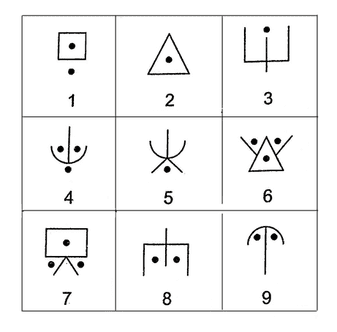
1, 8 and 9 form a group of figures in which two shaded circles are present.
2, 3 and 5 form a group of figures in which one shaded circle is present.
4, 6 and 7 form a group of figures in which three shaded circle are present.
Group the given figures into different classes on the basis of their orientation, shape etc.
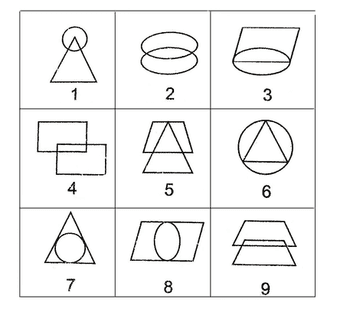
2, 4 and 9 are composed of two similar figures intersecting each other.
6, 7 and 8 contain one figure enclosed inside the other.
1, 3 and 5 are composed of two dissimilar figures intersecting each other.
Group the given figures into different classes on the basis of their orientation, shape etc.
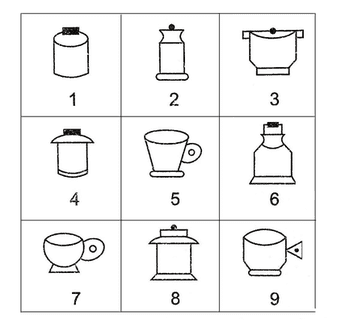
1, 4 and 6 form a group of figures in which one shaded rectangle is present at the top of the figure.
2, 3 and 8 form a group of figures in which one shaded circle is present at the top of the figure.
5, 7 and 9 represent cup shaped figures.
Group the given figures into different classes on the basis of their orientation, shape etc.

1, 4 and 7 form a group of figures containing a square in which one smaller circle is present at each corner and one larger circle is present at centre.
2, 6 and 9 form a group of figures which contain three shaded triangles at the corners and four similar design at the centre of the figure.
3, 5 and 8 form a group of figures in which the curved portion of the figure contains certain design.
Group the given figures into different classes on the basis of their orientation, shape etc.
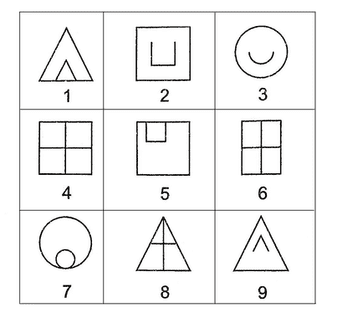
1, 5 and 7 contain two similar figures, one inside the other.
2, 3 and 9 form a group of figures in which half portion of the figure is enclosed inside that figure.
4, 6 and 8 contain two straight lines perpendicular to each other dividing the figure into four parts.
Group the given figures into different classes on the basis of their orientation, shape etc.
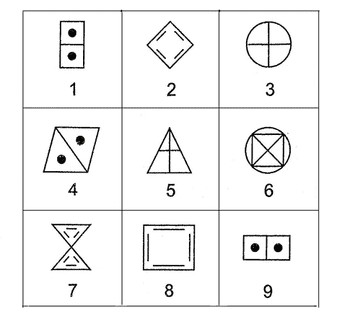
1, 4 and 9 form a group of figures which are divided into two equal parts and each part contains one small dark circle.
2, 7 and 8 form a group of figures in which lines equal to the number of lines present in the main figure are present inside the figure (one line parallel to each line).
3, 5 and 6 form a group of figures in which two straight lines mutually perpendicular to each other are present.
Group the given figures into different classes on the basis of their orientation, shape etc.

1, 5 and 8 are open figures bisected by a straight line.
4, 6 and 7 are figures having an extended arm.
2, 3 and 9 are closed figures intersected by a line.
Group the given figures into different classes on the basis of their orientation, shape etc.
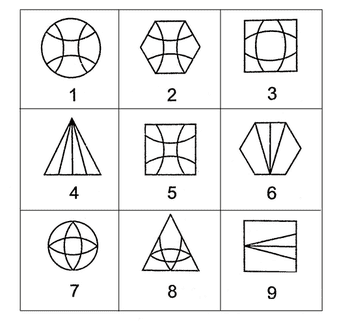
1, 2 and 5 contain similar pattern enclosed inside different figures.
3, 7 and 8 contain similar pattern (different form that in 1, 2 and 5) enclosed inside different figures.
4, 6 and 9 are figures enclosing a triangle with one median.
Group the given figures into different classes on the basis of their orientation, shape etc.
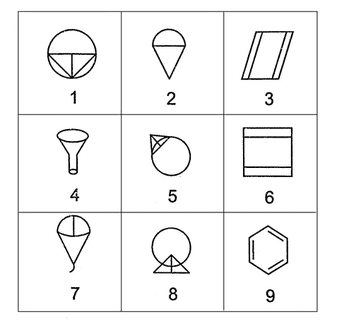
1, 5 and 8 form a group of figures in which a circle and a triangle (divided into two equal parts) are present in contact with each other.
2, 4 and 7 contain figures which have curved portions.
3, 6 and 9 form a group of figures formed by straight lines only.
Group the given figures into different classes on the basis of their orientation, shape etc.
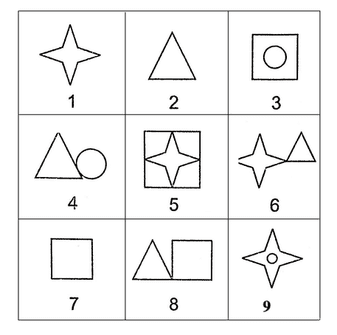
1, 2 and 7 are single figures.
3, 5 and 9 contain two dissimilar figures one inside the other.
4, 6 and 8 contain two different figures touching each other.