Salesforce CG Cloud TPM Interview Questions & Answers for Freshers and Experienced
Salesforce CG Cloud TPM interview questions and answers for freshers and experienced — core concepts, setup, promotions and real scenarios.
Salesforce TPM and Consumer Goods Cloud interview questions for developers and functional consultants — promotions, KPIs, funds and integrations.
If you’re working with Salesforce TPM (Trade Promotion Management) on CG Cloud, whether you're a developer, functional consultant, or part of the support team, you’ve probably realized that it's not just about standard Salesforce skills.
TPM brings a mix of funds, claims, promotions, tactics, KPIs, Apex logic, and real-time data integration (RTR)—all packed into a domain built for Consumer Goods companies.
In this post, I’ve compiled a list of real-world TPM interview questions that cover not just the data model and configurations, but also Apex customization, business workflows, batch jobs, and scenario-based logic that you’re likely to face in client projects or interviews.
Whether you're preparing for a job switch, brushing up for a project kickoff, or reviewing the platform deeper—this guide will help you gain clarity and confidence.
Trade Promotion Management (TPM) in Salesforce CG Cloud helps Consumer Goods (CG) companies plan, execute, track, and optimize trade promotions. It enables efficient fund allocation, tactic execution, claim validation, and ROI analysis.
In CG, up to 25–30% of revenue is spent on trade promotions. TPM helps optimize ROI on that spend.
TPM allows CG companies to create data-driven promotion plans, aligning them with marketing goals, budgets, and supply chain capacity.
With TPM in Salesforce CG Cloud, brands can track promotions from creation —> approval —> execution —> settlement, improving control and compliance.
TPM integrates with Retail Execution (store visits, audits) to ensure promotions are executed properly at the shelf.
TPM enhances collaboration between account managers, field reps, and finance teams by providing a centralized view of all trade activities.
It offers insights like incremental lift, cannibalization, ROI, etc., to help businesses learn and improve future promotions.
Example:
A beverage company can use TPM to:
Diagram
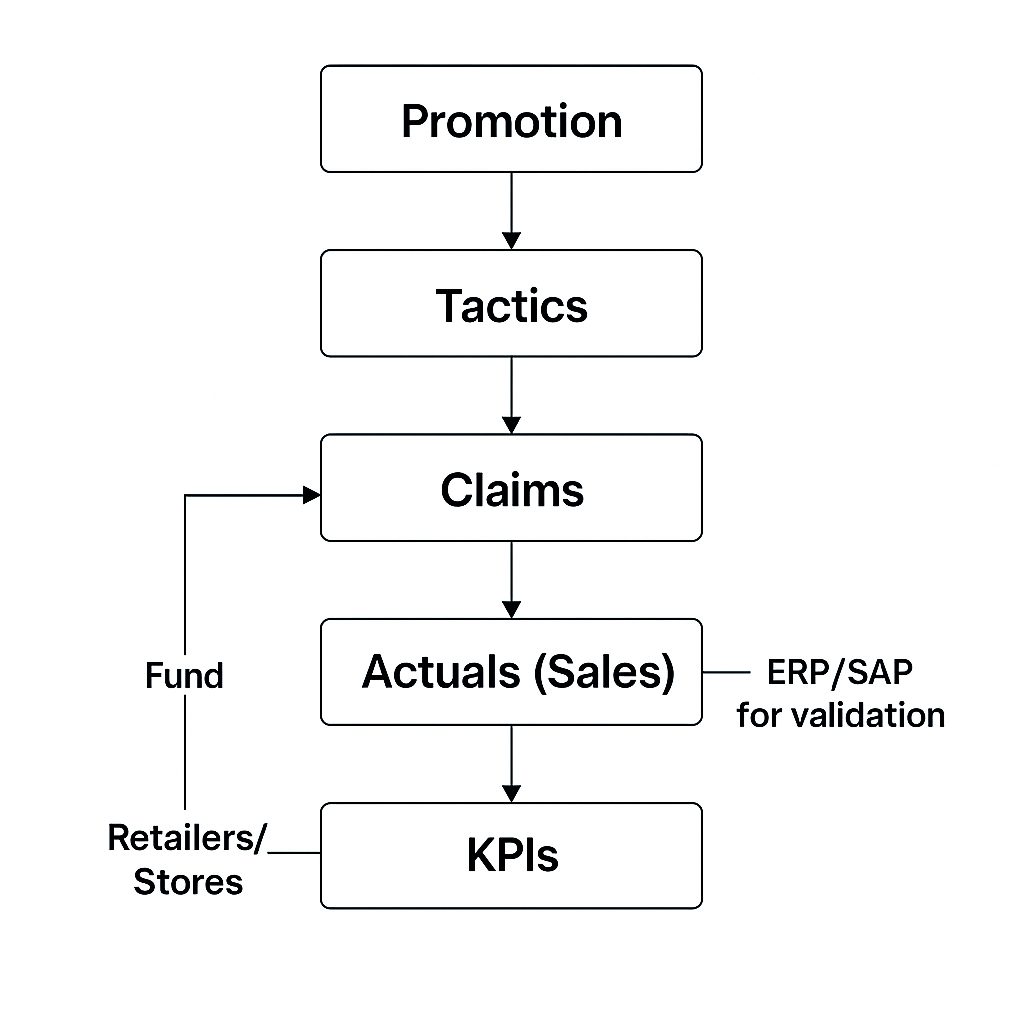
Examples: Festive discounts, seasonal sales. They target short bursts of volume uplift.
Example: Loyalty programs, year-long trade deals with retailers.
Mind it!
| Type | Duration | When to use |
|---|---|---|
| Short Term Promotion (STP) | Days–Weeks | Seasonal or festival bursts. Example : Diwali discount 10% on snacks |
| Long Term Promotion (LTP) | Months–Year | Loyalty, distribution deals |
| Everyday Low Price (EDLP) | Continuous | Market position / low-price strategy |
| Off-Invoice | When billed | Discount applied directly on invoice |
| Bill-Back | Post-event | Retailer reimbursed after proof |
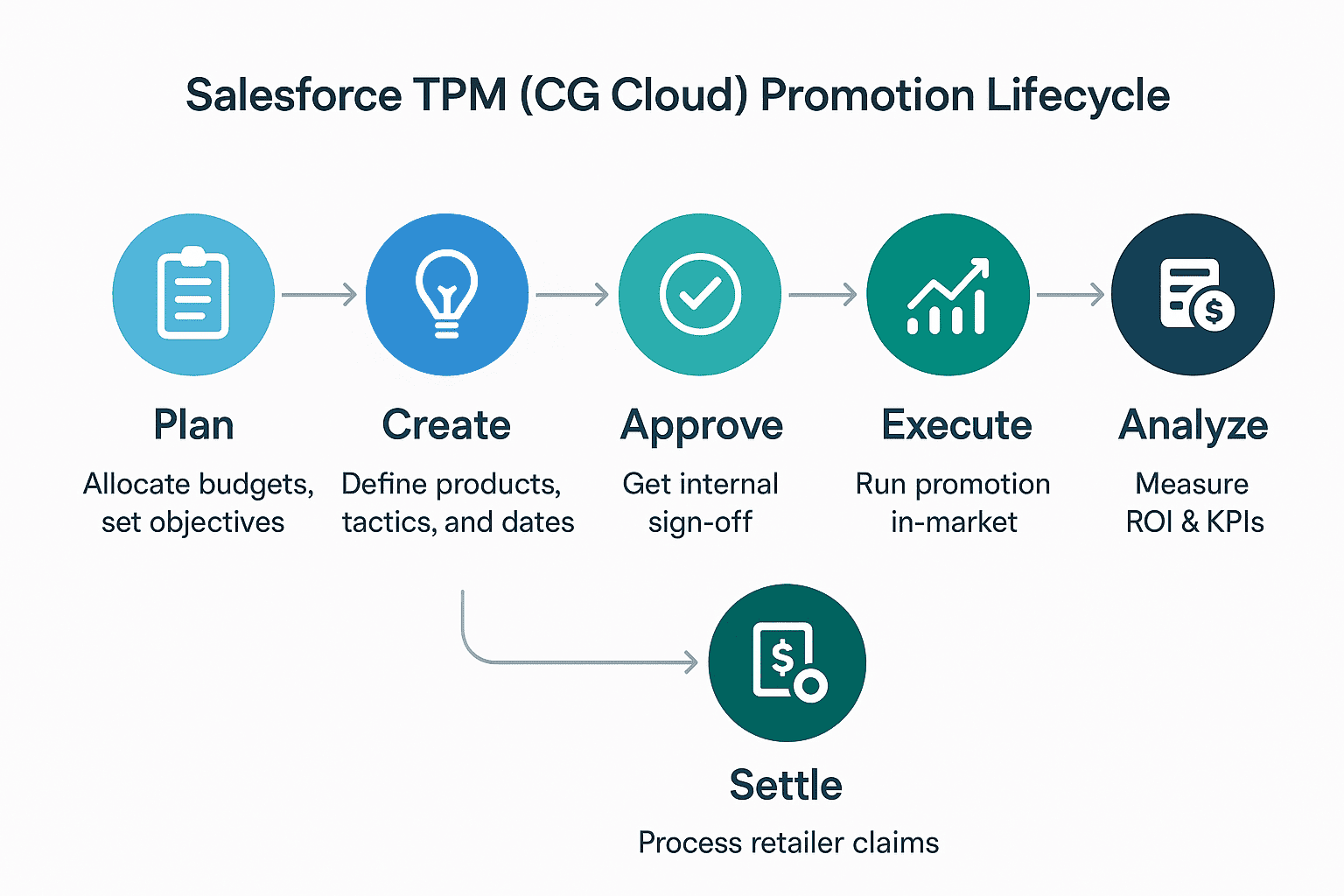
Example
Yes, let me explain.
Trade Promotion Management (TPM) is the structured process that Consumer Goods companies use to plan, execute, and analyze trade promotions with their retail partners. In Salesforce Consumer Goods Cloud, the TPM process is designed as a closed loop, meaning every stage connects back to the next, ensuring accounts are managed across the full promotion lifecycle.
At the center of the process, we have Unify Master Data. This is critical because managing user, product, and customer data consistently across multiple orgs ensures that all promotions run on clean, accurate information. Without strong master data, none of the outer stages would work properly.
Now, the process itself flows through six stages:
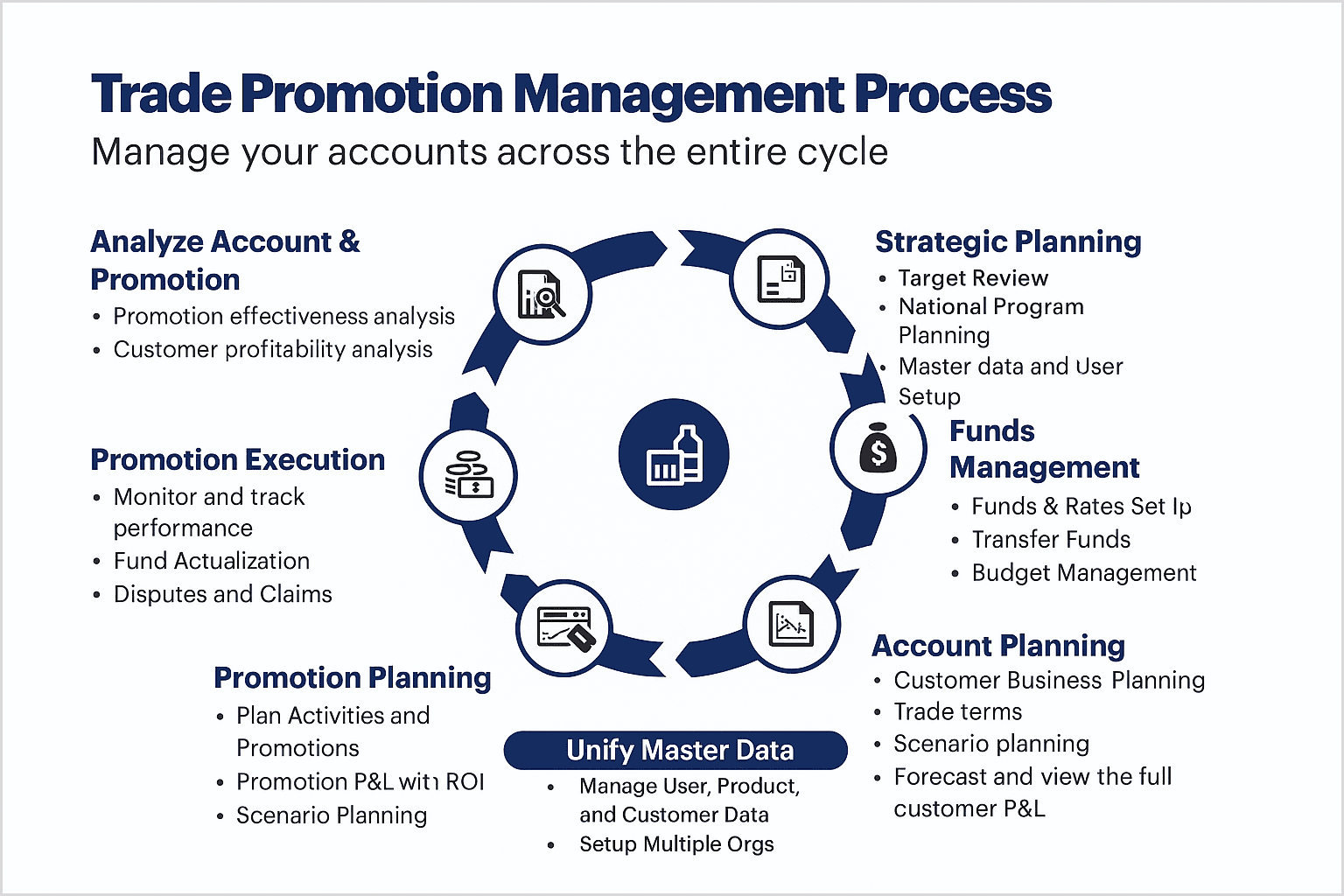
The key value is that this circular process ensures transparency and control. From the retailer account’s perspective, it means all promotions are planned, funded, executed, and analyzed in one system. From the company’s perspective, it reduces overspending, improves ROI visibility, and helps build stronger account relationships.
So, TPM isn’t just about running discounts—it’s about managing the entire account cycle with data-driven decisions.
In Salesforce TPM (Trade Promotion Management), a tactic is a planned promotional activity that supports a trade promotion’s objectives.
Think of it as the specific action you execute to influence sales, customer behavior, or product movement.
Key Points
Budgets —> Promotions —> Tactics.
A tactic is part of a promotion, and multiple tactics can exist under one promotion.
Defines how you will execute the promotion - for example, discounts, displays, sampling, etc.
Product(s) involved, time frame, type of tactic, expected uplift, budget allocation.
Example
Imagine you are a Trade Marketing Manager for a beverage company.
Promotion: "Diwali Festive Beverage Offer – Maharashtra"
- Start Date: 1 Oct 2025
- End Date: 20 Oct 2025
- Target: Increase sales of 2L Cola bottles by 15% during Diwali.
Tactics under this promotion
In Salesforce Consumer Goods Cloud, the Trade Promotion Management (TPM) data model is built around a set of standard and custom objects that help track the entire promotion lifecycle — from planning to execution to settlement.
| Object Name | Description | Relationships |
|---|---|---|
| Promotion (cgcloud__Promotion__c) | The central object representing a planned trade promotion. | Linked to Tactics, Accounts, Products, Budgets, and KPIs |
| Tactic (cgcloud__Tactic__c) | A promotional mechanism or offer type (e.g., discount, display, bundle). Each promotion can have multiple tactics. | Lookup to Promotion |
| Tactic Template (cgcloud__Tactic_Template__c) | A configuration template defining valid fields and dependencies for different tactic types. | Referenced by Tactic and used for UI rendering |
| Promotion Product (cgcloud__Promotion_Product__c) | The product(s) associated with the promotion or tactic. | Related to Promotion, Tactic, and Product (Standard) |
| Retail Store (cgcloud__Retail_Store__c) | Represents the store/location where the promotion is executed. | Linked to Promotion or Account |
| Fund (cgcloud__Fund__c) | The financial pool allocated for promotions (marketing, trade, or other). | Linked to Promotion and Fund Plan |
| Settlement (cgcloud__Settlement__c) | Captures financial settlement and reconciliation details post-promotion. | Related to Promotion, ERP ID, Funds |
| KPI (cgcloud__KPI__c) | Stores key performance indicators like ROI, uplift, etc. | Related to Promotion |
| Budget (cgcloud__Budget__c) | Total promotional budget available for a brand, product, or account. | Linked to Fund and Promotion |
| Condition Code (TPM_SAPConditionCode__c) | Custom object used to model SAP-style condition dependencies for field logic. | Referenced in field rendering or dependency logic |
Simplified Relationship Flow
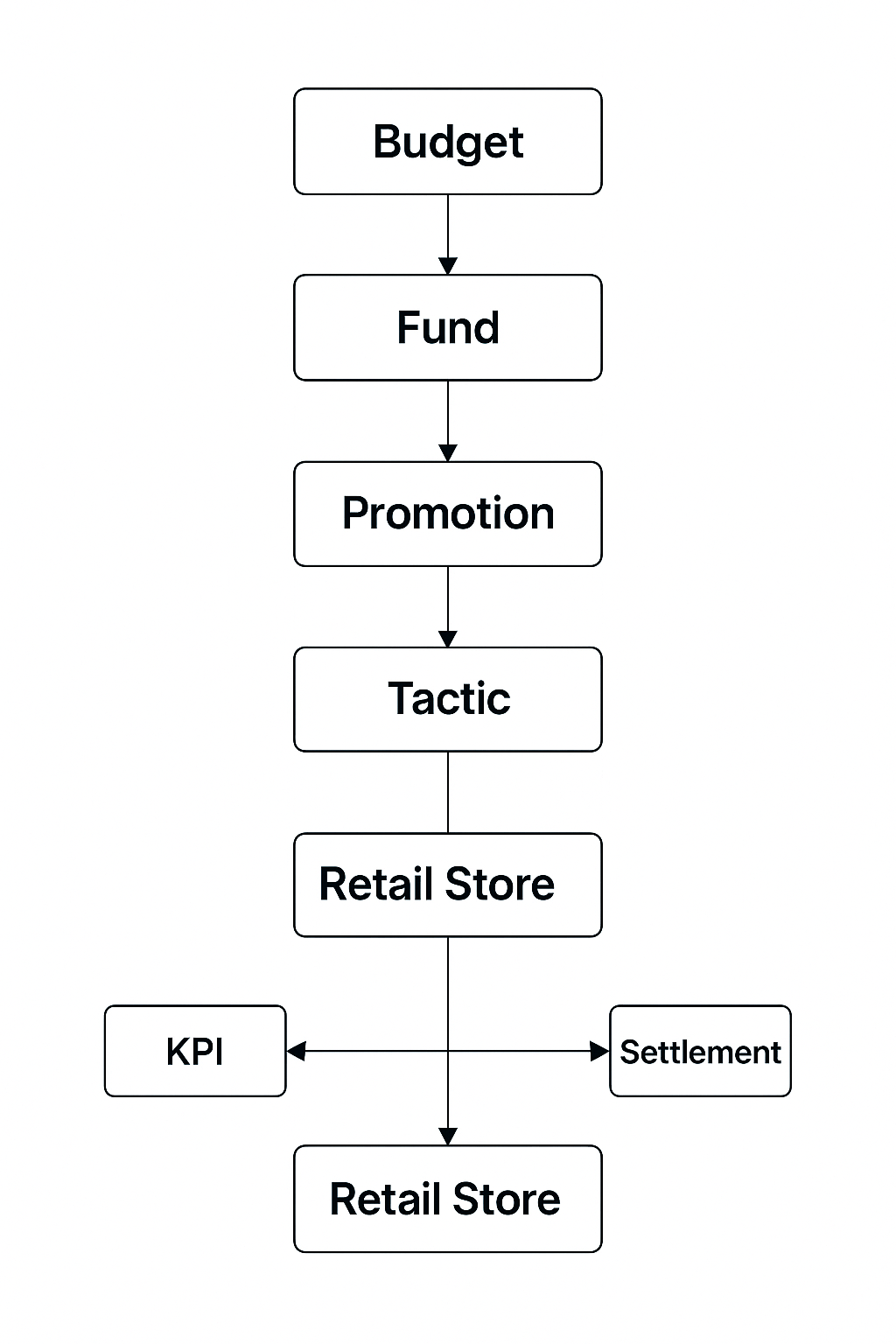
Example Use Case
TPM in CG Cloud helps Consumer Goods (CG) companies plan, execute, track, and optimize trade promotions. It's structured around key objects:
Example
For a "Diwali Sales Promotion", the Promotion would hold details like timeline and account, Tactics would include "Buy One Get One Free", and Funds would track allocated budget.
These three objects form the core financial and executional structure in TPM:
cgcloud__Promotion__c (Promotion): The parent record representing the overall trade event. It holds strategic information like time period, account, and objectives.cgcloud__Trade_Promotion_Tactic__c (Tactic): Child of Promotion, representing actionable activities (e.g., displays, discounts). Each tactic can be budgeted and tracked individually.cgcloud__Fund__c (Fund): Represents the monetary pool allocated to trade promotions. Tactics and Promotions draw from this fund for planned spend and actual claim settlement.Relationship
Answer – Trade Promotion Funds (TPF) are budget pools allocated to accounts, customers, or product categories. These funds are consumed when promotions are executed.
In Salesforce TPM, this is represented by the object cgcloud__Fund__c.
Mind it!

In short
Trade Promotion Funds (TPF) are the financial backbone of TPM. They ensure every promotion has budget backing, prevent overspend, and allow measurement of effectiveness across accounts and brands.
Why it matters: Without TPM, deductions are often manual and messy. TPM links them back to specific promotions/funds so you can validate if they are justified.
In short
Business Object API Workflow Steps in CG Cloud allow for custom process automation tied to specific business objects like Promotions, Claims, or Tactics. They are declarative or programmable steps that define what should happen during a lifecycle stage.
Use cases
These steps are used to enforce business rules, manage state transitions, and trigger integrations during the lifecycle of a business object.
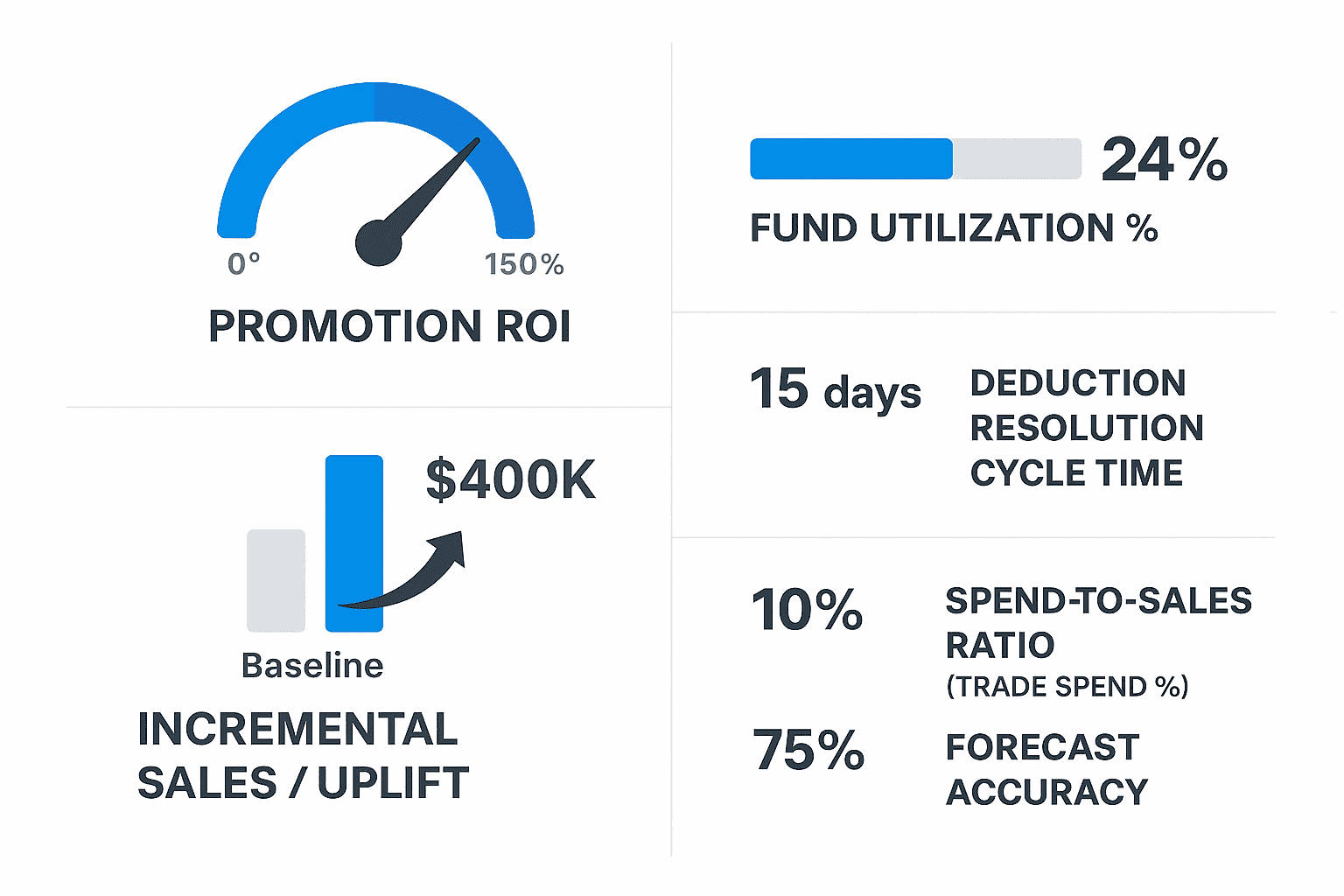
Answer — KPIs (Key Performance Indicators) are the heartbeat of Trade Promotion Management (TPM) in Consumer Goods Cloud because they show whether promotions are driving profitable growth or just burning funds.
KPIs (Key Performance Indicators) are used to measure promotion effectiveness. Common KPIs include:
Example:
If a promotion generated $1,000,000 in incremental sales from a $200,000 spend:
These KPIs are often derived using actuals from POS or ERP data, which can be integrated or connected via Salesforce Connect.
Answer – Here are the main KPIs used in TPM and why they matter:
ROI = (Incremental Sales – Promotion Spend) / Promotion Spend
| Fund Utilization = | Funds Spent | x 100 |
| Funds Allocated |
\text{Trade Spend %} = \frac{\text{Trade Spend}}{\text{Net Sales}} \times 100
In Salesforce Trade Promotion Management (TPM), dynamic field and picklist rendering on the UI is driven by Custom Metadata Types (CMDTs) and field configuration records. This flexible approach allows admins and developers to control field behavior without changing code, which is essential for supporting different tactic types, brands, and countries.
TPM uses Custom Metadata (TPM_TacticTemplateFieldConfig__mdt) and Condition Code data (TPM_SAPConditionCode__c) to render tactic fields dynamically. This config-driven approach allows developers to build highly adaptable UI experiences with field-level dependency, visibility control, and picklist value resolution—all driven without hardcoding.
| Component | Description |
|---|---|
| Tactic Template (cgcloud__Tactic_Template__c) | Stores tactic-level configuration and links to applicable UI field setup. |
| Tactic Template Field Config (TPM_TacticTemplateFieldConfig__mdt) | A Custom Metadata Type used to define which fields should appear on the Tactic UI, their order, controlling fields, and other behavior. |
| TPM_SAPConditionCode__c | A custom object containing SAP-style field dependency mappings (used for multilevel picklist dependencies). |
Code Snippet (Apex)
for (TPM_TacticTemplateFieldConfig__mdt config : fieldConfigs) {
    if (config.TPM_IsConfiguredinTactic__c && config.TPM_TacticControllingField__c != null) {
        controllerFieldMap.put(config.API_Name__c, config.TPM_TacticControllingField__c);
    }
}To enforce multi-level dynamic dependencies (e.g., Payment Method --> Compensation Model --> Claim Type) in Salesforce TPM (Trade Promotion Management) forms, Salesforce CG Cloud uses a combination of:
TPM_SAPConditionCode__c)| Component | Role |
|---|---|
TPM_TacticTemplateFieldConfig__mdt |
Declares each field's controlling field (if any) and field order. |
TPM_SAPConditionCode__c |
Contains dependency data, mapping parent-child value combinations across levels. |
Apex (getPicklistFieldsData) |
Returns valid picklist values, metadata, and dependency maps to the UI. |
| JavaScript (LWC) | Renders picklists, filters values dynamically, and disables downstream fields until parents are selected. |

One short email when we publish something new — interview questions, Salesforce guides and career tips. No spam, unsubscribe in one click.
Salesforce CG Cloud TPM interview questions and answers for freshers and experienced — core concepts, setup, promotions and real scenarios.
Thirty Salesforce CG Cloud TPM interview questions with answers — promotions, tactics, funds, KPIs, payments and integrations — for TPM roles.
Salesforce TPM and Consumer Goods Cloud interview Q&A — trade promotions, accounts, products, KPIs and visits — with clear answers.
Questions, corrections or your own experience — they all help the next reader.
Norajohnson