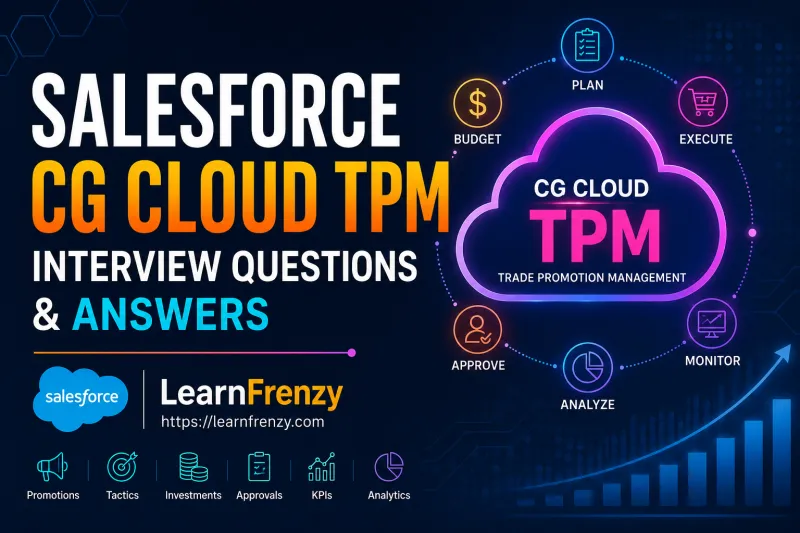
Salesforce CG Cloud TPM Interview Questions & Answers for Freshers and Experienced
Salesforce CG Cloud TPM interview questions and answers for freshers and experienced — core concepts, setup, promotions and real scenarios.
Salesforce TPM and Consumer Goods Cloud interview Q&A — trade promotions, accounts, products, KPIs and visits — with clear answers.
So, you have an interview for a Salesforce TPM role focused on Consumer Goods Cloud. First off, congratulations! This isn't your average Salesforce position. A TPM in this space sits at a really special crossroads—where deep technology, strategic business vision, and flawless execution all have to meet.
But let's be honest, preparing for it can feel daunting. You're not just being tested on your knowledge of objects and workflows. They want to see how you think, how you lead, and how you connect complex technical challenges to real-world business goals, especially in the critical area of Trade Promotion Management (TPM).
Sound familiar? Then you're in the right place. Whether you're coming from a business analyst, functional consultant, or technical background, this guide is for you. We've broken down the key questions—and solid answers—that you're likely to face, covering the fundamentals, specific TPM scenarios, and the integrations you'll need to explain with confidence.
TPM in Consumer Goods Cloud helps companies plan, execute, and settle trade promotions with retailers. It starts with accounts and products, then budget is allocated through funds. A promotion is created, and each product is added with expected volume and price from the price book. Tactics define the discount or spend mechanics and draw from the fund.
During execution, field teams validate whether the promotion is active in stores. After the promotion ends, retailers submit claims or deductions. These are matched to the promotion through settlement. Reporting compares planned versus actual spend, uplift, and ROI. Overall, TPM gives full visibility from planning to financial settlement and helps improve future promotions.
 Interview Series
Let start the interview series on Salesforce TPM - CG Cloud (Between Interviewer & Interviewee).
TPM in Salesforce’s Consumer Goods Cloud is a structured way for consumer goods companies to plan, manage, execute, and analyze trade promotions (discounts, displays, events) for their retail partners. These promotions drive in-store activity and help brands increase their market visibility and sales.
CG Cloud provides a unified platform for managing everything from planning (budget, tactics) to execution (transfer to retail) and post-promotion analysis, reducing manual effort and improving ROI.
In simple terms, it's about planning 'if we spend X dollars on a promotion, we expect to sell Y more units.'
Curious?
Before a system like Salesforce CG Cloud, this was often done with spreadsheets and emails, which was messy and inefficient.
What Salesforce CG Cloud does is bring this entire process into one unified platform. It helps companies in three key stages:
Mind it!
So, in short, TPM (Trade Promotion Management) in CG Cloud is a Salesforce solution that helps consumer goods companies plan, execute, and track trade promotions with distributors and retailers. It provides visibility into budgets, claims, and performance metrics so companies can improve ROI on promotions.
Consumer goods companies need TPM because trade spend is one of their biggest costs, often 15–30% of total revenue. Without a structured system, it’s hard to control overspend, validate retailer claims, or understand which promotions actually worked.
Example
A brand runs a “Buy 2 Get 1” offer with a retailer. TPM helps the team plan the promotion, track the discount cost, send the tactic to field reps, and later match the retailer’s claim to what was actually planned. This avoids paying more than expected and shows whether the promotion truly drove extra sales.

The main components of TPM in Salesforce CG Cloud cover the full lifecycle of a promotion. It starts with planning and budgeting, where teams set goals and allocate funds. Then comes promotion creation and approval, where KAMs build the promotion and get it approved by finance or management.
Once approved, the promotion moves into execution and monitoring, which includes sending tactics to Retail Execution and tracking how the promotion performs in stores. After the promotion runs, retailers submit claims, so claims and settlements help validate what was actually executed and settle the payments.
Finally, post-event analysis looks at the results—ROI, sales lift, spend vs. plan, and other KPIs—so the company can learn what worked and improve future promotions.
Mind it!
The main components of TPM in Salesforce CG Cloud cover the full promotion lifecycle:
Salesforce TPM in Consumer Goods Cloud relies on a set of standard CG Cloud and CRM objects that support planning, execution, settlement, and reporting.

Core objects:
A Promotion doesn’t directly store multiple Accounts or Products inside the same object. Instead, Salesforce TPM uses two junction objects to manage these relationships:
Object: cgcloud__PromotionAccount__c
This object links a Promotion to one or more Accounts.
Retailers often run the same promotion across:
Account <—— Promotion Account ——> PromotionObject: cgcloud__PromotionProduct__c
This links each product to the Promotion and stores all planning metrics.
Product <—— Promotion Product ——> PromotionA Promotion is linked to Accounts using the Promotion Account junction object, and to Products using the Promotion Product object. These junction objects allow one Promotion to support multiple Accounts and multiple Products, while storing account-level and product-level attributes like volume, uplift, pricing, and spend.
Promotion Product tracks product-specific data such as:
This level of detail is required for forecasting, settlement, and ROI. A simple product list cannot store these attributes.
Why is Promotion Product required?
Promotion Product is required because each product in a promotion needs its own volume forecast, pricing snapshot, spend calculation, and discount information. Promotions often include many products, and each behaves differently. Promotion Product stores all of these product-level details and connects the Promotion with Product for planning, execution, and settlement.
A Promotion is the overall plan for the retailer — it defines the account, date range, products, budgets, and KPIs.
A Tactic is a specific spend mechanic inside the promotion, like an off-invoice discount, a display fee, or a scan-back. One promotion usually contains multiple tactics because each mechanic is planned and executed separately. Promotions answer ‘what and when,’ while tactics answer ‘how and how much.’
Imagine Coca-Cola is running a promotion with Walmart.
This includes:
This is the high-level umbrella activity.
Tactic 1 – 10% Off-Invoice Discount
Tactic 2 – Display Fee for Endcap
Tactic 3 – Buy 2 Get 1 Free (Scan-back)
Each tactic represents a specific way the promotion creates value and uses funds.
You define trade budgets by account, product, or region, allocate funds to promotions, and track spend versus allocation. Budgets can roll up into higher-level categories like brand or channel.
A Claim represents the retailer or distributor’s request for reimbursement after executing a promotion (e.g., claiming the display cost or discount amount). Claims can be validated, approved, or rejected.
A Deduction is an unapproved amount a retailer subtracts from payments expecting reimbursement.
A Settlement is the final reconciliation or payment done after claim validation.
The TPM Calendar shows promotions by date, account, and product category. It identifies overlaps, conflicts, and cannibalization risks.
The system checks:
Approval freezes key commercial data to prevent uncontrolled changes.
Settlement matches retailer claims or deductions against planned promotion spending. It records actual spend and adjusts fund balances.
Common TPM KPIs include base volume, promoted volume, incremental uplift, ROI, trade spend, fund utilization, ISR, net margin, and execution compliance. These KPIs help companies measure the effectiveness, efficiency, and profitability of promotions and drive better planning and post-event analysis.
Multi-account promotions are promotions that apply to more than one retailer or customer group at the same time.
Salesforce TPM handles this using a dedicated junction object and account-grouping logic.
In TPM, multi-account promotions are managed through the Promotion Account junction object. It allows a single promotion to be linked to multiple retailers while still keeping account-specific elements like pricing, fund allocation, volume plans, tactics, and settlement separate. Planners can also use account groups to assign multiple accounts in one step. This gives flexibility to run a single umbrella promotion across many retailers while maintaining account-level control.

One short email when we publish something new — interview questions, Salesforce guides and career tips. No spam, unsubscribe in one click.
Salesforce CG Cloud TPM interview questions and answers for freshers and experienced — core concepts, setup, promotions and real scenarios.
Thirty Salesforce CG Cloud TPM interview questions with answers — promotions, tactics, funds, KPIs, payments and integrations — for TPM roles.
Salesforce TPM and Consumer Goods Cloud interview questions for developers and functional consultants — promotions, KPIs, funds and integrations.
Questions, corrections or your own experience — they all help the next reader.