Cubes and Dice - 1
Practice and master this topic with our carefully crafted questions.
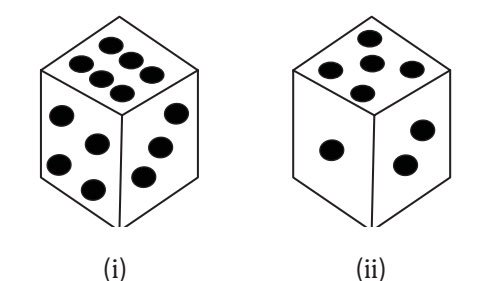
Number three is common in both the figures we assume the block in figure (ii) to be rotated so that three appears at the same position as in figure (i) and the numbers 5 and 2 move to the faces hidden behind the numbers 4 and 6 respectively. Thus the combined figure will have 3 on right hand side face, 4 on the front face, 6 on the top face, 5 on the rear face and 2 on the bottom face. Clearly when 2 is at the bottom, then 6 is at the top.
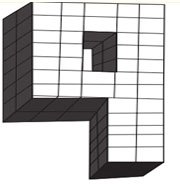
There are total 42 cubes present in the upper portion.
24 columns with 2 cubes each = 24 × 2 = 48
14 columns with 2 cubes each = 28
4 columns with 2 cubes each = 8
Total cubes = 48 + 28 + 8 = 84
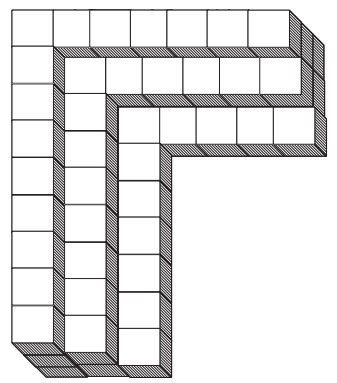
15 × 3 + 13 × 2 + 11 × 1 = 82 cubes
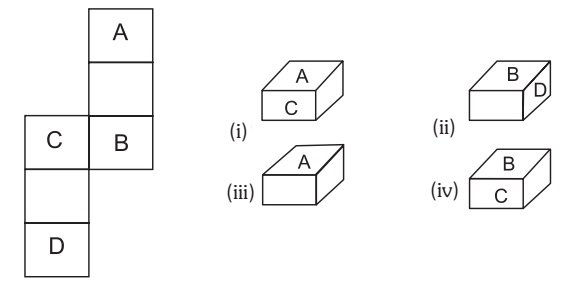
option (b) and option (c) cannot satisfies the conditions of dice formation, as option (b) B cannot be adjacent to D and in option (c) two white faces cannot be adjacent to each other.
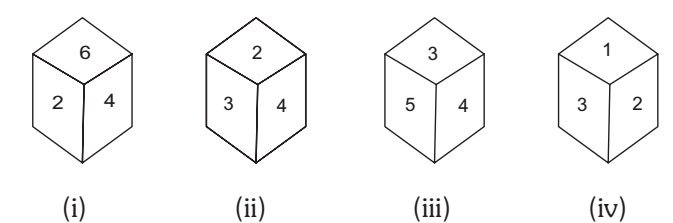
from figure i, ii and iv we conclude that 6, 4, 3 and 1 lie adjacent to 2. Hence 5 be opposite of 2.
For the better understanding take a dice ans apply the same steps which is mentioned above.
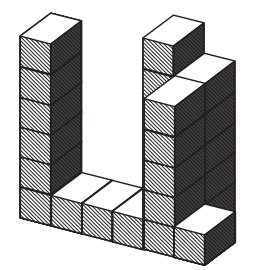
Total cubes 25
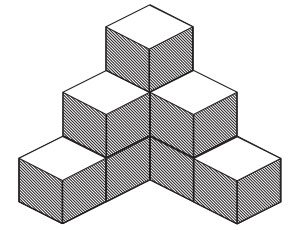
Total cubes = 9
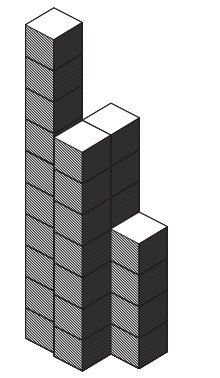
One column with 10 boxes = 1 × 10 = 10
Two column with 7 boxes = 2 × 7 = 14
One column with 4 boxes= 1 × 4 = 4
Total boxes = 28
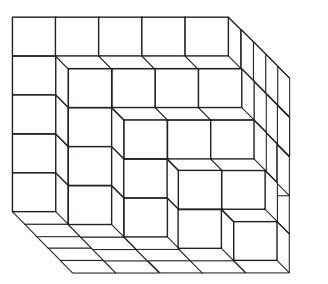
There are 9 columns with 5 cubes = 9 × 5
There are 7 columns with 4 cubes = 7 × 4
There are 5 columns with 3 cubes = 5 × 3
There are 3 columns with 2 cubes = 3 × 2
There is one column with 1 cubes = 1 × 1
Total = 9 × 5 + 7 × 4 + 5 × 3 + 3 × 2 + 1 × 1 = 81
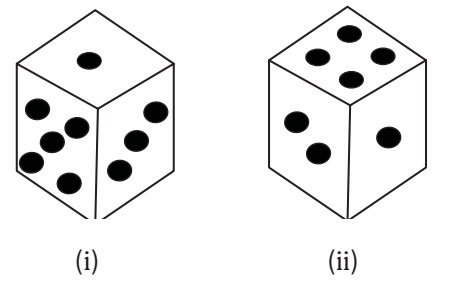
Number 1 is common to both the figures (i) and (ii). The dice in fig. (ii) is assumed to be rotated so that 1 dot moves to the top face i.e to the same position as in figure (i) and 2 and 4 dots move to the face behind the faces with 3 and 5 dots respectively. Clearly by combination, 3 dots lie on the face opposite the face having 2 dots. Therefore, when there are 2 dots at the bottom, the number of dots at the top will be 3.