Number puzzles - Section 1
Practice and master this topic with our carefully crafted questions.
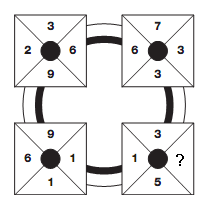
Starting with the top left square, and moving clockwise around the other 3, the sum of the digits in each square follows the sequence 20, 19, 18, 17.
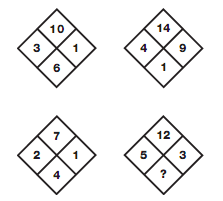
In each diamond, add the left and right hand numbers together, and subtract this sum from the top number to give the value at the bottom.
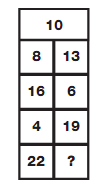
Starting with the 10 at the top, one set of numbers increases by 3 each time, written in alternate boxes as you move down the diagram, and the other set of numbers decreases by 2, written in the boxes remaining.
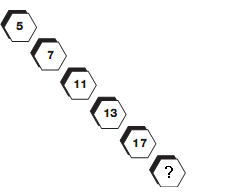
As you move diagonally down, numbers follow the sequence of Prime Numbers.
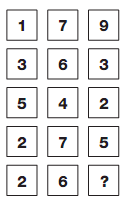
Reading each row of the diagram as a series of 3 digit numbers, the centre 3 digit number equals the sum of the top 2 numbers, and the sum of the lower 2 numbers.
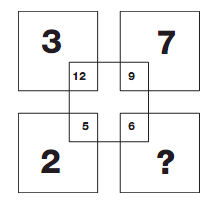
Taking numbers in diagonally opposite squares, calculate their sum, and put the answer in the small, inner square of the upper number. Calculate their difference, and put this answer in the small, inner square of the lower number.
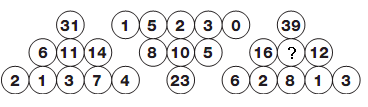
In each triangular group of circles, start with the longest row and add together 3 adjacent values and put this sum in the circle directly above or below the centre of the 3 values. Continue this sequence towards the apex of each.

Working from left to right and reading each pair of numbers as a 2 digit value, these values represent the sequence of multiples of 7, starting at 49 and finishing on 70.
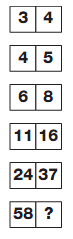
Working from top to bottom, left to right, add together the first two numbers and subtract 3 to give the next value along.
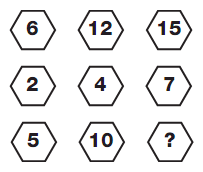
Working in rows, from left to right, double the left hand number to get the middle number, and add 3 to this to get the right hand number.