Matrix Coding
🧠 Build a strong foundation in logical reasoning with clear explanations and real-world examples. Understand core concepts and develop critical thinking skills.
Introduction & Key Concepts
Study MaterialMatrix Coding
Matrix Coding is one of the most important and highly scoring topics in Verbal Reasoning and Logical Aptitude sections of competitive examinations. These questions test a candidate’s ability to understand symbol-based coding systems, row-column relationships, positional logic, and pattern recognition using matrices.
In Matrix Coding, letters of the English alphabet are represented using numerical codes based on their positions inside one or more matrices. Candidates must decode words, identify correct code combinations, or determine encoded forms using systematic logical analysis.
Questions from Matrix Coding are regularly asked in SSC, Banking, Railway, Insurance, Defence, State PSC, Management Entrance, and aptitude examinations because they evaluate observation skill, logical interpretation, and coding-decoding ability under time pressure.
What is Matrix Coding?
A matrix is a rectangular arrangement of elements in rows and columns.
In Matrix Coding, letters are placed inside matrices and each letter is represented using:
- Row Number
- Column Number
The code of a letter is generally formed by:
Code = Row Number + Column Number
Thus, every letter receives a numerical code depending on its position inside the matrix.
Basic Structure of Matrix Coding
Most competitive examination questions use two matrices:
| Matrix | Rows & Columns | Number Range | Purpose |
|---|---|---|---|
| Matrix I | 5 × 5 | 0 to 4 | First coding matrix |
| Matrix II | 5 × 5 | 5 to 9 | Second coding matrix |
Each matrix contains letters arranged differently in rows and columns.
Core Logic Behind Matrix Coding
Every Matrix Coding question follows one simple logical rule:
Step 1 → Locate the letter inside the matrix
Step 2 → Identify its row number
Step 3 → Identify its column number
Step 4 → Combine row and column numbers to form the code
The same letter may appear multiple times across different matrices, producing multiple valid codes.
Understanding Row and Column Representation
A letter is represented first by its row number and then by its column number.
Example:
Letter M located at:
Row = 2
Column = 0
Code = 20
Similarly:
- Row 1, Column 3 → Code = 13
- Row 5, Column 7 → Code = 57
- Row 8, Column 5 → Code = 85
Important Characteristics of Matrix Coding
| Characteristic | Description |
|---|---|
| Position-Based Coding | Codes depend on row and column positions |
| Multiple Valid Codes | One letter may have several codes |
| Matrix Dependency | Coding depends completely on matrix arrangement |
| Logical Verification | Every code must match matrix positions |
| Pattern Recognition | Requires careful observation |
Major Types of Matrix Coding Questions
Competitive examinations ask several standard patterns from Matrix Coding.
- Finding the correct code for a word
- Decoding a given numerical sequence
- Identifying invalid code combinations
- Selecting correct alternative codes
- Finding missing coded values
- Matrix-based symbol coding
- Multiple-code verification
- Reverse coding questions
How Multiple Codes are Possible
In many Matrix Coding questions, the same letter may appear more than once across different matrices.
Therefore, one letter can have multiple valid codes.
Example:
Suppose letter A appears at:
- Row 0, Column 0 → 00
- Row 1, Column 2 → 12
- Row 2, Column 4 → 24
Then all these values become valid codes for A.
This is why candidates must verify every code carefully instead of assuming only one answer possibility.
Basic Matrix Coding Example
Suppose the following simplified matrix is given:
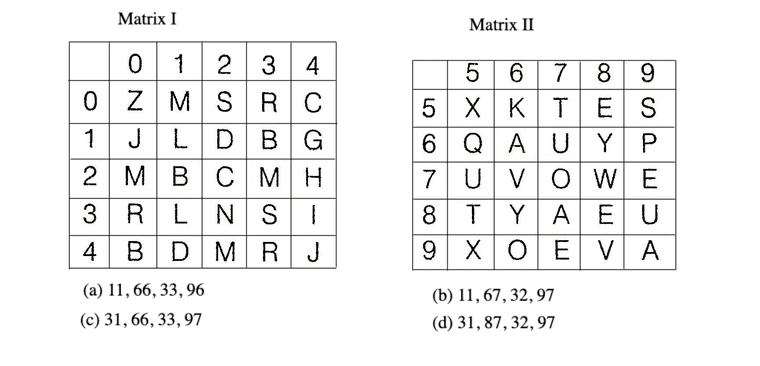
If:
- L = 11
- A = 66
- N = 32
- E = 58
Then:
LANE → 11 66 32 58
Candidates must compare all options carefully to identify the valid code sequence.
Important Concepts Required for Matrix Coding
| Concept | Application | Importance |
|---|---|---|
| Row Identification | Finding first code digit | Very High |
| Column Identification | Finding second code digit | Very High |
| Position Tracking | Locating letters accurately | Very High |
| Pattern Matching | Verifying correct code combinations | High |
| Multiple-Code Analysis | Checking alternative possibilities | Very High |
| Logical Elimination | Removing incorrect options quickly | High |
Important Examination Patterns
The following Matrix Coding patterns are repeatedly asked in examinations:
- Selecting valid code for a word
- Identifying incorrect coded sequence
- Finding missing matrix values
- Decoding a coded word
- Choosing correct alternative combinations
- Finding code of mixed-letter words
- Multiple-matrix verification
- Position-based logical elimination
Common Mistakes Made by Students
- Interchanging row and column numbers
- Ignoring multiple valid codes
- Checking only one matrix
- Reading columns before rows
- Incorrect positional tracking
- Skipping code verification
- Selecting partially correct options
- Ignoring alternative combinations
Smart Solving Strategy
Top-performing candidates solve Matrix Coding questions using structured positional analysis and elimination logic.
Locate the Letter
↓
Identify Row Number
↓
Identify Column Number
↓
Form the Code
↓
Verify Alternative Options
↓
Select the Correct Answer
Why Matrix Coding is Important for Competitive Exams
| Reason | Benefit |
|---|---|
| Highly Repeated Topic | Strong scoring opportunity |
| Logic-Based Questions | Less calculation-intensive |
| Short Solving Time | Excellent for speed improvement |
| Observation-Oriented | Improves analytical ability |
| Pattern-Based | Easy to master with practice |
Final Takeaway
Matrix Coding is a highly important reasoning topic based on row-column relationships, positional coding systems, pattern analysis, and logical verification.
Candidates who master matrix structure, positional coding, multiple-code analysis, and elimination techniques can solve Matrix Coding questions quickly and accurately across all major competitive examinations.