Mathematical Operations
🧠 Build a strong foundation in logical reasoning with clear explanations and real-world examples. Understand core concepts and develop critical thinking skills.
Introduction & Key Concepts
Study MaterialMathematical Operations
Mathematical Operations is one of the most important and frequently asked topics in Verbal Reasoning and Logical Aptitude sections of competitive examinations. These questions test a candidate’s ability to apply substituted mathematical symbols, logical calculation rules, coded inequalities, and numerical reasoning under time pressure.
In this topic, standard mathematical operators such as addition (+), subtraction (−), multiplication (×), and division (÷) are replaced with artificial symbols, letters, or coded expressions. Candidates must first identify the actual operation represented by each symbol and then solve the expression using logical simplification rules.
Questions from Mathematical Operations are commonly asked in SSC, Banking, Railway, Insurance, Defence, State PSC, Teaching, Clerical, and Management Entrance examinations because they evaluate observation skill, analytical thinking, calculation accuracy, and logical interpretation.
What are Mathematical Operations?
Mathematical Operations questions are based on coded arithmetic systems where actual mathematical signs are replaced by different symbols, letters, or expressions.
Candidates are required to:
- Identify substituted operations
- Replace artificial symbols with actual operators
- Apply the correct order of simplification
- Solve the expression logically
These questions are fundamentally based on substitution logic and arithmetic reasoning.
Fundamental Mathematical Operators
The four fundamental mathematical operations used in these questions are:
| Operator | Meaning | Symbol |
|---|---|---|
| Addition | Adding values | + |
| Subtraction | Finding difference | − |
| Multiplication | Repeated addition | × |
| Division | Splitting into equal parts | ÷ |
In Mathematical Operations questions, these symbols are often replaced with different signs or alphabets.
Core Logic Behind Mathematical Operations
Every Mathematical Operations question follows one central principle:
Replace Artificial Symbols
↓
Apply Correct Operations
↓
Use VBODMAS Rule
↓
Simplify the Expression
The candidate must first decode the operators before solving the expression.
VBODMAS Rule
Mathematical Operations questions are solved using the VBODMAS simplification rule.
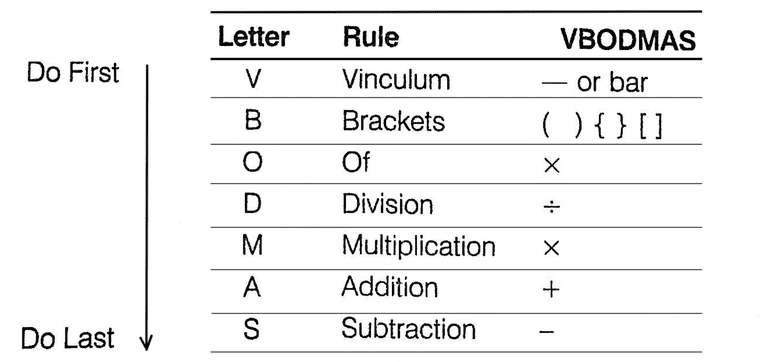
VBODMAS defines the correct order in which operations should be performed.
| Letter | Operation | Meaning |
|---|---|---|
| V | Vinculum | Bracket line operation |
| B | Bracket | Solve brackets first |
| O | Of | Multiplication by “of” |
| D | Division | Perform division |
| M | Multiplication | Perform multiplication |
| A | Addition | Perform addition |
| S | Subtraction | Perform subtraction |
Basic Example of Symbol Substitution
Suppose:
+ means ÷
− means ×
× means +
÷ means −
Expression:
45 + 9 − 3 × 15 ÷ 2
After substitution:
45 ÷ 9 × 3 + 15 − 2
Now apply VBODMAS:
= 5 × 3 + 15 − 2
= 15 + 15 − 2
= 28
Major Types of Mathematical Operations Questions
| Question Type | Description | Difficulty Level |
|---|---|---|
| Problem Solving by Substitution | Replace symbols and solve expressions | Easy to Moderate |
| Interchanging Signs and Numbers | Swap operators or numbers | Moderate |
| Miscellaneous Mathematical Patterns | Identify hidden calculation logic | Moderate to High |
| Coded Inequalities | Interpret relational symbols logically | High |
Type 1 – Problem Solving by Substitution
In this type:
- Symbols are replaced with different operators
- Candidates decode the symbols
- Expressions are solved using VBODMAS
Example:
If:
+ means ÷
− means ×
Then:
18 + 6 − 2
becomes:
18 ÷ 6 × 2 = 6
Type 2 – Interchanging Signs and Numbers
In these questions:
- Signs interchange among themselves
- Numbers interchange positions
- Candidates identify the correct transformation
Example:
If + and − interchange:
8 + 5 − 2
becomes:
8 − 5 + 2
Type 3 – Hidden Mathematical Patterns
These questions involve discovering hidden arithmetic relationships.
Example:
5 × 4 = 15
7 × 8 = 49
Pattern:
a × b = a × (b − 1)
Candidates must identify the hidden rule logically.
Type 4 – Coded Inequalities
These questions use relational operators such as:
- > Greater Than
- < Less Than
- = Equal To
- ≥ Greater Than or Equal To
- ≤ Less Than or Equal To
- ≠ Not Equal To
Candidates must evaluate whether conclusions logically follow from the given statements.
Important Concepts Required
| Concept | Application | Importance |
|---|---|---|
| VBODMAS Rule | Correct simplification order | Very High |
| Symbol Replacement | Operator decoding | Very High |
| Pattern Recognition | Hidden arithmetic logic | High |
| Relational Reasoning | Inequality evaluation | High |
| Interchanging Logic | Operator swapping | Moderate |
| Elimination Technique | Reject incorrect options quickly | High |
Most Common Examination Patterns
- Replace symbols and solve
- Find incorrect equation
- Interchange signs and numbers
- Balance equations logically
- Identify hidden arithmetic rules
- Evaluate coded inequalities
- Find valid conclusions
- Select correct transformation
Common Mistakes Made by Students
- Ignoring VBODMAS order
- Replacing symbols incorrectly
- Solving before substitution
- Overlooking hidden patterns
- Incorrect inequality interpretation
- Confusing operator meanings
- Skipping step-by-step verification
- Calculation mistakes under pressure
Fast Solving Framework
Fast Solving Framework for Mathematical Operations
Identify Symbol Meanings
↓
Replace Artificial Operators
↓
Apply VBODMAS Rule
↓
Simplify Step-by-Step
↓
Verify Final Answer
Why Mathematical Operations is Important for Competitive Exams
| Reason | Benefit |
|---|---|
| Frequently Asked Topic | Strong scoring opportunity |
| Logic-Based Questions | Improves analytical reasoning |
| Calculation-Oriented | Enhances speed and accuracy |
| Pattern Recognition | Develops observation skill |
| Short Solving Time | High score in less time |
Final Takeaway
Mathematical Operations is a highly important reasoning topic based on operator substitution, arithmetic simplification, logical pattern recognition, and coded inequality analysis.
Candidates who master VBODMAS, symbol replacement, hidden arithmetic logic, and elimination techniques can solve Mathematical Operations questions quickly and accurately across all major competitive examinations.