Counting of Figures
💡 Discover powerful problem-solving techniques including elimination methods, Venn diagrams, and analytical reasoning strategies used by experts.
Key Techniques
Study MaterialKey Techniques
Success in Counting of Figures depends on following a systematic counting strategy rather than relying on visual estimation. Most mistakes occur because candidates either miss hidden figures or count the same figure multiple times.
The techniques discussed below help candidates identify all possible figures accurately while reducing counting errors in competitive examinations.
Technique 1: Count from Smallest to Largest
This is the most reliable and widely used technique for solving Counting of Figures questions.
Always begin with the smallest visible figures and gradually move towards larger figures formed by combining smaller ones.
Recommended Counting Order
- Count smallest figures.
- Count combinations of two figures.
- Count combinations of three figures.
- Continue with larger combinations.
- Count the largest figure last.
✓ Memory Shortcut
Small → Medium → Large → Largest
Technique 2: Divide Complex Figures into Smaller Sections
Large geometrical figures often appear difficult because multiple shapes overlap with one another.
The best approach is to mentally divide the figure into smaller sections and count each section separately.
Benefits
- Reduces confusion.
- Improves accuracy.
- Makes hidden figures easier to identify.
- Prevents double counting.
Technique 3: Use the Combination Method
Many larger figures are formed by combining smaller figures.
After counting individual figures, identify all possible combinations systematically.
Examples
- Two small triangles forming a larger triangle.
- Two adjacent squares forming a rectangle.
- Multiple rectangles forming larger rectangles.
- Several polygons combining into a bigger polygon.
Technique 4: Apply Symmetry Recognition
Many figures are symmetrical. Symmetry can significantly reduce counting effort.
Types of Symmetry
- Horizontal Symmetry
- Vertical Symmetry
- Diagonal Symmetry
- Rotational Symmetry
If one half of the figure mirrors the other half, count one side first and verify using symmetry.
Technique 5: Identify Hidden Figures
Most examination questions are designed to test a candidate's ability to identify hidden shapes.
Common Hidden Figures
- Large triangles inside smaller triangles.
- Rectangles hidden within grids.
- Squares formed by combining smaller squares.
- Polygons embedded within larger structures.
🔍 Recognition Tip
After counting visible figures, deliberately search for larger shapes formed by combining adjacent regions.
Technique 6: Count Triangles Systematically
Triangle counting questions are among the most frequently asked in competitive examinations.
Triangle Counting Method
- Count all smallest triangles.
- Count triangles formed by combining two triangles.
- Count triangles formed by combining three triangles.
- Continue until the largest triangle is counted.
This method ensures that no triangle is missed.
Triangle Counting Trick #1
Addition of Divided Parts
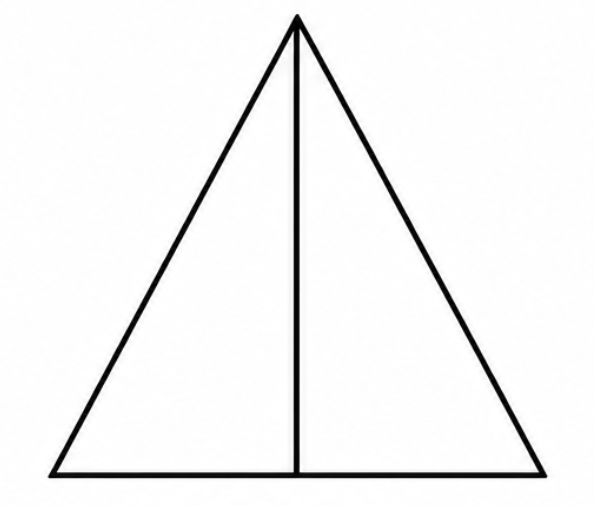
This is one of the simplest and most frequently used techniques for counting triangles. When a large triangle is divided into smaller parts using lines drawn from the vertex to the base, the total number of triangles can often be found by adding the triangles present in each divided section.
💡 Key Concept
If a triangle is divided into multiple parts by drawing lines from the top vertex to the base, the total number of triangles can be obtained by counting the triangles present in each part and then adding them together.
Step-by-Step Counting
| Part | Number of Triangles |
|---|---|
| Left Section | 1 |
| Right Section | 2 |
Calculation
Total Triangles = 1 + 2 = 3
✓ Final Answer
Total Number of Triangles = 3
🎯 Exam Tip
Whenever a triangle is divided by one or more lines from the vertex to the base, first count the triangles in each individual section and then look for larger triangles formed by combining adjacent sections. This method helps solve many counting problems quickly.
Triangle Counting Trick #2
When Parts Are Further Divided into Parts
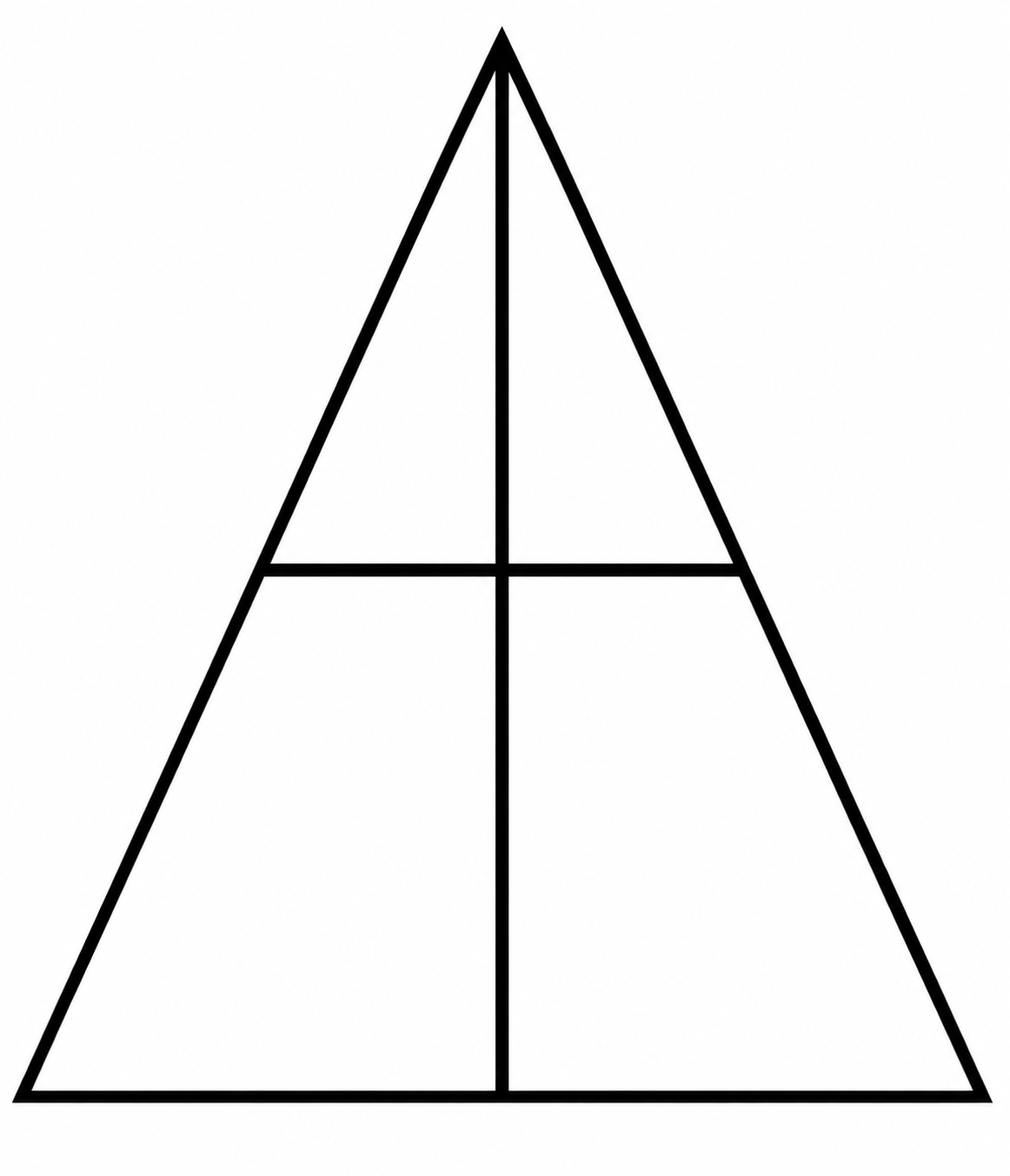
When a triangle is divided into sections and each section is further divided in the same manner, the total number of triangles can often be calculated by multiplying the count obtained from one section by the number of identical sections.
🔍 Step-by-Step Analysis
The vertical line divides the triangle into two identical halves.
Each half contains:
- 1 small triangle
- 2 triangles in total within that section
Using Triangle Counting Trick #1:
1 + 2 = 3
Since there are two identical sections, multiply the result by 2.
🧮 Calculation
(1 + 2) × 2
= 3 × 2
= 6
✓ Final Answer
Total Number of Triangles = 6
🎯 Exam Shortcut
Whenever a figure contains identical triangular sections on both sides of a central line, first count the triangles in one section and then multiply by the number of identical sections. This shortcut can save considerable time in competitive exams.
Technique 7: Count Squares Using Size Groups
For square counting questions, count squares according to their sizes.
Counting Order
- 1 × 1 squares
- 2 × 2 squares
- 3 × 3 squares
- 4 × 4 squares
- Largest square
This technique is particularly useful for grid-based questions.
Tricks for Counting Squares
Questions based on counting squares are frequently asked in Non Verbal Reasoning examinations. Instead of counting every square individually, candidates can use simple mathematical shortcuts to calculate the total number of squares quickly.
Square Counting Trick #1
When Number of Rows = Number of Columns
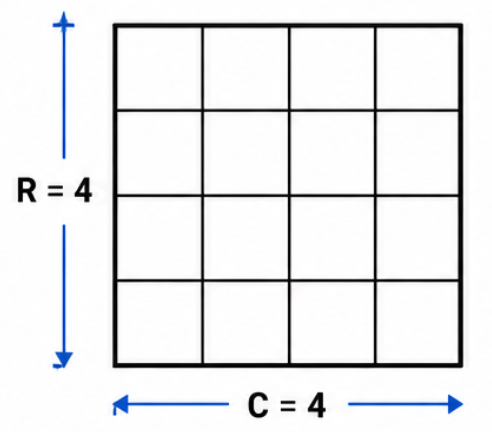
When a figure forms a perfect square grid, i.e., the number of rows and columns are equal, the total number of squares can be calculated using the following formula:
1² + 2² + 3² + ... + n²
Example
Rows (R) = 4
Columns (C) = 4
Therefore,
1² + 2² + 3² + 4²
= 1 + 4 + 9 + 16
= 30
✓ Final Answer
Total Squares = 30
Square Counting Trick #2
When Number of Rows ≠ Number of Columns
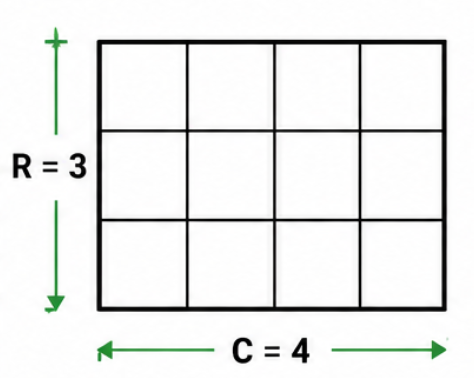
When the number of rows and columns are different, use the rectangular grid method.
Formula:
(R × C) + [(R-1) × (C-1)] + [(R-2) × (C-2)] + ...
Example
Rows (R) = 3
Columns (C) = 4
Therefore,
(4 × 3)
+
(3 × 2)
+
(2 × 1)
= 12 + 6 + 2
= 20
✓ Final Answer
Total Squares = 20
🎯 Quick Exam Shortcut
- If Rows = Columns, use 1² + 2² + 3² + ... + n².
- If Rows ≠ Columns, multiply corresponding row-column pairs and continue reducing both dimensions by 1.
- Always count squares size-wise: 1×1, 2×2, 3×3, and so on.
- This method is much faster than counting each square individually.
Technique 8: Count Rectangles Row-wise and Column-wise
Rectangle counting becomes easier when performed systematically.
Method
- Count smallest rectangles.
- Count horizontal combinations.
- Count vertical combinations.
- Count larger combined rectangles.
Tricks for Counting Rectangles
Rectangle counting questions are very common in Non Verbal Reasoning examinations. Instead of counting every rectangle individually, candidates can use simple mathematical shortcuts to calculate the total number of rectangles quickly and accurately.
Rectangle Counting Trick #1
When Number of Rows = Number of Columns
When a figure forms a square grid, i.e., the number of rows and columns are equal, the total number of rectangles can be calculated using the following formula:
(1 + 2 + 3 + ... + n) × (1 + 2 + 3 + ... + n)
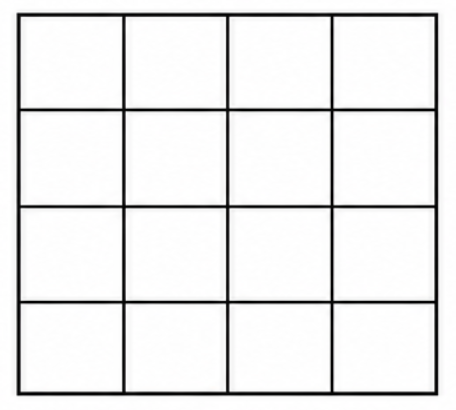
Example
R = 4, C = 4
(1 + 2 + 3 + 4) × (1 + 2 + 3 + 4)
= 10 × 10
= 100
✓ Final Answer
Total Rectangles = 100
Rectangle Counting Trick #2
When Number of Rows ≠ Number of Columns
When the number of rows and columns are different, use the rectangular grid shortcut formula.
(1 + 2 + 3 + ... + R) × (1 + 2 + 3 + ... + C)
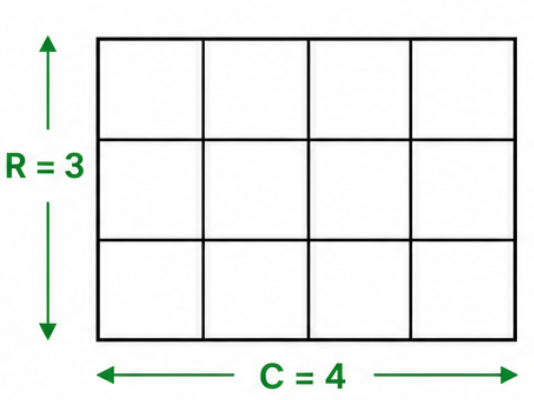
Example
R = 3, C = 4
(1 + 2 + 3) × (1 + 2 + 3 + 4)
= 6 × 10
= 60
✓ Final Answer
Total Rectangles = 60
🎯 Quick Exam Shortcut
- For a grid of R rows and C columns, first calculate the sum of row positions and column positions separately.
- Multiply both sums to obtain the total number of rectangles.
- This formula counts rectangles of all sizes, including squares.
- Much faster than counting individual rectangles manually.
Technique 9: Avoid Double Counting
Double counting is one of the most common reasons for incorrect answers.
Common Causes
- Counting overlapping figures repeatedly.
- Forgetting previously counted combinations.
- Random counting order.
- Ignoring figure boundaries.
✓ Memory Shortcut
Count Once, Verify Twice.
Technique 10: Use Reverse Verification
After obtaining the total count, verify your answer by counting in the reverse order.
For example:
- If counted from smallest to largest, verify from largest to smallest.
- Recheck major combined figures.
- Confirm hidden figures are included.
This simple technique greatly reduces errors.
Logical Deduction Framework
- Identify the figure to be counted.
- Locate the smallest visible shapes.
- Count systematically.
- Check figure combinations.
- Look for hidden figures.
- Verify using symmetry.
- Avoid double counting.
- Calculate the final answer.
Strategic Thinking Framework
SMART Counting Strategy
S → Study the figure carefully
M → Mark smallest figures first
A → Analyze combinations
R → Recognize hidden shapes
T → Total and verify
Expert Examination Tips
- Always count systematically.
- Never rely on visual estimation.
- Search for hidden figures after counting visible ones.
- Use symmetry whenever possible.
- Verify totals before finalizing.
- Practice triangle and square counting regularly.
- Avoid rushing through complex diagrams.
Final Takeaway
The key to solving Counting of Figures questions is systematic counting. Candidates who consistently count from smallest to largest, identify hidden combinations, apply symmetry, and verify their answers can solve even the most complex figure-counting problems accurately.
Mastering these techniques improves observation skills, analytical thinking, and overall performance in Non Verbal Reasoning examinations.