Counting of Figures
✏️ Practice with curated questions covering all difficulty levels. Detailed solutions and expert tips help you master each question type.
Sample Questions
Study MaterialSample Questions
The following sample questions demonstrate the most commonly asked concepts from Counting of Figures. These questions cover counting of triangles, squares, rectangles, quadrilaterals, and mixed geometrical figures frequently asked in SSC, Banking, Railway, Defence, Insurance, State PSC, CDS, NDA, and various aptitude examinations.
While solving these questions, always remember the golden rule:
Count from Smallest Figure → Medium Figure → Largest Figure.
Sample Question 1
Find the minimum number of straight lines required to make the given figure.
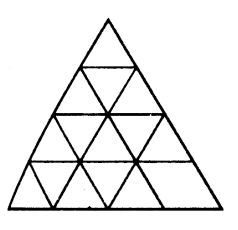
(a) 9
(b) 11
(c) 15
(d) 16
Concept Tested: Straight Lines Required
🔍 Count the Minimum Straight Lines
Count only the longest continuous straight lines in each direction.
Horizontal Lines
DE, FH, IL, BC = 4 Lines
Lines Parallel to AC
AC, DO, FN, IM = 4 Lines
Lines Parallel to AB
AB, EM, HN = 3 Lines
Total Straight Lines
4 + 4 + 3 = 11
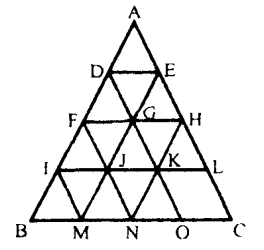
Correct Answer: (B) 11
⚡ Quick Exam Shortcut
For minimum straight line questions:
- Count continuous horizontal lines.
- Count continuous lines parallel to the left side.
- Count continuous lines parallel to the right side.
- Add them together.
4 + 4 + 3 = 11
Shortcut Answer: 11 Straight Lines
Sample Question 2
How many triangles are there in the given figure?
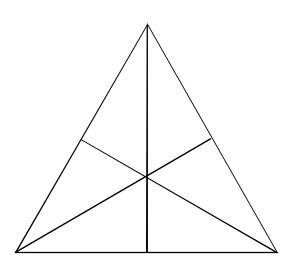
(a) 16
(b) 13
(c) 9
(d) 7
Concept Tested: Basic Triangle Counting
🔍 Count the Triangles
The figure contains triangles of different sizes. Counting all the smallest, medium and larger composite triangles gives:
The triangles are:
AGE, EGC, GFC, BGF, DGB, ADG,
AGC, BGC, ABG, AFC, BEG, BDC,
ABF, ABE, DAC, ABC
Total number of triangles: 16
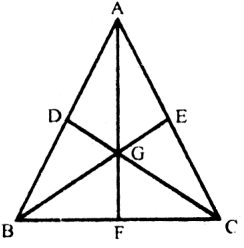
Correct Answer: (A) 16
⚡ Quick Exam Shortcut
In triangle-counting questions, do not stop after counting the visible small triangles. Always check for:
- Medium triangles formed by combining two small triangles.
- Large triangles formed by combining multiple regions.
- The complete outer triangle.
Total Triangles = 16
Sample Question 3
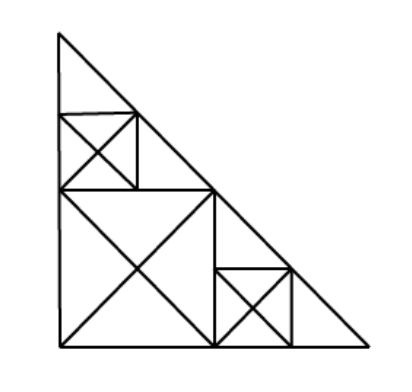
How many triangles are there in the given figure?
(a) 32
(b) 34
(c) 37
(d) 40
Concept Tested: Advanced Triangle Counting
🔍 Analyze the Figure
This is a complex triangle-counting figure containing several overlapping triangles of different sizes.
To obtain the correct answer, count the triangles systematically according to their sizes.
Step 1: Count Smallest Triangles
First count all the elementary triangles formed inside the three squares and the outer triangular sections.
Small triangles = 24
Step 2: Count Medium-Sized Triangles
Next count the triangles formed by combining two or more small triangles within the individual sections of the figure.
Medium triangles = 10
Step 3: Count Largest Composite Triangles
Finally count the larger triangles formed by combining multiple sections of the figure, including those extending across the squares and the outer boundary.
Large triangles = 3
Step 4: Calculate Total Triangles
24 + 10 + 3 = 37
Correct Answer: (c) 37
⚡ Quick Exam Shortcut
In counting-of-figures questions, the most common mistake is counting only the visible small triangles and forgetting the larger composite triangles formed by combining adjacent regions.
After counting all small, medium and large triangles, the total number of triangles is: 37
Shortcut Answer: Total Triangles = 37
Sample Question 4
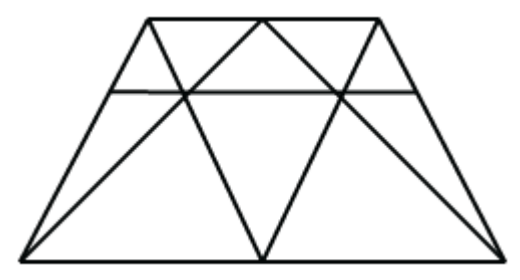
How many triangles are there in the given figure?
(a) 18
(b) 19
(c) 20
(d) 21
Concept Tested: Advanced Triangle Counting
🔍 Analyze the Figure
Count the triangles according to their sizes.
Step 1: Small Triangles
8 Triangles
Step 2: Medium Triangles
6 Triangles
Step 3: Large Triangles
4 Triangles
Step 4: Largest Composite Triangles
2 Triangles
8 + 6 + 4 + 2 = 20
Correct Answer: (c) 20
⚡ Quick Exam Shortcut
Count triangles size-wise:
- Small = 8
- Medium = 6
- Large = 4
- Largest = 2
Total = 20
Shortcut Answer: 8 + 6 + 4 + 2 = 20
Sample Question 5
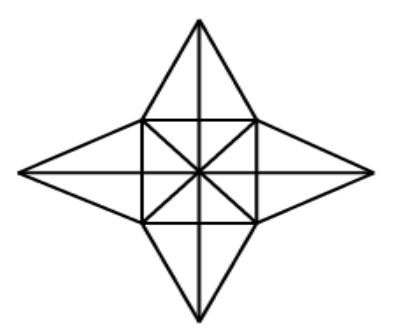
How many triangles are there in the given figure?
(a) 28
(b) 36
(c) 40
(d) 48
Concept Tested: Advanced Triangle Counting
🔍 Analyze the Figure
The figure consists of a central square having both diagonals and centre lines, with four triangles attached on its four sides.
Step 1: Count Small Triangles
16 Triangles
Step 2: Count Medium Triangles
12 Triangles
Step 3: Count Large Triangles
8 Triangles
Step 4: Calculate Total
16 + 12 + 8 = 36
Correct Answer: (b) 36
⚡ Quick Exam Shortcut
Count triangles size-wise:
- Small = 16
- Medium = 12
- Large = 8
Total = 36
Shortcut Answer: 16 + 12 + 8 = 36
Sample Question 6
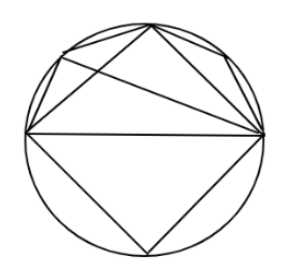
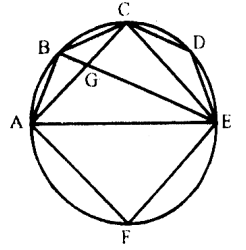
How many triangles are there in the given figure?
(a) 10
(b) 8
(c) 12
(d) 11
Concept Tested: Advanced Triangle Counting
🔍 Analyze the Figure
Count triangles according to their sizes.
Step 1: Small Triangles
4 Triangles
Step 2: Medium Triangles
4 Triangles
Step 3: Large Triangles
2 Triangles
4 + 4 + 2 = 10
ABG, BCG, CGE, CDE, AGE, AEF, ABE, ABC, BCE, ACE
Correct Answer: (a) 10
⚡ Quick Exam Shortcut
Ignore the circle and count only the regions formed by the straight line segments.
- Small triangles = 4
- Medium triangles = 4
- Large triangles = 2
Total = 10
Sample Question 7
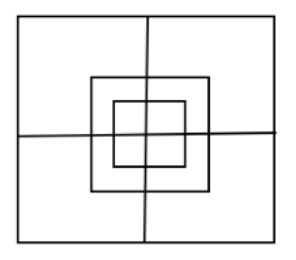
Find the number of squares?
(a) 13
(b) 14
(c) 15
(d) 16
Concept Tested: Counting Squares in a Grid
🔍 Analyze the Figure
Count the squares size-wise.
Step 1: Outer Figure
- 4 corner squares
- 1 outer square
Total = 5
Step 2: Middle Square Region
- 4 small squares inside the middle square
- 1 middle square
Total = 5
Step 3: Innermost Square Region
- 4 tiny squares
- 1 innermost square
Total = 5
Step 4: Adjust Overcount
One square is counted twice due to overlapping boundaries.
16 − 1 = 15
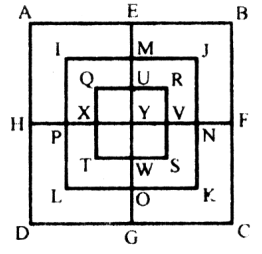
ABI, BIC, ALJ, CIJ, AHJ, CDJ, JHG, JDE, GJF, EJF, ABC, BCJ, ACJ, BAJ, AJG, CJE, GJE, ACG, ACE, CGE, AGE
Correct Answer: (c) 15
⚡ Quick Exam Shortcut
Count square-by-square:
- Outer figure = 5
- Middle square region = 5
- Inner square region = 5
Total: 5 + 5 + 5 = 15
Shortcut Answer: 15 Squares
Sample Question 8
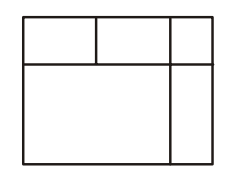
How many rectangles are there in the figure given ?
(a) 8
(b) 9
(c) 10
(d) 11
Concept Tested: Counting Rectangles in a Grid
🔍 Count the Rectangles
Step 1: Small Rectangles
- Top row = 3 rectangles
- Bottom row = 2 rectangles
Total = 5
Step 2: Top Row Combinations
- Left + Middle
- Middle + Right
- Left + Middle + Right
Total = 3
Running Total = 8
Step 3: Full-Height Rectangles
2 Rectangles
Running Total = 10
Step 4: Outer Rectangle
1 Rectangle
10 + 1 = 11
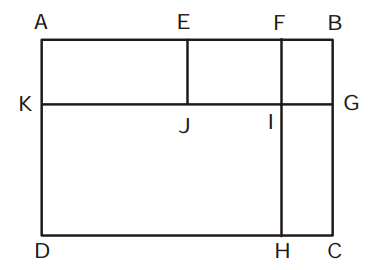
The rectangles are : ABCD, AEJK, AFIK, ABGK, EFIJ, EBGJ, FBGI, FBCH, IGCH, AFHD, KIHD
Correct Answer: (d) 11
⚡ Quick Exam Shortcut
Count rectangles row-wise and then add all larger combinations.
5 + 3 + 2 + 1 = 11
Shortcut Answer: 11 Rectangles
Sample Question 9
How many rectangles are there in the figure given ?
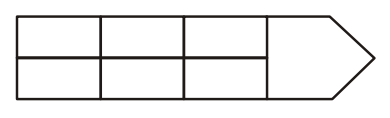
(a) 4
(b) 7
(c) 9
(d) 18
Concept Tested: Counting Rectangles in a Grid
🔍 Count the Rectangles
Only the rectangular portion contributes to the rectangle count. The arrow-head section does not form any rectangle.
Step 1: Small Rectangles
4 (top row) + 4 (bottom row) = 8
Step 2: Two-Column Rectangles
3 (top row) + 3 (bottom row) = 6
Running Total = 14
Step 3: Three-Column Rectangles
2 (top row) + 2 (bottom row) = 4
Running Total = 18
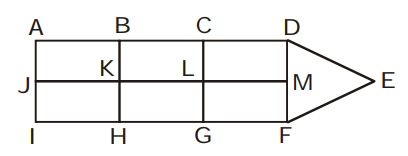
The rectangles are : ABKJ; JKHI; BCLK; KLGH; CDML; LMFG; ACGI; ACLJ; JLGI; BDFH; BDMK; KMFH; ADFI; ADMJ; JMFI ABHI, BCGH and CDFG are squares.
We know that every square is a rectangle. But its reverse is not always true.
Correct Answer: (d) 18
⚡ Quick Exam Shortcut
Ignore the arrow-head and count only complete rectangles.
- Small rectangles = 8
- Two-column rectangles = 6
- Three-column rectangles = 4
8 + 6 + 4 = 18
Shortcut Answer: 18 Rectangles
Sample Question 10
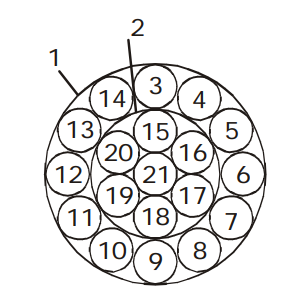
How many circles are there in this figure ?
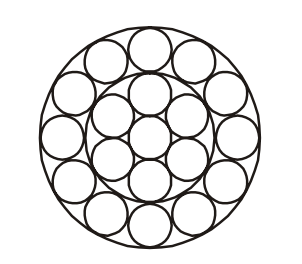
(a) 19
(b) 18
(c) 17
(d) 21
Concept Tested: Count the Circles
🔍 Count the Circles
Count all complete circles visible in the figure.
Step 1: Outer Ring Circles
The outer ring contains 12 circles.
Total = 12
Step 2: Inner Ring Circles
The inner ring contains 6 circles.
12 + 6 = 18
Step 3: Centre Circle
There is 1 circle at the centre.
18 + 1 = 19
Step 4: Boundary Circles
The figure also contains:
- 1 outer enclosing circle
- 1 inner enclosing circle
19 + 2 = 21
Correct Answer: (d) 21
⚡ Quick Exam Shortcut
Count circles ring-wise:
- Outer Ring = 12
- Inner Ring = 6
- Centre = 1
- Boundary Circles = 2
12 + 6 + 1 + 2 = 21
Shortcut Answer: 21 Circles
Sample Question 11
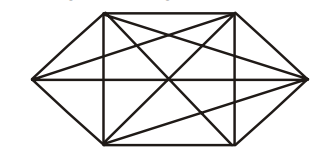
How many diagonals are there in the given diagram?
(a) 10
(b) 12
(c) 8
(d) 6
Concept Tested: Count the Circles
🔍 Analysis
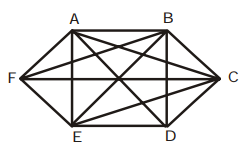
The diagonals are : EC, AC, BE, BF, AD, CF
Correct Answer: (d) 6
Sample Question 12
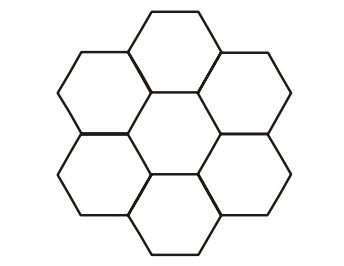
Six regular Hexagons of side 5 cm are joined together to form the figure given below. What is the perimeter of this figure?
(a) 210
(b) 180
(c) 120
(d) 240
Concept Tested: Mixed Figure Counting
🔍 Analyze the Figure
The figure is formed by 7 regular hexagons arranged in a honeycomb pattern.
Step 1: Count the Outer Boundary Sides
The complete outer boundary consists of 24 sides.
Outer sides = 24
Step 2: Multiply by Side Length
Each side of a hexagon measures 5 cm.
Perimeter = 24 × 5
= 120 cm
Correct Answer: (C) 120 cm
⚡ Quick Exam Shortcut
For 7 hexagons arranged in a honeycomb pattern:
Outer Boundary = 24 Side Units
Perimeter = 24 × 5 = 120 cm
Shortcut Answer: 120 cm
Approach to Solve Counting of Figures Questions
- Identify the figure to be counted.
- Count the smallest figures first.
- Count larger combined figures.
- Check for hidden figures.
- Use formulas wherever applicable.
- Verify the final count.
Important Concepts Covered
- Counting Straight Lines
- Counting Triangles
- Counting Squares
- Counting Rectangles
- Counting Quadrilaterals
- Counting Circles
- Counting Hidden Figures
- Grid-Based Counting
Common Mistakes Students Make
- Missing larger combined figures.
- Double counting the same figure.
- Ignoring hidden shapes.
- Using random counting order.
- Skipping verification.
Expert Tips for Solving Counting of Figures Questions
- Always count from smallest to largest.
- Use symmetry whenever possible.
- Apply shortcut formulas for squares and rectangles.
- Mark counted figures mentally.
- Verify your answer before final submission.
Quick Learning Framework
Identify Figure Type
↓
Count Small Figures
↓
Count Combined Figures
↓
Find Hidden Figures
↓
Verify Total Count
Final Takeaway
Counting of Figures is one of the most scoring topics in Non Verbal Reasoning. Candidates who develop the habit of systematic counting, recognize hidden geometrical structures, and apply shortcut formulas can solve complex figure-counting questions accurately within seconds.