Physics
🌍 Expand your horizons with comprehensive general knowledge covering history, geography, science, culture, and current events. Stay informed and aware.
Introduction
Study MaterialPhysics
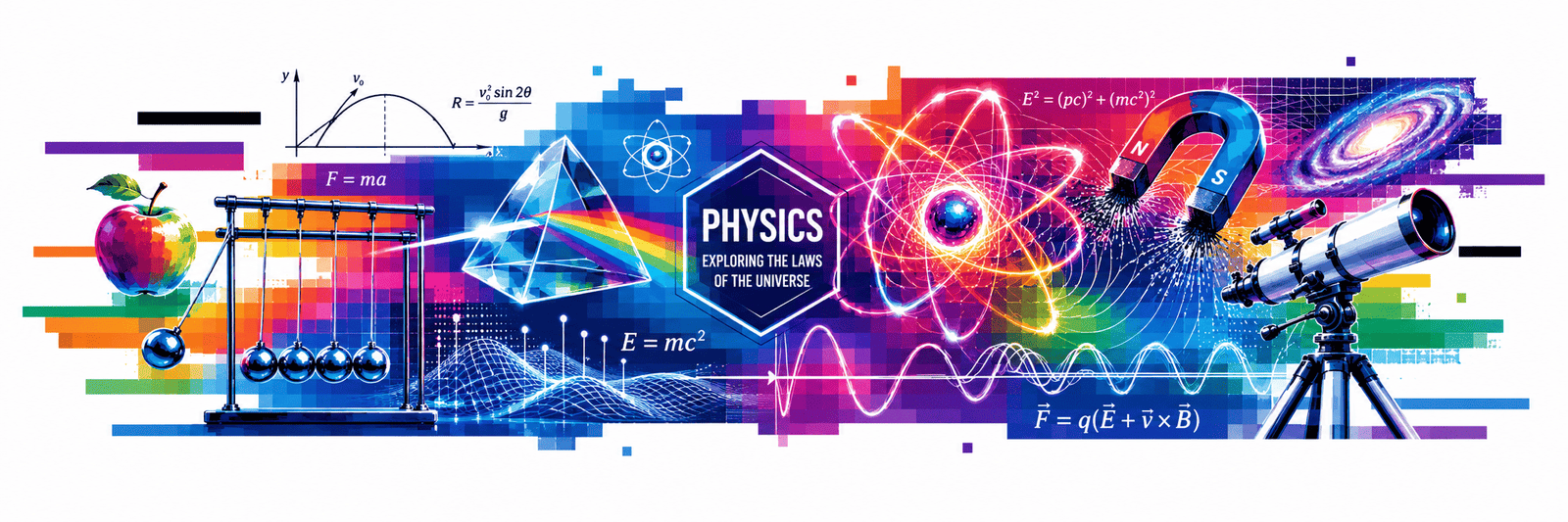
Physics is the branch of science that studies matter, energy, motion, force, space, time, and the fundamental laws governing the universe.
From the movement of planets to electricity, sound, light, heat, gravity, machines, communication systems, and modern technology, Physics explains how the physical world works around us.
Physics is one of the most important sections in General Science and General Knowledge for competitive examinations such as UPSC, SSC, Railway, Banking, Defence, State PSC, CDS, NDA, Insurance, and various government exams.
What is Physics?
Physics studies natural phenomena and the interaction between matter and energy using scientific laws, measurements, and mathematical principles.
Physics mainly deals with:
- Motion and Force
- Work, Energy & Power
- Heat and Temperature
- Light and Optics
- Sound and Waves
- Electricity and Magnetism
- Gravity and Planetary Motion
- Modern Physics & Technology
Importance of Physics
Daily Life
Electricity, transport, mobile phones, fans, TVs, and machines work on physics principles.
Competitive Exams
Physics concepts are frequently asked in General Science sections.
Technology
Modern inventions and communication systems depend heavily on physics.
Space & Research
Space missions, satellites, and scientific research use physics principles extensively.
Main Branches of Physics
| Branch | Study Area |
|---|---|
| Mechanics | Motion, force, and energy |
| Thermodynamics | Heat and temperature |
| Optics | Light and vision |
| Acoustics | Sound and waves |
| Electromagnetism | Electricity and magnetism |
| Modern Physics | Atomic and nuclear physics |
Motion & Force
Motion is the change in position of an object with time, while force causes or changes motion.
- SI unit of force → Newton
- SI unit of speed → Meter/Second
- SI unit of work → Joule
- SI unit of power → Watt
- Gravity pulls objects towards Earth
- Friction opposes motion
Newton’s Laws of Motion
- First Law → A body remains at rest or in uniform motion unless acted upon by an external force.
- Second Law → Force = Mass × Acceleration
- Third Law → Every action has an equal and opposite reaction.
Work, Energy & Power
| Quantity | Definition | Unit |
|---|---|---|
| Work | Force × Distance | Joule |
| Energy | Capacity to do work | Joule |
| Power | Rate of doing work | Watt |
Heat & Temperature
- SI unit of temperature → Kelvin
- Heat flows from hot object to cold object
- Clinical thermometer measures body temperature
- Normal human body temperature → 37°C
- Thermometer invented by → Galileo
- Heat transfer occurs by conduction, convection, and radiation
Light & Optics
| Concept | Explanation |
|---|---|
| Reflection | Bouncing back of light |
| Refraction | Bending of light |
| Convex Lens | Used in magnifying glass |
| Concave Mirror | Used in vehicle headlights |
| Rainbow Formation | Dispersion of light |
Sound & Waves
- Sound travels fastest in → Solids
- SI unit of frequency → Hertz
- Ultrasound used in → Medical imaging
- Human audible range → 20 Hz to 20,000 Hz
- Echo occurs due to → Reflection of sound
- SONAR uses → Sound waves
Electricity & Magnetism
| Quantity | Unit |
|---|---|
| Electric Current | Ampere |
| Potential Difference | Volt |
| Resistance | Ohm |
| Power | Watt |
| Charge | Coulomb |
Modern Physics & Technology
- Laser technology used in medicine and communication
- X-rays discovered by Wilhelm Roentgen
- Radioactivity discovered by Henri Becquerel
- Nuclear energy produced by atomic reactions
- Satellites use communication technology
- Solar cells convert sunlight into electricity
Important Physics Topics Asked in Exams
- Newton’s Laws of Motion
- Work, Energy & Power
- Heat & Thermodynamics
- Light & Reflection
- Sound & Waves
- Electricity & Magnetism
- Modern Physics
- Units & Measurements
- Gravity & Motion
- Scientific Discoveries
Applications of Physics
- Electricity generation
- Communication systems
- Transportation technology
- Medical equipment
- Space exploration
- Defense systems
- Computer technology
- Renewable energy systems
How to Prepare Physics?
- Understand basic physics concepts clearly.
- Remember important formulas and units.
- Study laws and scientific discoveries.
- Practice numerical and concept-based questions.
- Focus on everyday applications of physics.
- Solve physics MCQs regularly.
Quick Learning Framework
Learn Basic Concepts
↓
Understand Motion & Force
↓
Study Heat, Light & Sound
↓
Revise Electricity & Modern Physics
↓
Practice MCQs Daily
↓
Boost GK Preparation
Final Takeaway
Physics is an important branch of science that explains motion, force, energy, electricity, light, sound, and the laws governing the universe.
Strong preparation of physics concepts improves General Science knowledge, analytical thinking, and competitive examination performance significantly.