Indian Economy
🌍 Expand your horizons with comprehensive general knowledge covering history, geography, science, culture, and current events. Stay informed and aware.
Introduction
Study MaterialIndian Economy
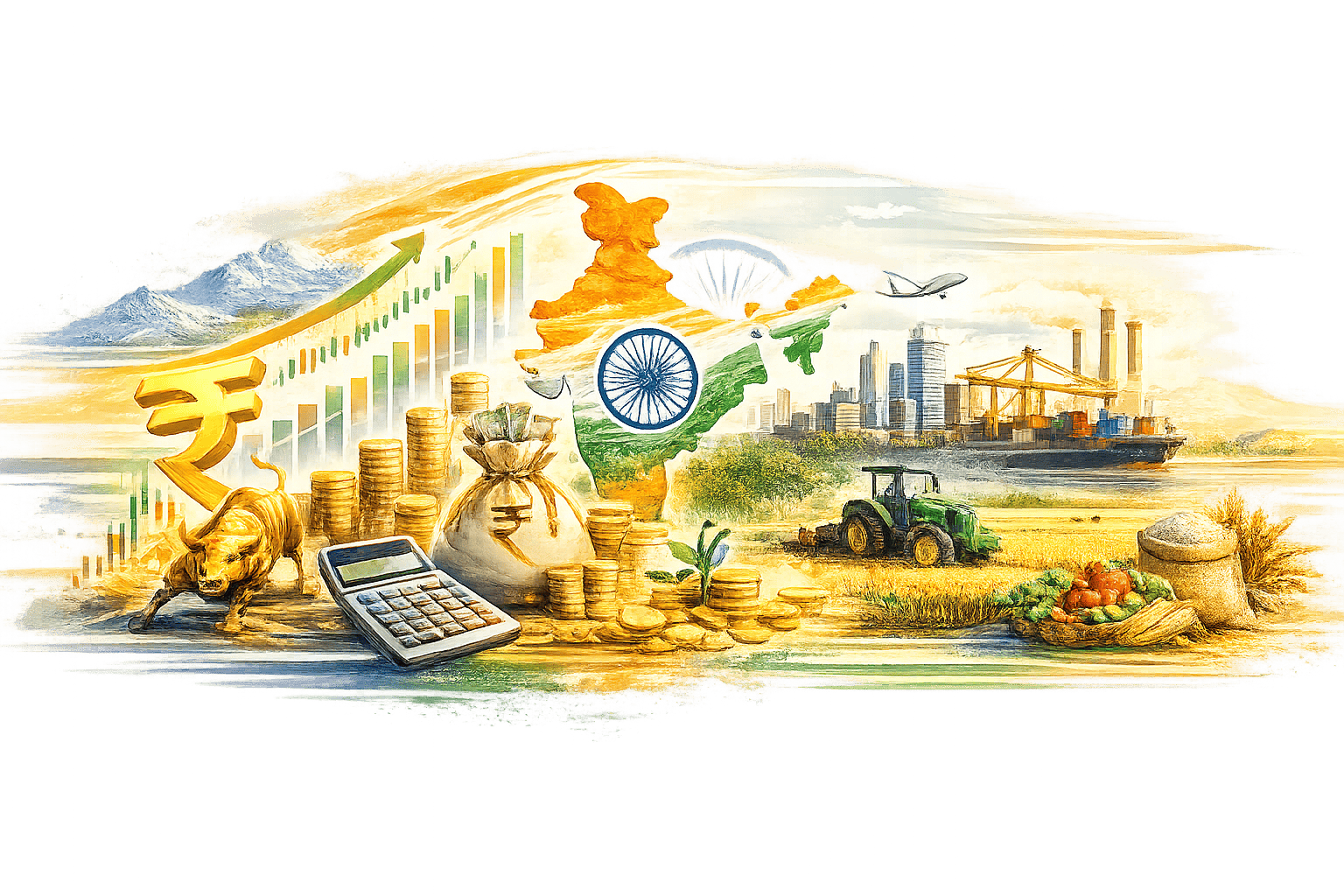
Indian Economy is one of the most important sections of General Knowledge and Current Affairs for competitive examinations. It studies the production, distribution, consumption, trade, banking, finance, taxation, agriculture, industries, and economic development of India.
The Indian economy is a mixed economy where both the government and private sector participate in economic activities. It is currently one of the fastest-growing major economies in the world.
Indian Economy is highly important for UPSC, SSC, Banking, Railway, Defence, State PSC, CDS, NDA, Insurance, MBA entrance exams, and various government examinations.
What is Economy?
An economy is a system through which goods and services are produced, distributed, and consumed in a country.
Indian Economy mainly deals with:
- Agriculture & Rural Development
- Industries & Manufacturing
- Banking & Finance
- Taxation & Budget
- Trade & Commerce
- Inflation & Unemployment
- Economic Planning & Policies
- GDP, Fiscal & Monetary Systems
Features of Indian Economy
Mixed Economy
Both public and private sectors participate in economic activities.
Agriculture-Based
A large population in India depends on agriculture for livelihood.
Developing Economy
India is rapidly growing in industry, services, and technology sectors.
Large Population
India has one of the world’s largest consumer and labor markets.
Main Sectors of Indian Economy
| Sector | Related Activities |
|---|---|
| Primary Sector | Agriculture, Fishing, Mining |
| Secondary Sector | Manufacturing & Industries |
| Tertiary Sector | Services, Banking, IT, Transport |
Important Economic Terms
- GDP → Gross Domestic Product
- GNP → Gross National Product
- Inflation → Rise in prices
- Deflation → Fall in prices
- Fiscal Deficit → Excess government expenditure over income
- Repo Rate → Rate at which RBI lends money to banks
- Reverse Repo Rate → Rate at which RBI borrows from banks
- CRR → Cash Reserve Ratio
- SLR → Statutory Liquidity Ratio
- Per Capita Income → Average income per person
Reserve Bank of India (RBI)
The Reserve Bank of India is the central bank of India responsible for monetary policy, currency issuance, banking regulation, and financial stability.
| Fact | Information |
|---|---|
| Established | 1935 |
| Nationalized | 1949 |
| Headquarters | Mumbai |
| Main Role | Control Monetary System |
Banking System in India
- Commercial Banks provide loans and deposits
- Regional Rural Banks support rural banking
- Cooperative Banks support agriculture and local finance
- Digital Banking enables online transactions
- UPI transformed India’s payment system
- NPCI manages digital payment systems
Budget & Taxation
| Term | Meaning |
|---|---|
| Union Budget | Annual financial statement of government |
| Direct Tax | Income Tax, Corporate Tax |
| Indirect Tax | GST, Customs Duty |
| GST | Goods and Services Tax |
| Fiscal Deficit | Expenditure exceeds revenue |
Agriculture & Green Revolution
- India is an agriculture-based economy
- Green Revolution increased food grain production
- Father of Green Revolution in India → M. S. Swaminathan
- White Revolution related to → Milk Production
- Operation Flood related to → Dairy Development
- Yellow Revolution related to → Oilseed Production
- Blue Revolution related to → Fish Production
Five-Year Plans & NITI Aayog
| Institution | Role |
|---|---|
| Planning Commission | Economic Planning (Old System) |
| NITI Aayog | Policy Think Tank |
| Five-Year Plans | Economic Development Planning |
| First Five-Year Plan | Started in 1951 |
Important Economic Institutions
- RBI → Central Bank of India
- SEBI → Securities Market Regulator
- NABARD → Agriculture & Rural Development
- SIDBI → Small Industries Development
- World Bank → International Financial Assistance
- IMF → Global Monetary Cooperation
- WTO → International Trade Organization
Important Economic Topics Asked in Exams
- GDP & National Income
- Inflation & Unemployment
- Banking & RBI
- Budget & Taxation
- Economic Planning
- Agriculture & Revolutions
- Digital Economy
- Government Schemes
- Fiscal & Monetary Policy
- International Economic Organizations
Applications of Economics in Daily Life
- Banking & digital payments
- Employment & business activities
- Price rise and inflation
- Taxation and government policies
- Investments and savings
- Agriculture and industries
- Imports and exports
- Public welfare schemes
How to Prepare Indian Economy?
- Learn basic economic terms clearly.
- Study banking and RBI functions regularly.
- Remember important schemes and institutions.
- Revise budget and taxation concepts.
- Follow current economic developments.
- Practice economy MCQs daily.
Quick Learning Framework
Learn Basic Economic Terms
↓
Understand Banking & RBI
↓
Study Budget & Taxation
↓
Revise Economic Policies & Schemes
↓
Practice MCQs Daily
↓
Boost GK Preparation
Final Takeaway
Indian Economy is an important branch of General Knowledge that explains banking, finance, taxation, agriculture, industries, trade, and economic development in India.
Strong preparation of Indian Economy improves current affairs awareness, analytical understanding, and competitive examination performance significantly.