Indian Culture
🌍 Expand your horizons with comprehensive general knowledge covering history, geography, science, culture, and current events. Stay informed and aware.
Introduction
Study MaterialIndian Culture
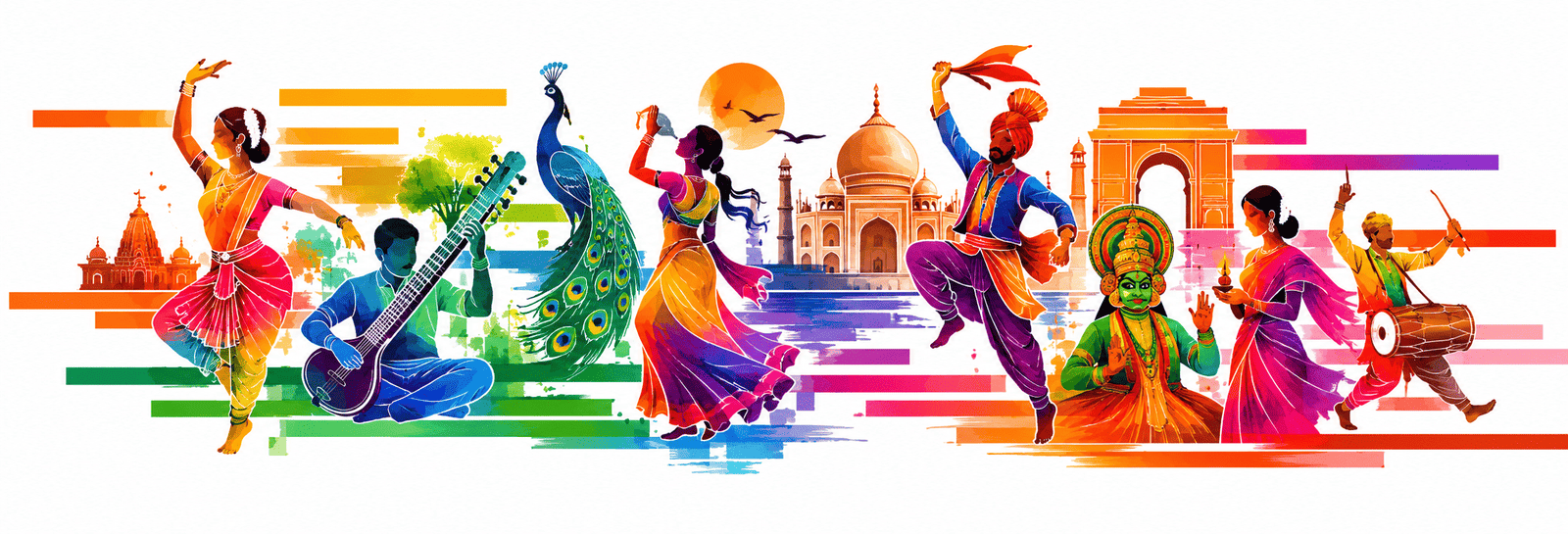
Indian Culture is one of the oldest, richest, and most diverse cultures in the world. It represents the traditions, religions, languages, festivals, music, dance, architecture, food, customs, literature, and lifestyle followed by people across India for thousands of years.
Indian Culture is an important topic in General Knowledge and Current Affairs sections of competitive examinations such as UPSC, SSC, Banking, Railway, Defence, State PSC, Insurance, NEET, and various government exams.
What is Indian Culture?
Indian Culture refers to the collective cultural heritage of India developed over several millennia through different civilizations, dynasties, religions, traditions, and communities.
Indian Culture mainly includes:
- Languages & Literature
- Religions & Philosophy
- Dance & Music
- Art & Architecture
- Festivals & Traditions
- Food & Clothing
- Historical Monuments
- Classical & Folk Arts
- Customs & Rituals
- Indian Heritage & Civilization
Features of Indian Culture
| Feature | Description |
|---|---|
| Diversity | Different religions, languages, traditions, and customs |
| Unity in Diversity | Cultural harmony among different communities |
| Ancient Civilization | One of the oldest civilizations in the world |
| Religious Tolerance | Respect for all religions |
| Spiritual Heritage | Strong philosophical and spiritual traditions |
| Cultural Continuity | Traditions passed from generation to generation |
Ancient Indian Civilization
Indian civilization is one of the most ancient civilizations in the world with a history of thousands of years.
- Indus Valley Civilization was one of the earliest civilizations on earth.
- Vedic Period marked the beginning of Hindu philosophy and traditions.
- Maurya and Gupta periods contributed greatly to Indian culture and knowledge.
- Indian philosophy influenced many parts of the world.
- Mughal architecture added significant cultural heritage to India.
Religions in India
India is the birthplace of many major religions and is known for religious diversity and tolerance.
| Religion | Holy Book | Place of Worship |
|---|---|---|
| Hinduism | Vedas & Bhagavad Gita | Temple |
| Islam | Quran | Mosque |
| Christianity | Bible | Church |
| Sikhism | Guru Granth Sahib | Gurdwara |
| Buddhism | Tripitaka | Monastery / Temple |
| Jainism | Agamas | Temple |
Classical Dance Forms of India
Indian classical dances are important cultural traditions representing devotion, storytelling, expressions, and heritage.
- Bharatanatyam → Tamil Nadu
- Kathak → North India
- Kathakali → Kerala
- Kuchipudi → Andhra Pradesh
- Manipuri → Manipur
- Odissi → Odisha
- Mohiniyattam → Kerala
- Sattriya → Assam
Traditional Music of India
| Music Type | Region |
|---|---|
| Hindustani Music | North India |
| Carnatic Music | South India |
Indian music includes vocal music, instrumental music, folk music, devotional music, and classical music traditions.
Important Historical Monuments
- Taj Mahal → Agra
- Qutub Minar → Delhi
- Ajanta & Ellora Caves → Maharashtra
- Konark Sun Temple → Odisha
- Khajuraho Temples → Madhya Pradesh
- Hawa Mahal → Jaipur
- Mysore Palace → Karnataka
- Mahabalipuram → Tamil Nadu
- Golden Temple → Amritsar
Festivals of India
India celebrates a large number of religious, seasonal, and cultural festivals throughout the year.
| Festival | Religion / Region |
|---|---|
| Diwali | Hindu Festival |
| Holi | Festival of Colours |
| Eid-ul-Fitr | Muslim Festival |
| Christmas | Christian Festival |
| Guru Nanak Jayanti | Sikh Festival |
| Pongal | Tamil Nadu Harvest Festival |
| Bihu | Assam Festival |
| Onam | Kerala Festival |
National Symbols of India
- National Flag → Tricolour
- National Anthem → Jana Gana Mana
- National Song → Vande Mataram
- National Animal → Tiger
- National Bird → Peacock
- National Flower → Lotus
- National Fruit → Mango
- National Tree → Banyan Tree
- National Emblem → Lion Capital of Ashoka
- National Motto → Satyameva Jayate
Basic Information About India
| Topic | Information |
|---|---|
| Capital of India | New Delhi |
| Continent | Asia |
| Official Languages | Hindi & English |
| Currency | Indian Rupee |
| Total Coastline | 7,517 KM |
| Largest State by Area | Rajasthan |
| Largest State by Population | Uttar Pradesh |
| Longest River | Ganga |
| Highest Peak | Kanchenjunga |
| Largest Desert | Thar Desert |
Important National Days
- Republic Day → 26 January
- Independence Day → 15 August
- Gandhi Jayanti → 2 October
- Teachers’ Day → 5 September
- Children’s Day → 14 November
- National Education Day → 11 November
- Martyrs’ Day → 30 January
Important Firsts in India
| First in India | Name |
|---|---|
| First President of India | Dr. Rajendra Prasad |
| First Prime Minister of India | Jawaharlal Nehru |
| First Indian in Space | Rakesh Sharma |
| First Indian Nobel Prize Winner | Rabindranath Tagore |
| First Woman Prime Minister | Indira Gandhi |
| First Indian Satellite | Aryabhata |
Nicknames of Famous Indian Cities
- Pink City → Jaipur
- City of Joy → Kolkata
- Financial Capital of India → Mumbai
- Silicon Valley of India → Bengaluru
- City of Nawabs → Lucknow
- Temple City of India → Bhubaneswar
- City of Lakes → Bhopal
- Steel City of India → Jamshedpur
Nicknames of Famous Indian Personalities
| Nickname | Personality |
|---|---|
| Bapu | Mahatma Gandhi |
| Nightingale of India | Sarojini Naidu |
| Iron Man of India | Sardar Vallabhbhai Patel |
| Gurudev | Rabindranath Tagore |
| Lokmanya | Bal Gangadhar Tilak |
| Frontier Gandhi | Khan Abdul Ghaffar Khan |
Most Important Topics Asked in Exams
- Classical Dances of India
- Religions & Holy Books
- National Symbols
- Historical Monuments
- Festivals of India
- Music & Musical Instruments
- Important Firsts in India
- Nicknames of Cities & Personalities
- Important Dates in Indian History
- Indian Heritage & Architecture
How to Prepare Indian Culture?
- Study important cultural facts regularly.
- Learn classical dances, music, and festivals.
- Remember national symbols and monuments.
- Focus on religions, holy books, and traditions.
- Revise important personalities and nicknames.
- Practice culture-based MCQs daily.
Quick Learning Framework
Learn Indian Heritage
↓
Remember Festivals & Religions
↓
Study Dances & Music
↓
Revise National Symbols
↓
Practice Culture MCQs
↓
Boost GK Preparation
Final Takeaway
Indian Culture reflects the rich heritage, traditions, diversity, spirituality, and historical development of India across thousands of years.
Strong preparation in Indian Culture improves general awareness, cultural understanding, and performance in competitive examinations and interviews.