Top 30 Salesforce CPQ Interview Questions & Answers
Thirty Salesforce CPQ interview questions with answers — quote-to-cash, products, bundles, price rules, product rules, approvals and contracts.
Salesforce Headless 360 explained — what headless CRM means, how APIs and data cloud power it, and what it changes for developers and businesses.

For years, CRM systems have followed a familiar pattern: users log in, navigate dashboards, and manually perform tasks. Platforms like Salesforce have been at the center of this model.
But things are changing.
With the rise of AI, automation, and real-time integrations, businesses no longer want to rely on human-driven workflows. They want systems that can think, decide, and act automatically.
This is where Salesforce Headless 360 Architecture comes in.
Headless 360 represents a shift from UI-driven CRM to API-driven CRM, where Salesforce operates as a backend engine powering intelligent workflows across multiple channels.
Salesforce Headless 360 is an API-first architecture where Salesforce runs without depending on its traditional user interface.
In a Headless setup, users are no longer dependent on screens or manual clicks. The entire system is accessed programmatically through:
👉 API becomes the primary interface
Salesforce is evolving from a traditional CRM platform into a powerful backend engine. With Headless 360, it becomes the core system that powers AI-driven workflows, integrations, and automation across multiple applications.
In short: Salesforce is no longer just a UI-based tool — it’s becoming an API-first, AI-powered platform.
Traditional CRM assumes humans are always in the loop.
But today’s reality is different.
AI agents are increasingly capable of:
And here’s the key insight:
AI does not use UI. It uses APIs.
This is why Salesforce restructured the platform so that:
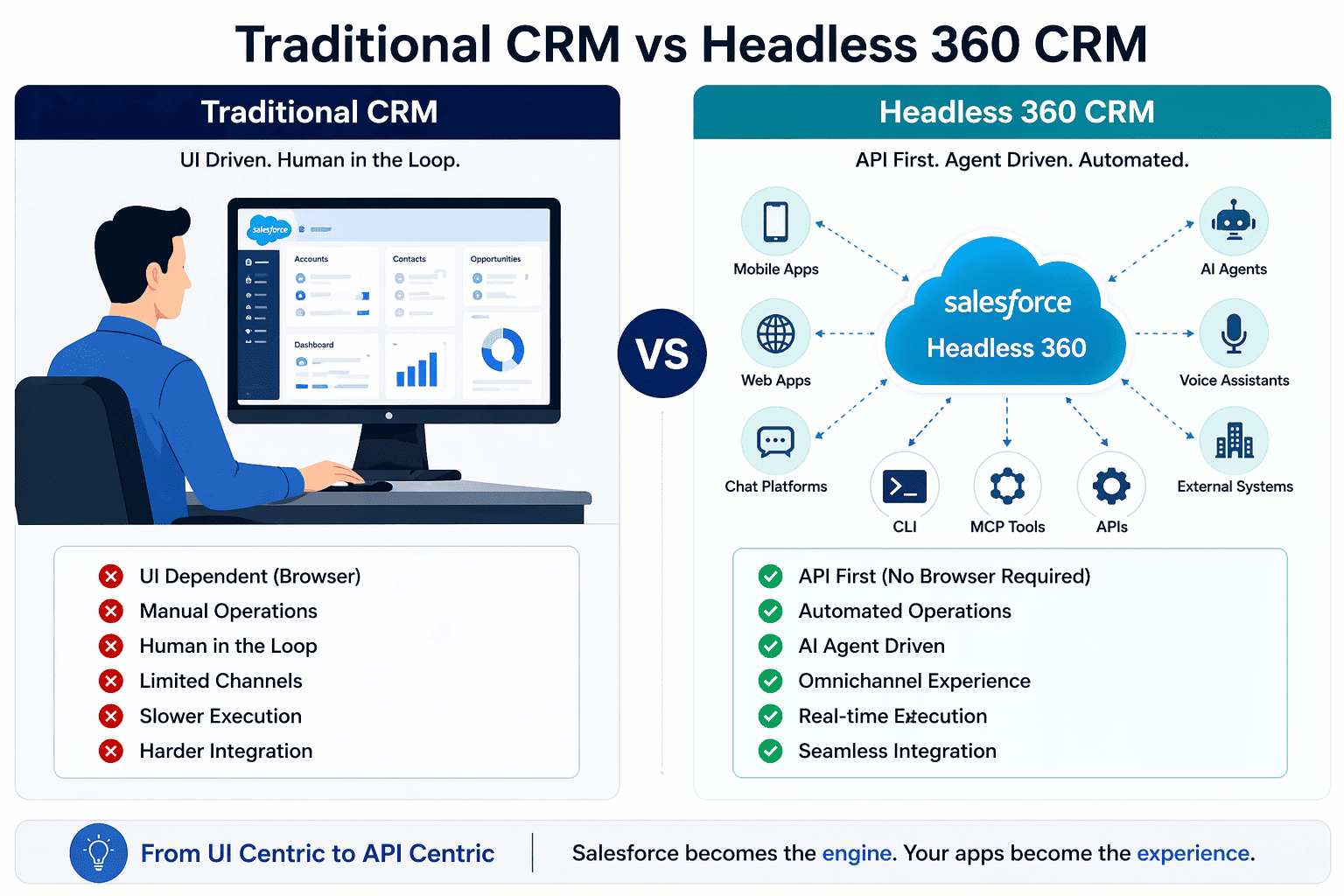
This marks the transition to what experts call agent-first architecture
Salesforce introduced three major capabilities:
Salesforce now provides 60+ MCP tools and prebuilt skills that allow AI agents to directly interact with:
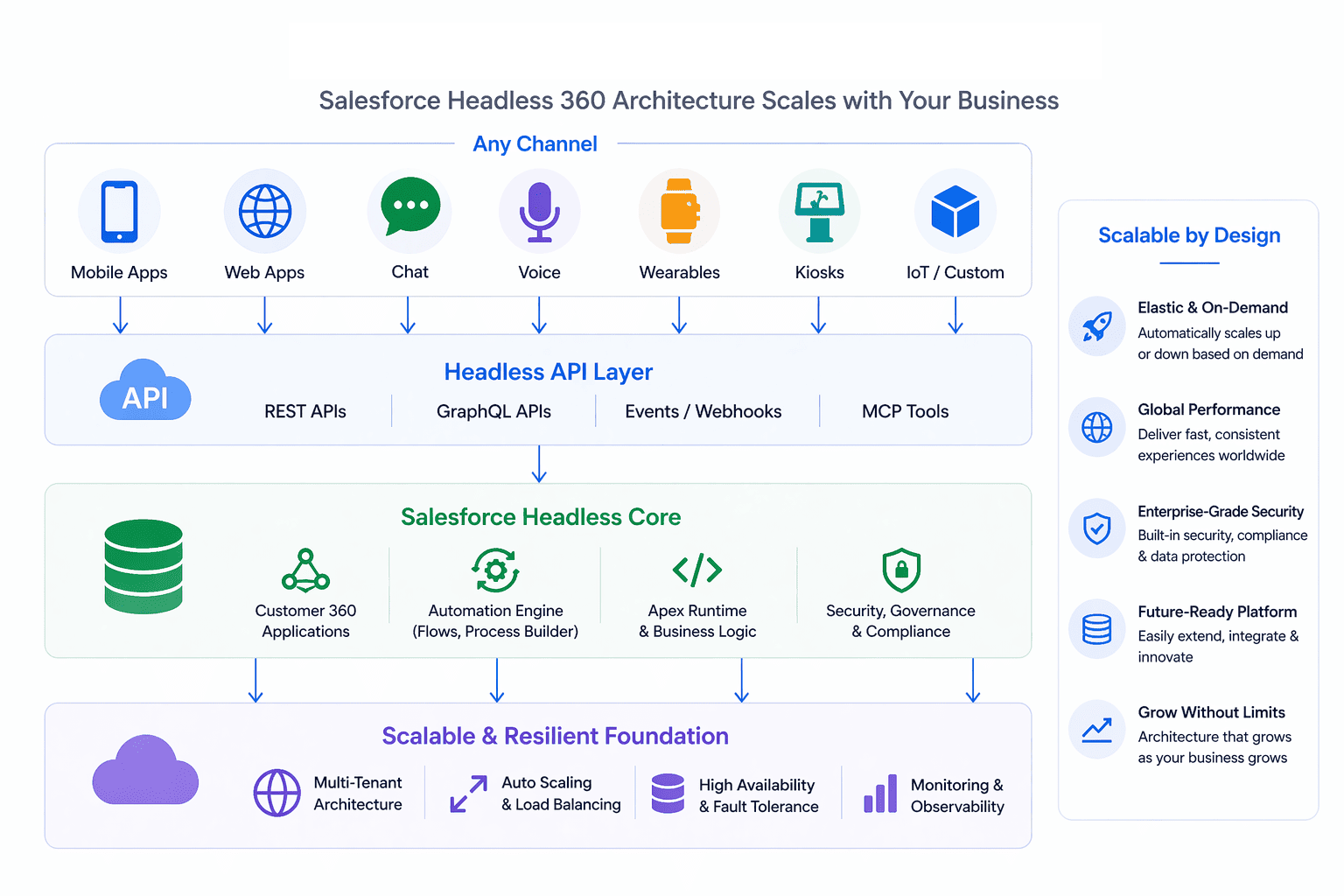
Agents can operate your entire org without custom integrations
Instead of one UI (Lightning), you can now interact through:
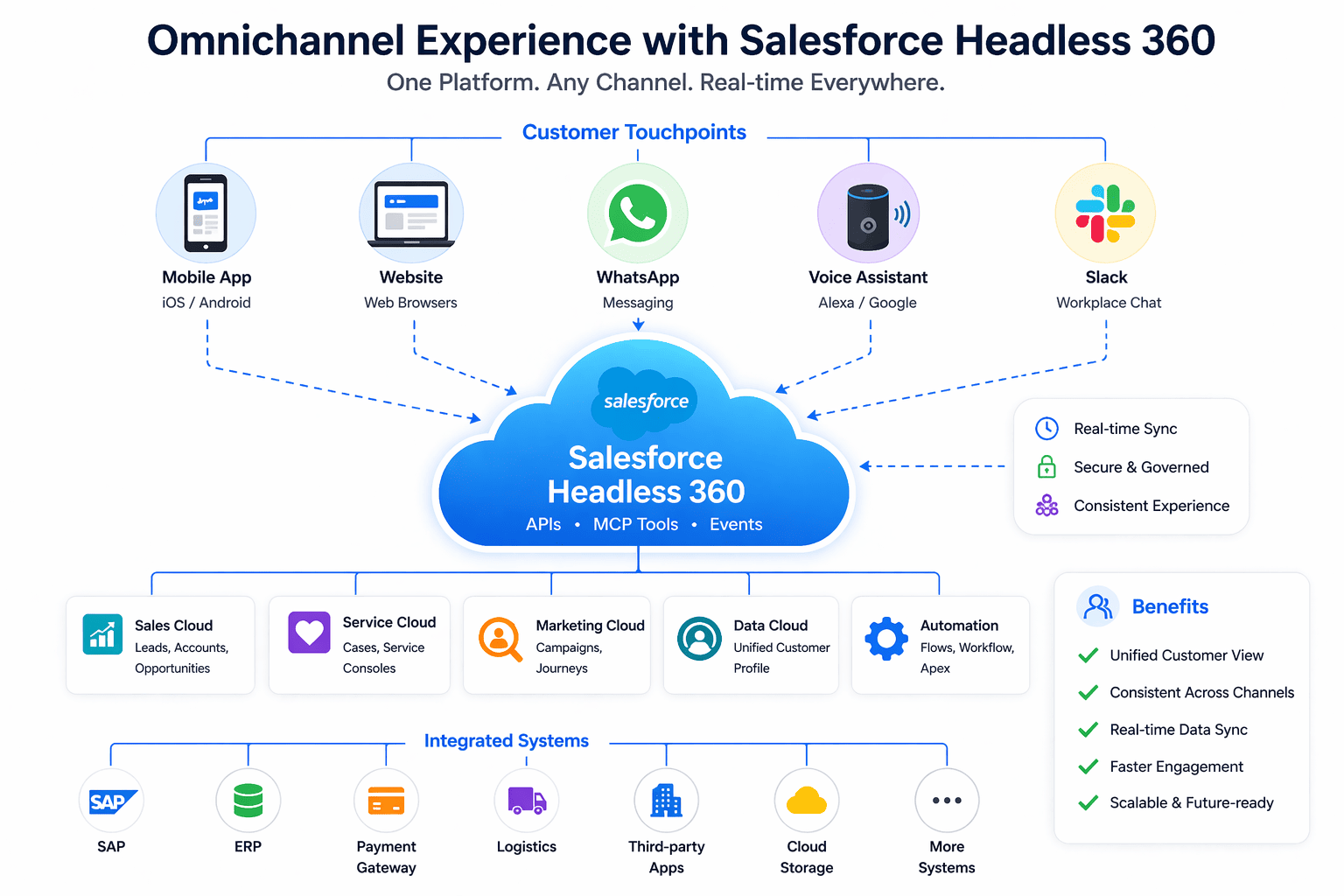
The interface is no longer fixed. It is flexible and context-driven
Salesforce adds control layers to:
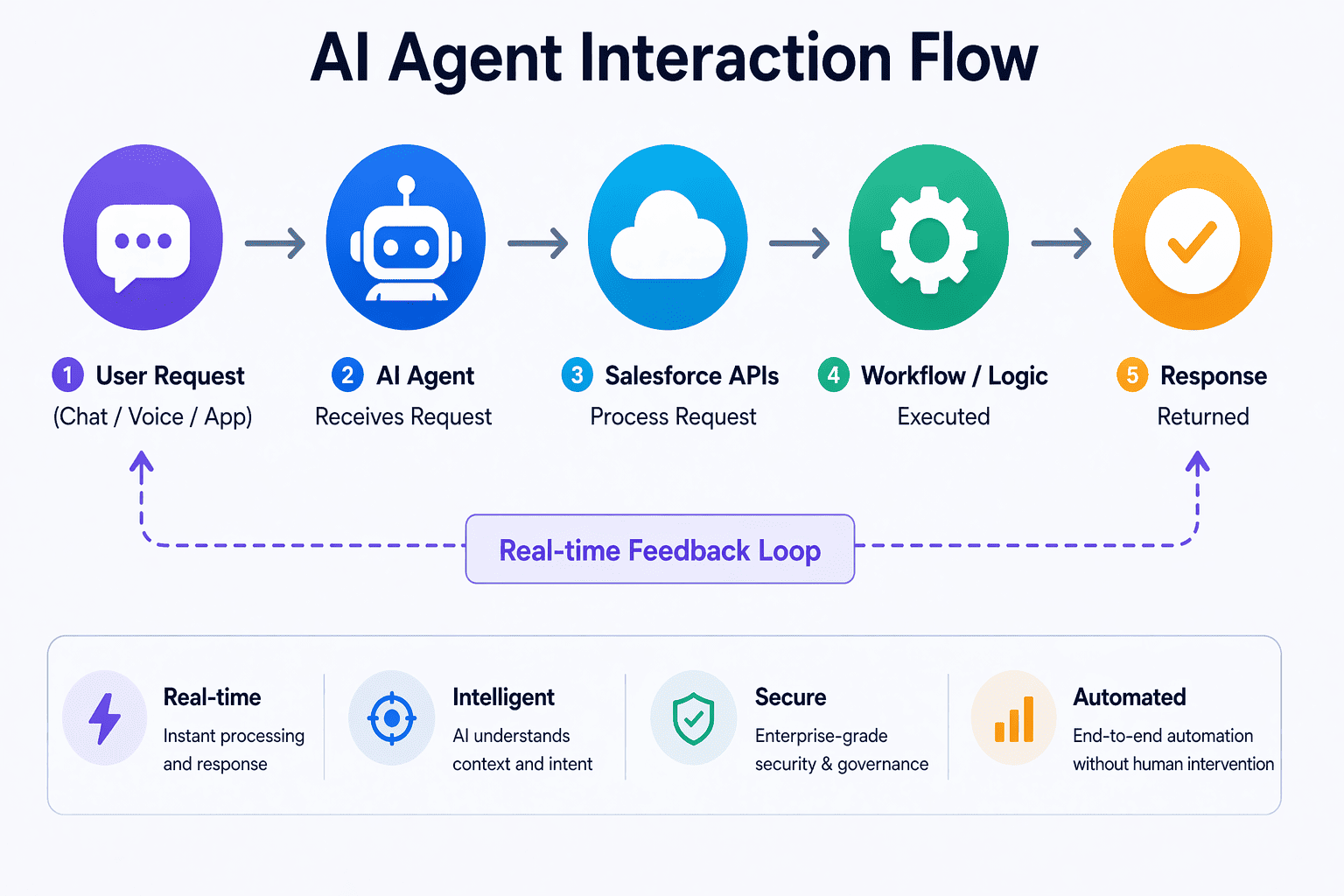
This is critical because now systems are acting independently.
One important question raised by experts is:
This is still evolving.
Possible interfaces include:
The key takeaway:
The interface is no longer Salesforce.
The interface is wherever the user already is.
This is a major conceptual shift in CRM thinking
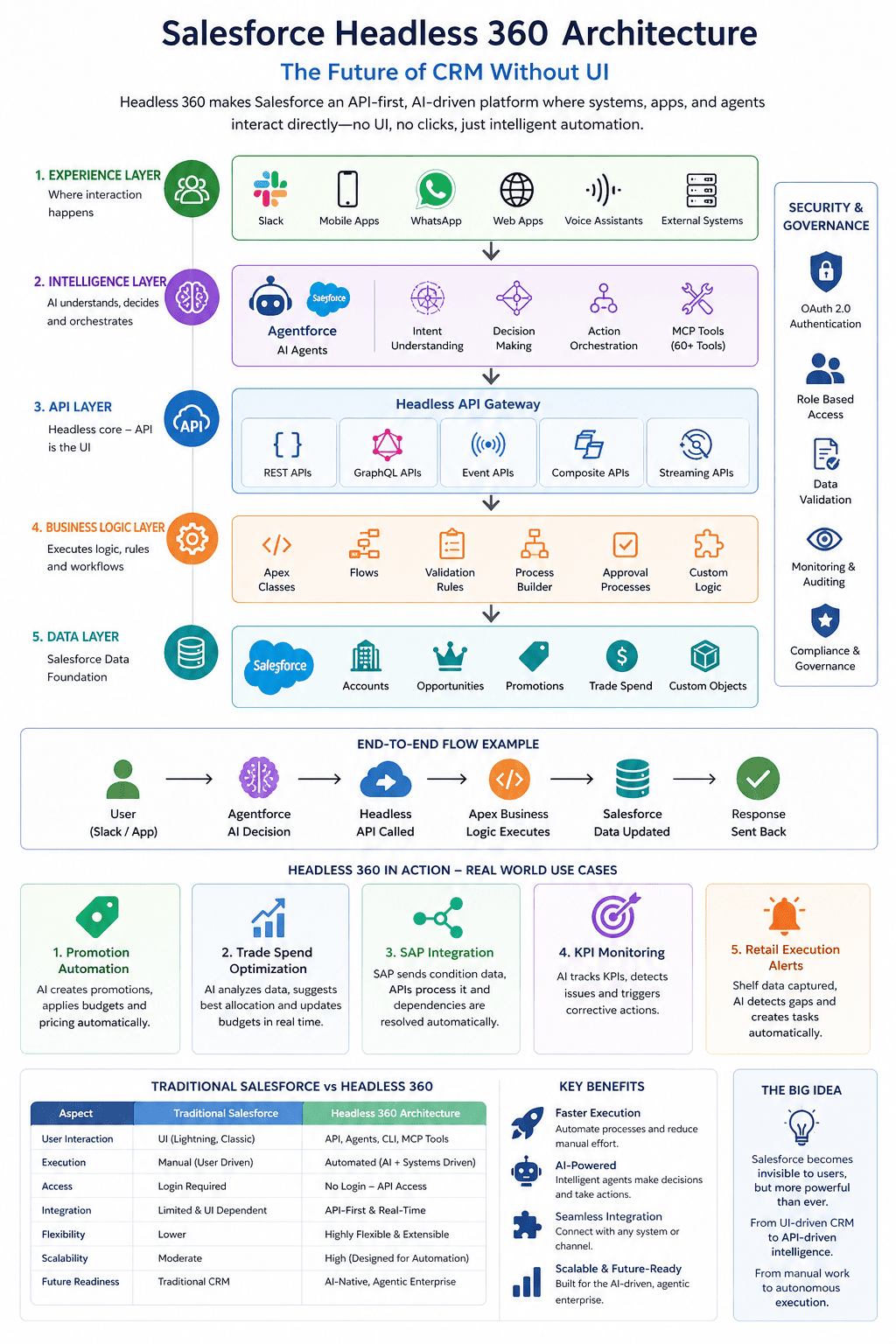
Headless 360 is a modern, API-first approach where Salesforce operates without depending on its traditional UI. Instead of users clicking through pages, systems, applications, and AI agents interact directly with Salesforce using APIs, events, and services. In this setup, Salesforce acts as a powerful backend engine that manages data, enforces business logic, and executes workflows behind the scenes.
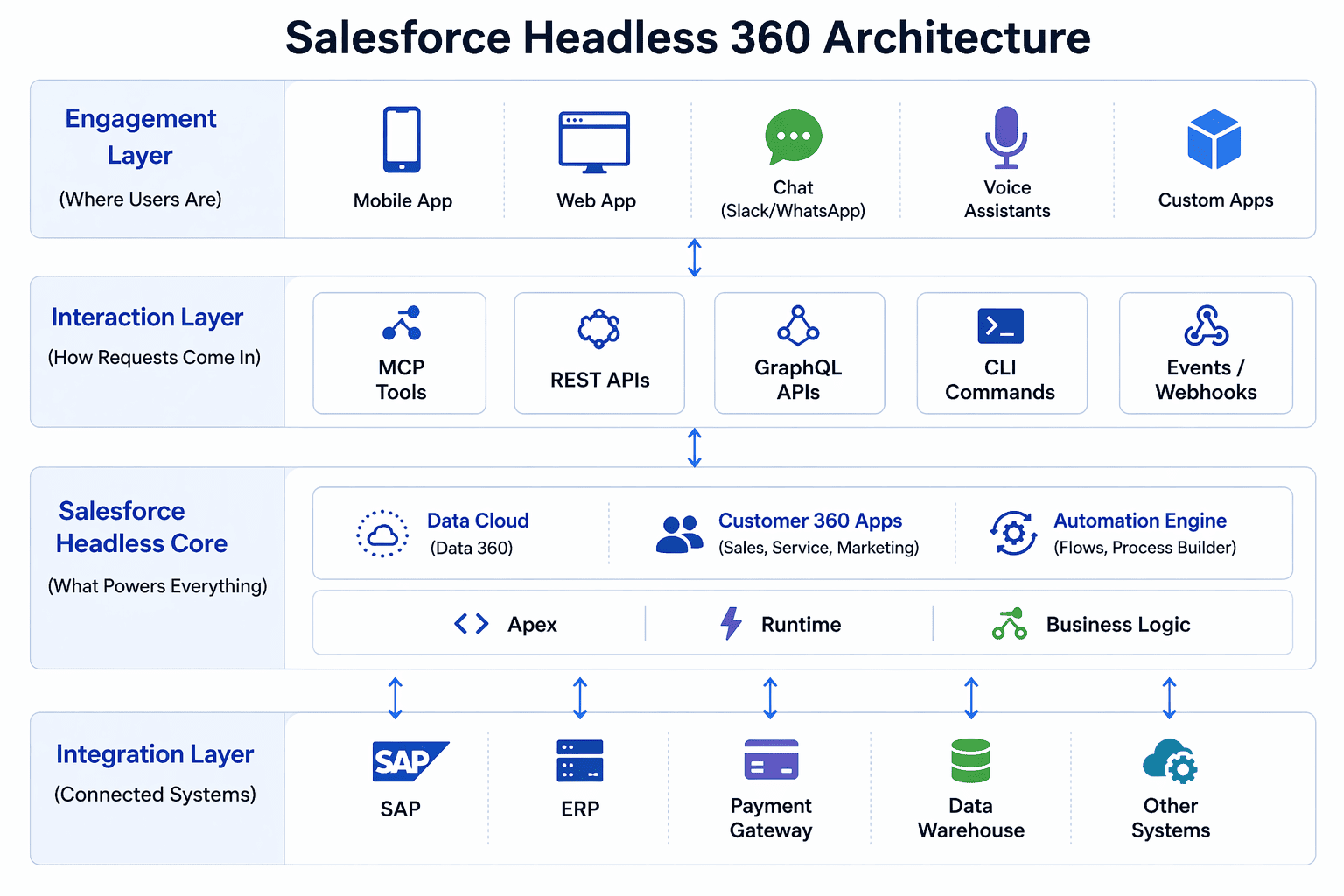
[ User / AI Interface Layer ]
  - Slack / Chat / Voice
  - Mobile App
  - Web App
  - AI Agent Interface

                ↓

[ Interaction Layer ]
  - MCP Tools (Agent Access)
  - REST / GraphQL APIs
  - CLI Commands

                ↓

[ Salesforce Headless Core ]
  - Customer 360 (Sales, Service, Marketing)
  - Data Cloud (Data 360)
  - Apex + Flows (Business Logic)
  - Automation Engine

                ↓

[ Agentforce Layer ]
  - AI Agents executing workflows
  - Decision engines
  - Autonomous operations

                ↓

[ External Systems ]
  - SAP / ERP
  - Payment Systems
  - Third-party tools
Key idea: Execution is API-driven. UI is optional.
Let’s simplify how Headless 360 works in real life:
No login. No UI navigation. No manual work.
Salesforce runs in the background.
The user never sees it.
# Login without browser (JWT based)
sf org login jwt \
  --client-id CLIENT_ID \
  --jwt-key-file server.key \
  --username user@company.com

# Generate AI Agent
sf agent generate agent-spec \
  --type customer-support \
  --role "Handle billing queries"

# Deploy Agent
sf project deploy start
This is a true headless workflow.
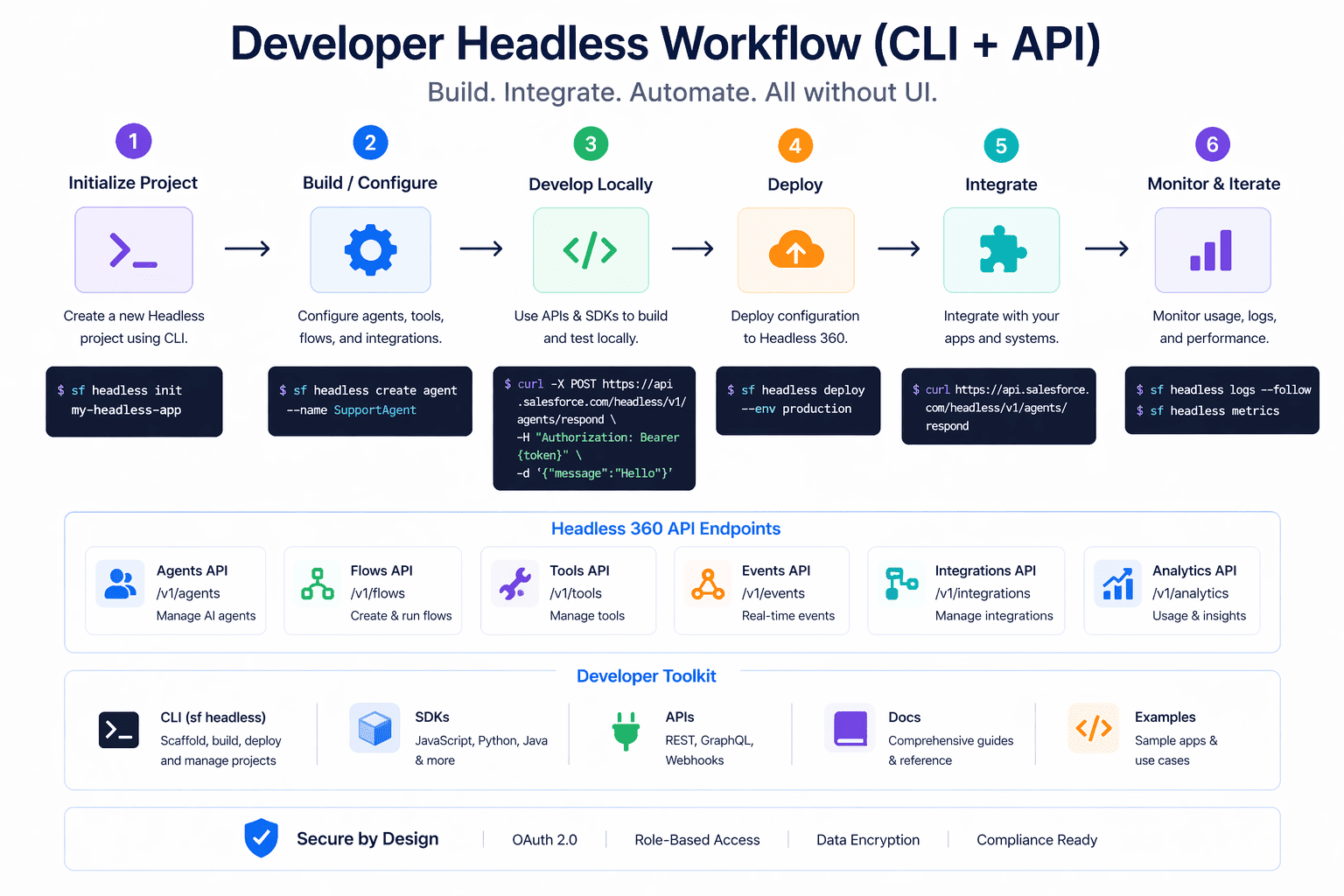
No UI involved at any stage.
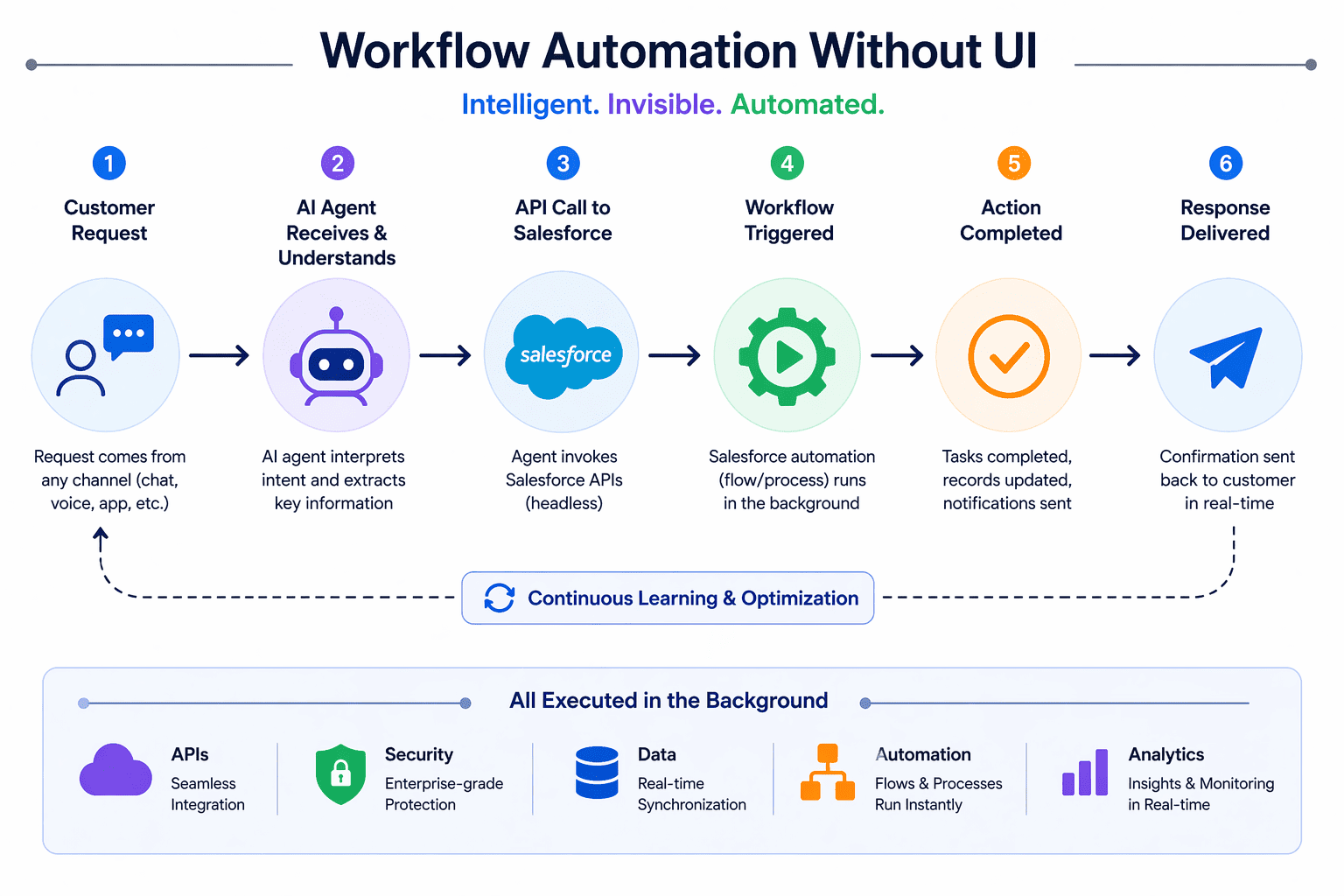
It enables systems to operate faster and more efficiently without human bottlenecks
This is where most blogs stop. But let’s be real.
Even experts acknowledge that many answers are still evolving
This is not a finished product.
This is a new direction.
| Aspect | Traditional CRM | Headless 360 |
|---|---|---|
| Access | Browser UI | APIs / Agents |
| Execution | Manual | Automated |
| User | Human | AI + Human |
| Interface | Fixed | Flexible |
| Speed | Slower | Real-time |
Earlier:
Now:
This is not just evolution.
This is a complete shift in how software is used.
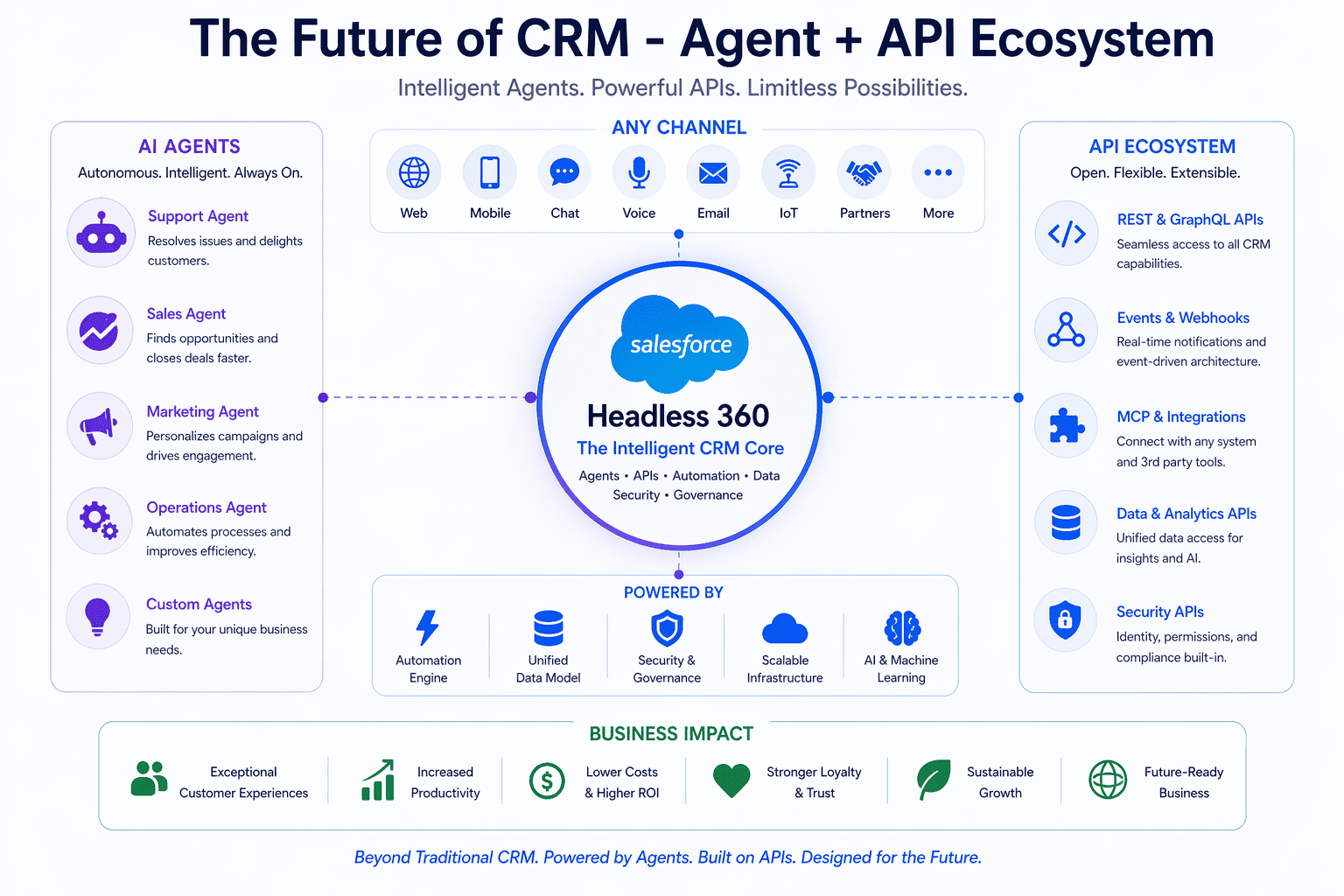
Salesforce is becoming:
Salesforce Headless 360 is not about removing UI.
It is about removing dependency on UI.
It represents a future where:
The most powerful CRM in the future will not be the one you log into.
It will be the one that works silently in the background.
If you are a Salesforce developer, architect, or business leader, this shift matters.
Start thinking beyond UI.
Start thinking APIs.
Start thinking agents.
Because the next version of Salesforce is not something you open.
It is something that runs.
Mind it!

One short email when we publish something new — interview questions, Salesforce guides and career tips. No spam, unsubscribe in one click.
Thirty Salesforce CPQ interview questions with answers — quote-to-cash, products, bundles, price rules, product rules, approvals and contracts.
The 30 Salesforce Apex interview questions asked most — collections, SOQL, DML, governor limits, triggers, async Apex and testing — with answers.
Apex design patterns explained with code — trigger handler, selector, service, unit of work and factory — for clean, scalable Salesforce code.
Questions, corrections or your own experience — they all help the next reader.