
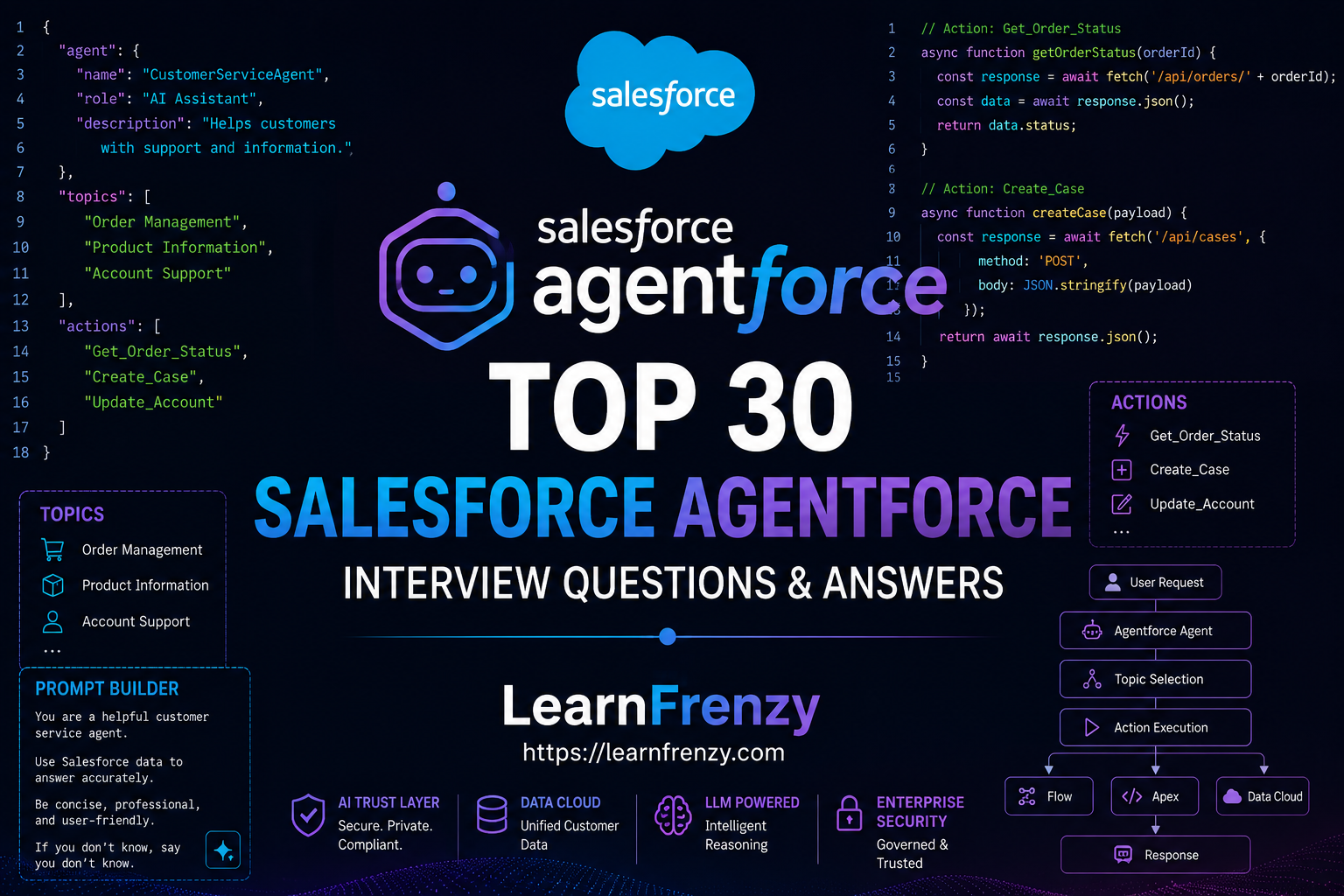
Artificial Intelligence is transforming the way organizations interact with customers, employees, and business data. Salesforce Agentforce is one of the most significant innovations introduced by Salesforce, enabling businesses to create intelligent AI agents capable of understanding user requests, reasoning through business context, and performing actions automatically.
Unlike traditional chatbots that rely on predefined conversation flows, Agentforce combines Large Language Models (LLMs), Salesforce data, automation tools, and business logic to deliver dynamic, context-aware, and action-oriented experiences. These AI agents can answer questions, retrieve records, trigger workflows, execute business processes, and integrate with external systems.
As more organizations adopt AI-driven solutions, Agentforce skills are becoming highly valuable for Salesforce Developers, Consultants, Architects, Administrators, and AI Specialists. Companies are actively looking for professionals who understand Agentforce architecture, Prompt Builder, Topics, Actions, Data Cloud integration, AI Trust Layer, and real-world implementation strategies.
In this comprehensive guide, we'll cover the Top 30 Salesforce Agentforce Interview Questions & Answers ranging from beginner-level concepts to advanced implementation scenarios. Whether you're preparing for a Salesforce AI Specialist role or working on your first Agentforce project, these questions will help strengthen your understanding of the platform.
What You'll Learn
- Agentforce Fundamentals
- Agents, Topics & Actions
- Prompt Builder
- Agent Builder
- Data Cloud Integration
- Flow & Apex Actions
- AI Trust Layer
- Agent Security & Governance
- Multi-Agent Architecture
- Real-World Agentforce Implementations
What is Salesforce Agentforce?
Salesforce Agentforce is a platform for building autonomous AI agents that can understand user requests, access business data, reason through tasks, and perform actions across Salesforce and connected systems.
Agentforce combines generative AI, Salesforce metadata, business processes, automation tools, and enterprise security controls to create intelligent digital assistants.
Agentforce is Salesforce's AI agent platform that enables organizations to build intelligent agents capable of answering questions, making decisions, and performing business actions.
Why Learn Agentforce?
| Reason | Benefit |
|---|---|
| AI Revolution | High Industry Demand |
| Salesforce Investment | Strategic Future Platform |
| Automation | Reduce Manual Work |
| Enterprise Adoption | Growing Market Demand |
| Career Growth | AI-Focused Salesforce Roles |
| Innovation | Build Intelligent Business Agents |
Core Components of Agentforce
| Component | Purpose |
|---|---|
| Agent | AI Assistant |
| Topics | Business Capabilities |
| Actions | Tasks Executed by Agent |
| Prompt Builder | AI Instructions |
| Agent Builder | Agent Configuration |
| Data Cloud | Enterprise Data Source |
| AI Trust Layer | Security & Governance |
Agentforce Architecture Overview
User Request
      │
      ▼
Agentforce Agent
      │
      ▼
Topic Selection
      │
      ▼
Action Execution
      │
 ┌────┼────┐
 ▼    ▼    ▼

Flow Apex Data Cloud

      │
      ▼

Generated Response
      │
      ▼

User
Agentforce vs Traditional Chatbots
| Feature | Traditional Chatbot | Agentforce |
|---|---|---|
| Decision Making | Rule-Based | AI Driven |
| Context Awareness | Limited | Advanced |
| Actions | Minimal | Business Actions |
| Learning Ability | Low | High |
| Data Access | Limited | Salesforce + External Systems |
Agentforce Interview Roadmap
| Section | Topics Covered |
|---|---|
| Q1 – Q10 | Agentforce Fundamentals |
| Q11 – Q20 | Agent Builder, Topics, Actions & Security |
| Q21 – Q30 | Advanced Architecture & Real-World Scenarios |
📚 Topics Covered in This Guide
Part 1: Agentforce Fundamentals (Q1–Q10)
- What is Agentforce?
- Why Agentforce?
- Agentforce vs Einstein Bots
- Core Components
- Agents
- Topics
- Actions
- Prompt Builder
- LLMs
- Architecture Overview
Part 2: Intermediate Agentforce (Q11–Q20)
- Agent Builder
- Topic Configuration
- Action Configuration
- Apex Actions
- Flow Actions
- Grounding
- Data Cloud Integration
- Testing
- Security
- Governance
Part 3: Advanced Agentforce (Q21–Q30)
- Multi-Agent Architecture
- Prompt Engineering
- External Integrations
- AI Trust Layer
- Performance Optimization
- Enterprise Architecture
- Real-World Implementations
💡 Interview Preparation Tip
Most Agentforce interviews focus on Topics, Actions, Prompt Builder, AI Trust Layer, Data Cloud integration, Flow Actions, Apex Actions, and real-world implementation scenarios. Understanding how Agentforce works behind the scenes is often more important than memorizing definitions.
Part 1: Agentforce Fundamentals (Q1–Q10)
Let's start with the most frequently asked Salesforce Agentforce interview questions covering the foundational concepts every Salesforce AI professional should understand.
Agentforce Basics, Agents, Topics, Actions, Prompt Builder, LLMs, and Architecture.
Q1. What is Salesforce Agentforce?
Answer:
Salesforce Agentforce is an AI-powered platform that enables organizations to build intelligent agents capable of understanding user requests, reasoning through business context, retrieving data, and performing actions across Salesforce and connected systems.
Unlike traditional chatbots, Agentforce agents can dynamically determine how to solve a problem rather than following predefined conversation paths.
Example:
A customer asks:
Where is my order?
The Agent can:
- Identify the customer
- Retrieve order information
- Check shipment status
- Generate a personalized response
Agentforce is not just a chatbot platform. It is an AI agent platform capable of reasoning and taking actions.
Q2. Why was Agentforce introduced?
Answer:
Traditional automation tools and chatbots are limited because they depend heavily on predefined rules and workflows.
Salesforce introduced Agentforce to provide:
- Intelligent Automation
- Natural Language Understanding
- Autonomous Decision Making
- Dynamic Action Execution
- AI-Powered Customer Experiences
| Traditional Bots | Agentforce |
|---|---|
| Rule Based | AI Powered |
| Fixed Conversations | Dynamic Responses |
| Limited Actions | Business Process Automation |
| Decision Trees | Reasoning Engine |
Agentforce enables organizations to move beyond simple chatbot interactions toward autonomous business agents.
Q3. What is the difference between Agentforce and Einstein Bots?
Answer:
Although both solutions provide conversational experiences, their capabilities are significantly different.
| Feature | Einstein Bots | Agentforce |
|---|---|---|
| Conversation Model | Rule-Based | AI-Driven |
| Decision Making | Predefined | Dynamic |
| LLM Support | Limited | Native |
| Business Actions | Basic | Advanced |
| Context Awareness | Low | High |
| Future Platform | Legacy Direction | Strategic Salesforce AI Platform |
Agentforce is considered the next-generation evolution beyond traditional Einstein Bots.
Q4. What are the core components of Agentforce?
Answer:
Agentforce consists of multiple building blocks working together to provide intelligent AI experiences.
| Component | Purpose |
|---|---|
| Agent | AI Assistant |
| Topics | Business Capabilities |
| Actions | Tasks Agent Can Perform |
| Prompt Builder | Agent Instructions |
| Agent Builder | Configuration Tool |
| Data Cloud | Enterprise Data Source |
| Trust Layer | Security & Governance |
Understanding these components is essential for Agentforce architecture discussions.
Q5. What is an Agent in Agentforce?
Answer:
An Agent is an AI-powered digital assistant designed to perform specific business functions.
Agents can:
- Answer Questions
- Retrieve Data
- Execute Actions
- Automate Processes
- Interact with Users
Examples:
- Customer Service Agent
- Sales Agent
- Product Recommendation Agent
- Case Management Agent
- Order Tracking Agent
Example Scenario:
User:
Show my open cases

Agent:
Retrieves cases from Salesforce
and displays results.
Q6. What are Topics in Agentforce?
Answer:
Topics define what an Agent is allowed to discuss or handle.
They act as business capability boundaries for the Agent.
Examples:
- Order Management
- Case Support
- Product Information
- Account Management
- Promotion Planning
Example:
Topic:
Order Status

User:
Where is my order?

Agent:
Routes request to
Order Status Topic.
Topics determine what the Agent can handle. Actions determine what the Agent can do.
Q7. What are Actions in Agentforce?
Answer:
Actions are the tasks that an Agent can execute after determining the user's intent.
Actions can invoke:
- Flows
- Apex Classes
- Prompt Templates
- External APIs
- Data Cloud Operations
Example:
Action:
Get_Order_Status

Input:
Order Number

Output:
Shipment Information
The Agent selects the appropriate action automatically based on the user's request.
Q8. What is Prompt Builder?
Answer:
Prompt Builder is Salesforce's tool for creating, managing, and testing prompts used by generative AI applications.
It allows organizations to define how AI should behave and respond.
Example Prompt:
You are a customer
support agent.

Always provide
professional responses.

Use Salesforce data
when available.
Prompt Builder ensures consistent and business-aligned AI responses.
Prompt Builder plays a critical role in controlling AI behavior and response quality.
Q9. How does Agentforce use Large Language Models (LLMs)?
Answer:
Large Language Models (LLMs) provide the reasoning and language understanding capabilities behind Agentforce.
Agentforce uses LLMs to:
- Interpret User Intent
- Generate Responses
- Select Topics
- Choose Actions
- Summarize Information
- Create Content
Workflow:
User Question
      │
      ▼
LLM Analysis
      │
      ▼
Topic Selection
      │
      ▼
Action Execution
      │
      ▼
Response Generation
The LLM acts as the reasoning engine that powers the Agent's intelligence.
Q10. Explain Agentforce Architecture.
Answer:
Agentforce architecture combines AI models, Salesforce data, automation tools, and security layers to create intelligent agents.
Architecture Flow:
User Request
      │
      ▼
Agentforce Agent
      │
      ▼
Prompt Builder
      │
      ▼
Large Language Model
      │
      ▼
Topic Selection
      │
      ▼
Action Execution
      │
 ┌────┼─────┐
 ▼    ▼     ▼

Flow Apex Data Cloud

      │
      ▼

Response
      │
      ▼

User
Key Layers:
- User Interaction Layer
- Agent Layer
- Reasoning Layer (LLM)
- Business Logic Layer
- Data Layer
- Trust & Security Layer
A Customer Service Agent can retrieve customer data, check orders, create cases, trigger flows, and respond naturally using a single Agentforce interaction.
Quick Revision: Q1–Q10
- Agentforce is Salesforce's AI Agent platform.
- Agentforce provides intelligent automation beyond traditional chatbots.
- Agentforce is the evolution beyond Einstein Bots.
- Core components include Agents, Topics, Actions, Prompt Builder, and Trust Layer.
- Agents perform business tasks autonomously.
- Topics define what Agents can discuss.
- Actions define what Agents can execute.
- Prompt Builder controls AI behavior.
- LLMs provide reasoning and language understanding.
- Agentforce architecture combines AI, Salesforce data, and automation tools.
Agent Builder, Topic Configuration, Action Configuration, Flow Actions, Apex Actions, Data Cloud Integration, Grounding, Testing, Security, and Governance.
Q11. What is Agent Builder in Salesforce Agentforce?
Answer:
Agent Builder is the primary configuration tool used to create, manage, and deploy AI agents in Salesforce Agentforce.
It provides a declarative interface where administrators and developers can configure:
- Agents
- Topics
- Actions
- Instructions
- Data Sources
- Security Controls
Agent Builder Workflow:
Create Agent
      │
      ▼
Define Topics
      │
      ▼
Configure Actions
      │
      ▼
Add Instructions
      │
      ▼
Test Agent
      │
      ▼
Deploy
Agent Builder is to Agentforce what Flow Builder is to Salesforce Flows.
Q12. How are Topics configured in Agentforce?
Answer:
Topics define the business areas an Agent can understand and handle.
Each Topic includes:
- Topic Name
- Description
- User Intent Examples
- Associated Actions
- Instructions
Example Topic:
Topic Name:
Order Management

Description:
Handle customer order
related requests.

Examples:

• Where is my order?
• Check shipment status.
• Track my package.
The LLM uses these examples to determine when a Topic should be activated.
Q13. How are Actions configured in Agentforce?
Answer:
Actions define the operations an Agent can perform after identifying user intent.
Actions can be linked to:
- Salesforce Flows
- Apex Classes
- Prompt Templates
- External APIs
- Data Cloud Queries
Example Action:
Action Name:
Get_Order_Status

Input:
Order Number

Output:
Current Shipping Status
When a user asks for order information, Agentforce automatically invokes this action.
Topics define the conversation scope. Actions perform the actual work.
Q14. What are Apex Actions in Agentforce?
Answer:
Apex Actions allow Agentforce to execute custom business logic written in Apex.
This is useful when standard Flow actions cannot meet business requirements.
Apex Example:
public with sharing class OrderService {

    @InvocableMethod

    public static List<String>
    getOrderStatus(
        List<String> orders
    ) {

        return new List<String>{
            'Shipped'
        };

    }

}
Use Cases:
- Complex Business Logic
- External Integrations
- Custom Calculations
- Advanced Data Processing
Q15. What are Flow Actions in Agentforce?
Answer:
Flow Actions allow Agentforce to execute Salesforce Flows directly.
Flows are the preferred no-code or low-code automation mechanism for Agentforce.
Example Flow:
Create Support Case

Input:
Customer Issue

Output:
Case Number
Flow Execution:
User Request
      │
      ▼
Agent
      │
      ▼
Flow Action
      │
      ▼
Case Created
      │
      ▼
Confirmation Response
Salesforce recommends using Flow Actions whenever possible before building Apex Actions.
Q16. How does Agentforce integrate with Data Cloud?
Answer:
Data Cloud provides unified customer data that can be used by Agentforce to generate more accurate and personalized responses.
Data Cloud enables:
- Customer Profiles
- Unified Data Models
- Real-Time Data Access
- Personalized Responses
- Customer Insights
Example:
Customer:
Show my recent orders.

Agent:
Retrieves unified data
from Data Cloud and
returns personalized
results.
| Without Data Cloud | With Data Cloud |
|---|---|
| Limited Data Context | Unified Customer View |
| Basic Responses | Personalized Responses |
| Fragmented Data | Connected Data Sources |
Q17. What is Grounding in Agentforce?
Answer:
Grounding is the process of providing trusted business data to the Large Language Model before generating a response.
Without grounding, LLMs may generate inaccurate or fabricated information.
Grounding Process:
User Question
      │
      ▼
Retrieve Salesforce Data
      │
      ▼
Provide Context to LLM
      │
      ▼
Generate Response
Example:
User:
What is my account balance?

Agent:
Retrieves actual account
balance before generating
the response.
Grounding significantly reduces AI hallucinations.
Q18. How do you test and debug Agentforce Agents?
Answer:
Agentforce provides testing tools that allow developers and administrators to validate agent behavior before deployment.
Testing Areas:
- Topic Detection
- Action Selection
- Prompt Accuracy
- Response Quality
- Security Controls
- Error Handling
Typical Testing Process:
User Question
      │
      ▼
Topic Selected?
      │
      ▼
Correct Action?
      │
      ▼
Expected Response?
Developers should test both expected and unexpected user inputs.
Q19. Explain the Agentforce Security Model.
Answer:
Agentforce follows Salesforce's enterprise-grade security architecture.
Security controls include:
- User Permissions
- Sharing Rules
- Field-Level Security
- Object-Level Security
- AI Trust Layer
- Data Masking
| Security Layer | Purpose |
|---|---|
| CRUD Security | Object Access |
| FLS | Field Access |
| Sharing Rules | Record Access |
| Trust Layer | AI Security |
| Data Masking | Protect Sensitive Data |
The Agent can only access data that the current user is authorized to view.
Q20. What is Agentforce Governance?
Answer:
Governance refers to the policies, controls, monitoring, and best practices used to ensure responsible AI usage.
Organizations should establish governance frameworks covering:
- Prompt Management
- Security Controls
- Data Access Policies
- Compliance Requirements
- Agent Monitoring
- Audit Logging
Governance Framework:
AI Policies
      │
      ▼
Prompt Controls
      │
      ▼
Security Validation
      │
      ▼
Monitoring
      │
      ▼
Compliance Reporting
Proper governance ensures that AI agents remain secure, trustworthy, and compliant with organizational policies.
Governance and AI Trust Layer are becoming extremely important topics in enterprise Agentforce implementations.
Quick Revision: Q11–Q20
- Agent Builder is used to create and manage AI Agents.
- Topics define business areas an Agent can handle.
- Actions perform tasks for the Agent.
- Apex Actions support custom business logic.
- Flow Actions provide low-code automation.
- Data Cloud enables personalized AI experiences.
- Grounding reduces hallucinations by using trusted business data.
- Agentforce provides testing and debugging tools.
- Security includes CRUD, FLS, Sharing Rules, and Trust Layer.
- Governance ensures responsible AI usage and compliance.
Multi-Agent Architecture, Prompt Engineering, External APIs, AI Trust Layer, Performance Optimization, Real-World Implementations, and Future of Agentforce.
Q21. What is Multi-Agent Architecture in Agentforce?
Answer:
Multi-Agent Architecture is a design approach where multiple specialized AI agents collaborate to solve complex business problems.
Instead of one agent handling everything, each agent focuses on a specific business domain.
Example:
Customer Service Agent
          │
          ▼
     Sales Agent
          │
          ▼
  Order Management Agent
          │
          ▼
 Support Agent
Benefits:
- Better Scalability
- Domain Expertise
- Improved Accuracy
- Easier Maintenance
- Reusable Agents
Large enterprises often deploy multiple specialized agents instead of one generic agent.
Q22. How does Agentforce work with Data Cloud?
Answer:
Data Cloud provides a unified customer profile that Agentforce uses to generate personalized and context-aware responses.
The Agent can access:
- Customer Profiles
- Purchase History
- Support Cases
- Engagement Data
- Marketing Data
Architecture Flow:
User Query
      │
      ▼
Agentforce
      │
      ▼
Data Cloud
      │
      ▼
Unified Customer Data
      │
      ▼
Personalized Response
This allows the Agent to provide highly relevant business responses.
Q23. How does Agentforce integrate with Salesforce Flow?
Answer:
Agentforce can invoke Salesforce Flows as Actions to automate business processes.
Flows are commonly used because they require minimal coding.
Example Use Cases:
- Create Case
- Update Opportunity
- Create Lead
- Send Email
- Approve Requests
Flow Integration Example:
User:
Create a support case

      │

Agentforce

      │

Flow Action

      │

Case Created

      │

Response Generated
Use Flows for standard business automation before building custom Apex solutions.
Q24. How does Agentforce integrate with Apex?
Answer:
Agentforce can execute Apex Actions to perform custom business logic that cannot be handled using Flows alone.
Apex Action Example:
public with sharing class ProductService {

    @InvocableMethod

    public static List<String>
    getRecommendedProducts(
        List<String> inputs
    ) {

        return new List<String>{

            'Product A',

            'Product B'

        };

    }

}
Common Use Cases:
- Complex Calculations
- External Integrations
- Custom Business Rules
- Advanced Data Processing
Apex provides maximum flexibility for Agentforce implementations.
Q25. How does Agentforce integrate with External APIs?
Answer:
Agentforce can interact with external systems using API-based Actions.
This enables agents to access data and services outside Salesforce.
Examples:
- SAP
- ERP Systems
- Payment Gateways
- Inventory Systems
- Shipping Providers
Architecture Example:
User Request
      │
      ▼
Agentforce
      │
      ▼
API Action
      │
      ▼
External System
      │
      ▼
Response
This capability allows Agentforce to become a central AI layer across enterprise applications.
Q26. What are Prompt Engineering Best Practices in Agentforce?
Answer:
Prompt Engineering is the practice of designing clear instructions that guide AI behavior.
Best Practices:
- Be Specific
- Define Agent Role Clearly
- Provide Business Context
- Use Grounded Data
- Define Output Format
- Avoid Ambiguity
Poor Prompt:
Help customers.
Better Prompt:
You are a customer support
agent.

Use Salesforce data when
available.

Provide professional
responses.

Never guess information.
Well-designed prompts significantly improve response quality and reduce hallucinations.
Q27. What is the Salesforce AI Trust Layer?
Answer:
The AI Trust Layer is Salesforce's security framework designed to ensure safe, secure, and responsible AI interactions.
It protects sensitive business data while enabling generative AI capabilities.
Key Features:
- Data Masking
- Zero Data Retention
- Audit Trails
- Secure Prompt Processing
- Compliance Controls
| Feature | Purpose |
|---|---|
| Data Masking | Protect Sensitive Information |
| Audit Logs | Track AI Activity |
| Policy Enforcement | Govern AI Usage |
| Zero Retention | Protect Customer Data |
The Trust Layer is one of the most important Agentforce architecture topics.
Q28. How can Agentforce performance be optimized?
Answer:
Performance optimization ensures faster response times and better user experiences.
Best Practices:
- Design Focused Topics
- Reduce Unnecessary Actions
- Use Efficient Flows
- Optimize Apex Logic
- Use Data Cloud Efficiently
- Minimize External API Calls
Performance Flow:
User Query
      │
      ▼
Topic Matching
      │
      ▼
Optimized Action
      │
      ▼
Response
Poorly designed Topics and Actions are among the most common causes of Agentforce performance issues.
Q29. Explain a Real-World Agentforce Implementation.
Answer:
Consider a Consumer Goods company implementing Agentforce for Trade Promotion Management (TPM).
Business Scenario:
- Sales Representatives need promotion information.
- Users need product recommendations.
- Approvals need automation.
- SAP integration is required.
Architecture:
Sales User
      │
      ▼
Agentforce Agent
      │
 ┌────┼────┐
 ▼    ▼    ▼

Flow Apex SAP API

      │
      ▼

Salesforce TPM Data
      │
      ▼

Response
Possible User Questions:
- Show active promotions.
- Create a trade promotion.
- Check promotion approval status.
- Recommend products for this customer.
The Agent can retrieve information, trigger automation, and integrate with external systems through a single conversational interface.
Be prepared to explain a real business scenario where Agentforce combines Topics, Actions, Flows, Apex, and integrations.
Q30. What is the Future of Agentforce?
Answer:
Agentforce is expected to become a central platform for enterprise AI automation across Salesforce and connected ecosystems.
Future Trends:
- Autonomous AI Agents
- Multi-Agent Collaboration
- Deeper Data Cloud Integration
- Industry-Specific Agents
- Enhanced Reasoning Capabilities
- Expanded Enterprise Automation
Future Vision:
User Request
      │
      ▼
Agentforce
      │
      ▼
Multiple AI Agents
      │
      ▼
Business Processes
      │
      ▼
Automated Outcomes
Salesforce's long-term vision is to make AI agents active participants in business operations rather than simple assistants.
Quick Revision: Q21–Q30
- Multi-Agent Architecture uses specialized AI agents.
- Data Cloud provides unified customer data.
- Flows are commonly used as Agentforce Actions.
- Apex supports advanced custom logic.
- External APIs enable enterprise integrations.
- Prompt Engineering improves response quality.
- AI Trust Layer ensures secure AI interactions.
- Performance depends on optimized Topics and Actions.
- Agentforce can automate complex enterprise workflows.
- Future Agentforce implementations will involve autonomous multi-agent systems.
Final Thoughts
Agentforce represents a major shift in how organizations build intelligent business applications on Salesforce. By combining Large Language Models, enterprise data, automation tools, and security controls, Agentforce enables businesses to create AI agents that can reason, act, and deliver meaningful outcomes.
Understanding Agents, Topics, Actions, Prompt Builder, Data Cloud, AI Trust Layer, and enterprise architecture patterns will help you succeed in modern Salesforce AI projects and Agentforce interviews.
Conclusion
In this guide, we covered the Top 30 Salesforce Agentforce Interview Questions & Answers from foundational concepts to advanced enterprise implementations. These questions are highly relevant for Salesforce Developers, AI Specialists, Consultants, Architects, and professionals working with Agentforce and Salesforce AI solutions.
As Agentforce continues to evolve, gaining hands-on experience with Prompt Builder, Agent Builder, Data Cloud, Flows, Apex Actions, and AI governance will be critical for building successful AI-powered business solutions.
Keep learning, keep experimenting, and stay ahead in the rapidly growing world of Salesforce AI and Agentforce. 😊
Comments (0)
What others are saying about this article
No Comments Yet
Be the first to share your thoughts on this article.
Leave a Comment
Share your thoughts and join the discussion