
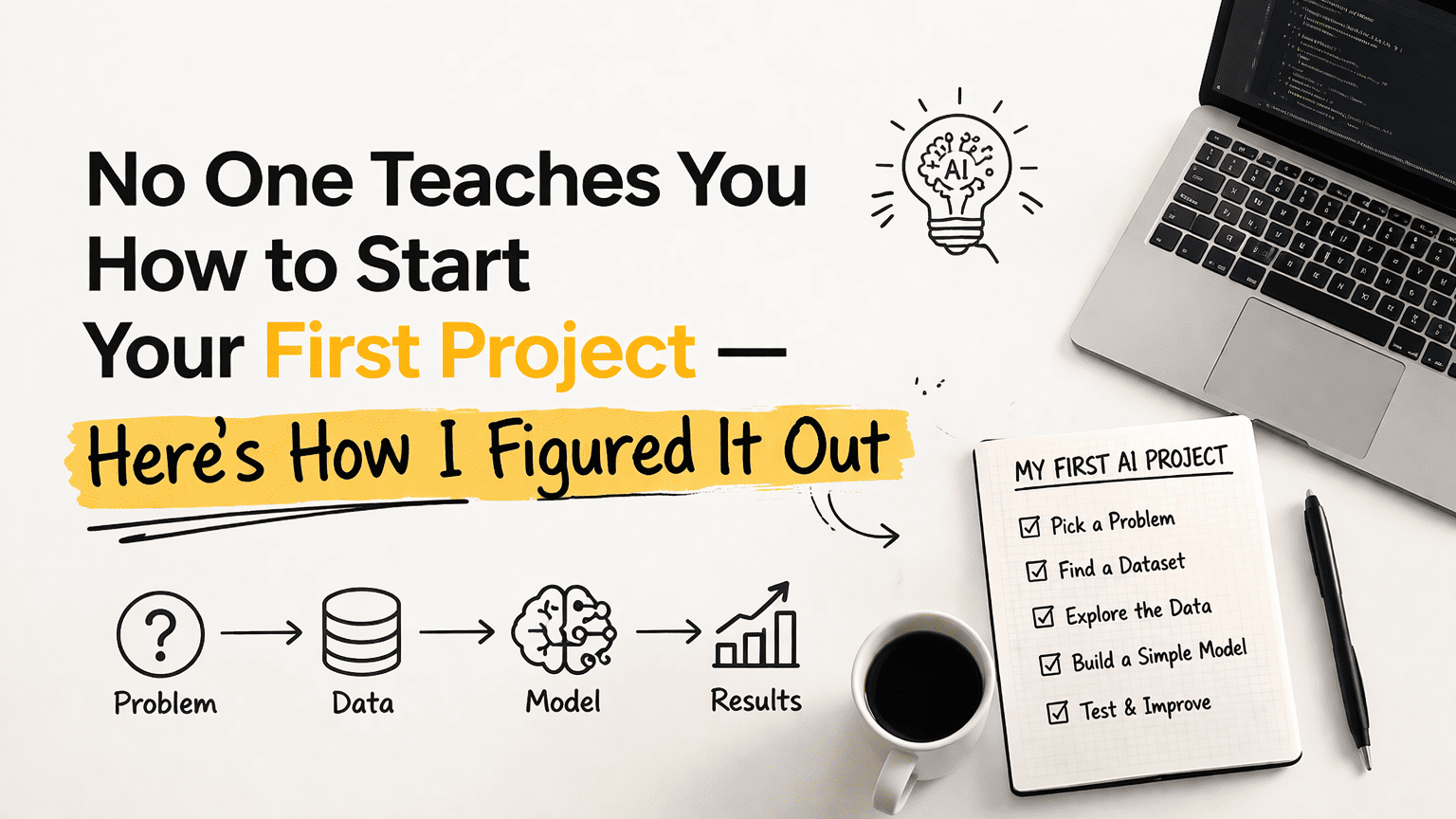
The confusion every student faces when starting their first real project—and what I realized while figuring it out myself.
I Thought I Was Doing Everything Right
As an engineering student, I genuinely believed I was on the right path.
I wasn’t just following my college syllabus. I enrolled in my first course, completed it, and earned a certificate.
That certificate made me feel like I had achieved something meaningful.
I thought:
“Now I know enough to build something.”
But the moment I decided to start my first real project…
I got stuck.
The Question That Stayed in My Mind
I remember sitting in front of my laptop, thinking:
“How do we actually start a project when no one teaches us how to start?”
Everyone says:
“Build projects.”
But no one explains:
- how to choose a topic
- how to begin
- what the first step looks like
And that’s where the real confusion begins.
The Questions That Stopped Me
When I tried to begin, my mind was full of questions:
- Which domain should I choose — AI, Web Development, or something else?
- Should I start with frontend or backend?
- Where do I find real datasets?
- How do I even structure a project?
- What should be the first file?
- How do I debug errors?
So I did what most students do…
I went back to tutorials.
The Biggest Mistake I Didn’t Realize
I kept watching videos.
Taking notes.
Saving resources.
And I kept telling myself:
“I’ll start when I understand everything.”
But in reality…
I never even created a project folder.
That was my biggest mistake.
Not lack of knowledge.
Not lack of resources.
Just the fear of starting.
What I Realized (The Turning Point)
At some point, I noticed something important:
A project doesn’t start with confidence. It starts with confusion.
I had been thinking completely wrong.
I thought:
- I needed a perfect idea
- I needed full knowledge
- I needed a clear plan
But real projects don’t work like that.
I Stopped Thinking Big
Earlier, I believed:
- My project should be impressive
- My idea should be unique
- My code should be clean from the start
But none of that helped me begin.
So I changed one thing.
Instead of asking:
“What big project should I build?”
I asked:
“What is the smallest thing I can start today?”
How My First Project Actually Started
It didn’t feel like a “project”.
It looked like:
- Opening a blank folder
- Writing a few lines of code
- Printing some output
- Trying to understand why something failed
At that time, it felt small.
Almost meaningless.
But those small steps slowly turned into something real.
The Part No One Mentions: Errors
Almost every step created a new problem.
Something didn’t run.
Something broke.
Something didn’t make sense.
At first, it felt frustrating.
But after some time, I noticed something:
Every error was forcing me to learn something new.
That’s when I understood:
Learning doesn’t happen when everything works.
It happens when things don’t.
How My Learning Changed
Before starting:
- I watched full tutorials
- I tried to learn everything first
After starting:
- I searched only what I needed
- I read documentation
- I experimented with code
- I learned while solving problems
This shift made learning faster and more real.
Why This Matters More in the AI Era
Today, everything is changing.
Companies are adopting AI everywhere:
- Automation
- Data analysis
- Intelligent applications
AI doesn’t replace developers. It replaces developers who don’t build.
You can use tools like:
- ChatGPT
- GitHub Copilot
- AI code assistants
But they only help if you are actually building something.
What Most Students Get Wrong
- Starting with big, complex ideas
- Copy-pasting code without understanding
- Waiting to “feel ready”
- Consuming content instead of creating
These things feel productive.
But they delay real learning.
What Actually Helped Me Start (A Practical System That Works)
At some point, I stopped looking for motivation and started following a simple system.
Not perfect. Not complicated. Just something I could actually do.
Here’s what worked for me — and what can help you start today:
1. Start With a Problem, Not a Project Idea
Earlier, I used to think:
“I need a unique and impressive project idea.”
That thinking kept me stuck.
What actually worked was this:
Pick a small, real problem — not a big idea.
Examples:
- “I can’t track my daily expenses properly” → build a simple expense tracker
- “I want to understand data” → load a dataset and visualize it
- “I want to try AI” → build a basic chatbot using an API
A project is just a solution to a small problem.
That’s it.
2. Define the Simplest Possible Version (MVP Thinking)
Don’t think of the full project.
Think of the smallest working version.
Ask yourself:
“What is the simplest version of this that I can finish in 1–2 days?”
Example:
Instead of:
- Full-stack app with login, dashboard, database
Start with:
- One input → one output
This reduces pressure and helps you actually begin.
3. Follow the 30-60-90 Rule
This helped me a lot in avoiding overthinking.
- First 30 minutes → Set up (folder, files, basic structure)
- Next 60 minutes → Write simple working code (even if messy)
- Next 90 minutes → Debug, fix, improve
No perfection. Just progress.
4. Build in Micro-Steps (Not Big Jumps)
Instead of thinking:
“I need to complete the project”
Break it like this:
- Step 1: Setup project folder
- Step 2: Print something
- Step 3: Take input
- Step 4: Process data
- Step 5: Show output
Each step should feel small enough to complete quickly.
Momentum comes from small wins.
5. Use AI the Right Way (This Is Important Today)
AI is powerful, but only if used correctly.
Wrong way:
- Copy-paste full code
- Not understanding anything
Right way:
- Ask: “Explain this code”
- Ask: “Why is this error happening?”
- Ask: “What is the next step?”
Use AI as:
A guide, not a replacement for thinking
6. Debug Like a Developer (Not a Beginner)
Earlier, one error used to stop me.
Now I follow this:
- Read the error message carefully
- Search the exact error
- Try small fixes
- Test again
Debugging is not a problem.
Debugging is the real skill.
7. Stop Consuming, Start Creating
This was my biggest shift.
Before:
- Watching tutorials
- Taking notes
- Feeling productive
After:
- Writing code
- Making mistakes
- Fixing things
Rule I follow now:
If I watch 1 hour of content, I must build for 2 hours.
8. Track Progress, Not Perfection
Your first project will not be perfect.
So don’t measure:
- How clean your code is
- How advanced your project looks
Measure:
- Did I start?
- Did I solve one problem?
- Did I learn something new?
That’s real progress.
9. Finish Something Small (This Builds Confidence)
Most students start projects.
Very few finish them.
Even if it’s small:
- Complete it
- Run it
- Share it
Because:
Finishing builds confidence. Starting builds courage.
10. Repeat the Cycle
After your first project:
- Build another
- Slightly more complex
- Apply what you learned
This cycle is what actually makes you better.
One Simple Truth
Starting is not about motivation. It’s about reducing friction and taking the first step.
The Reality of My First Project
- The code was messy
- Many things didn’t work properly
- I made mistakes constantly
But it worked.
Because for the first time, I didn’t just learn. I built something.
What Changed After That
It’s not just:
- lectures
- notes
- certificates
It’s:
- trying
- failing
- fixing
- understanding
Final Thought
For a long time, I waited to feel ready.
I thought I needed:
- more knowledge
- more courses
- more confidence
But none of that helped me start.
What helped was simple:
I decided to begin, even when I didn’t know what I was doing.
No one taught me how to start my first project.
But starting it taught me something more important:
You don’t need to be ready to begin.
You need to begin to become ready.
Comments (5)
What others are saying about this article
Rahul Sharma
ReaderKaran Mehta
ReaderSneha Reddy
ReaderPriya Verma
ReaderAnkit Patel
ReaderLeave a Comment
Share your thoughts and join the discussion