Analogy - Non Verbal
🎓 Master important formulas and concepts with examples, shortcuts, and practice exercises. Build speed, accuracy, and confidence for exam success.
Study Material
Sample Questions
The following sample questions cover the most important concepts of Non Verbal Analogy including size transformation, rotation, position interchange, rearrangement of symbols, mirror images, counting of elements, shape transformation, and logical pattern recognition.
Carefully observe the relationship between the first pair of figures and apply the same logic to identify the correct answer in the second pair.
Sample Question 1
DIRECTIONS (Q. 1) : Each of the following examples consists of two sets of figures. Figures A, B, C and D constitute the problem set while figures 1, 2, 3, 4 and 5 constitute the answer set. There is a definite relationship between figures 1 and 2. Establish a similar relationship between figures 3 and 4 and choose the one figure from answer set as the correct answer.
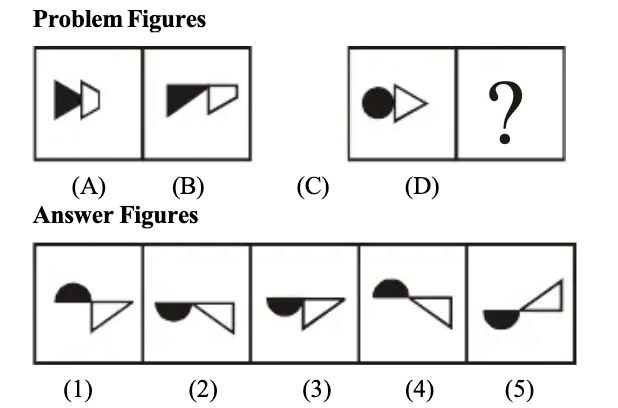
Pattern Identified: Lower Half Retention / Figure Truncation
🔍 Analysis
In the first pair, Figure (B) represents the lower half of Figure (A). The upper portions of both triangles are removed while preserving their relative arrangement.
Applying the same rule to the second pair, only the lower half of the circle and triangle combination is retained. The resulting figure matches the required answer.
Correct Answer: Option (3)
Sample Question 2
DIRECTIONS (Q. 2) : Figures A and B are related in a particular manner. Establish the same relationship between figures C and D by choosing a figure from amongst the five alternatives, which would replace the question mark in fig. (D)
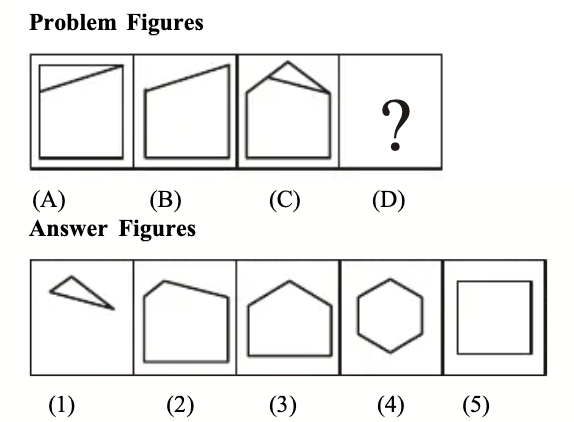
Pattern Identified: Removal of the Upper Separated Portion
🔍 Analysis
In the first pair, the slanting line divides the figure into two parts. The upper separated portion is removed, leaving only the lower part of the figure.
Applying the same rule to Figure (C), the triangular roof portion above the internal line is removed. The remaining shape matches Option (2).
Correct Answer: Option (2)
Sample Question 3
DIRECTIONS (Q. 3) : Figures A and B are related in a particular manner. Establish the same relationship between figures C and D by choosing a figure from amongst the four alternatives, which would replace the question mark in fig. (D)
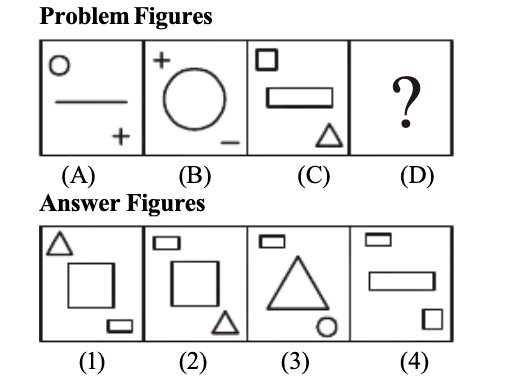
Pattern Identified: Cyclic Position Shift with Enlargement and Reduction
🔍 Analysis
In the first pair, the upper element becomes enlarged and moves to the centre. The central element becomes smaller and shifts to the lower position. The lower element moves to the upper position.
Applying the same transformation to Figure (C), the square becomes large and occupies the centre, the rectangle becomes smaller and moves to the bottom, and the triangle shifts to the top.
Correct Answer: Option (1)
Sample Question 4
DIRECTIONS (Q. 4) : Figures A and B are related in a particular manner. Establish the same relationship between Figures C and D by choosing a figure from amongst the alternatives, which would replace the question mark.
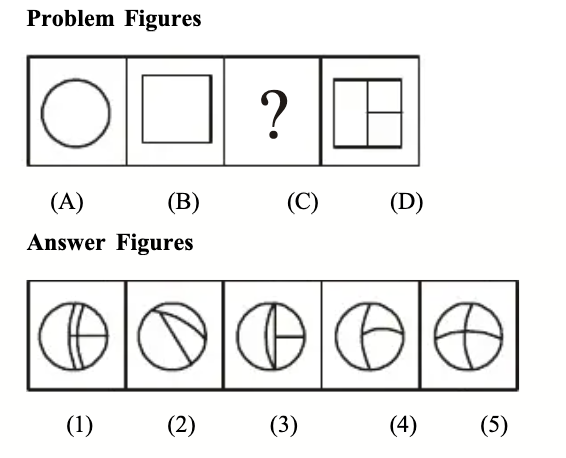
Pattern Identified: Straight-Line Division Converted into Curved Division
🔍 Analysis
Figure (D) is obtained by dividing the square into sections using straight lines. When the same concept is applied to a circular figure, the divisions adapt to the circular boundary and appear as curved arcs.
Thus, the circle should contain partitions corresponding to those in the square, but represented in a curved form. Among the answer figures, Option (4) best matches this transformation.
Correct Answer: Option (4)
Sample Question 5
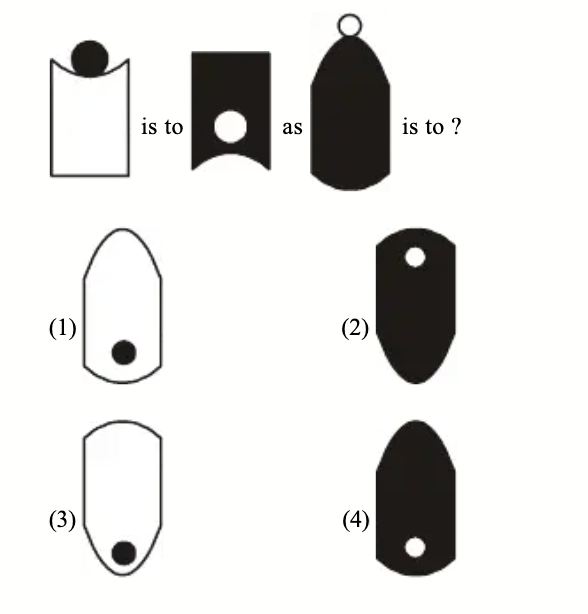
Pattern Identified: Colour Reversal and Top-to-Bottom Movement of Circle
🔍 Analysis
In the first pair, the colours of the outer figure and the circle are reversed. The circle moves from the top position to the bottom position of the main figure.
Applying the same rule to the third figure, the black outer figure becomes white, the white circle becomes black, and the circle shifts to the bottom. The resulting figure matches Option (3).
Correct Answer: Option (3)
Sample Question 6
There is a definite relationship between figures A and B. Establish a similar relationship between figure C and D by choosing a suitable figure (4) from the answer figures.
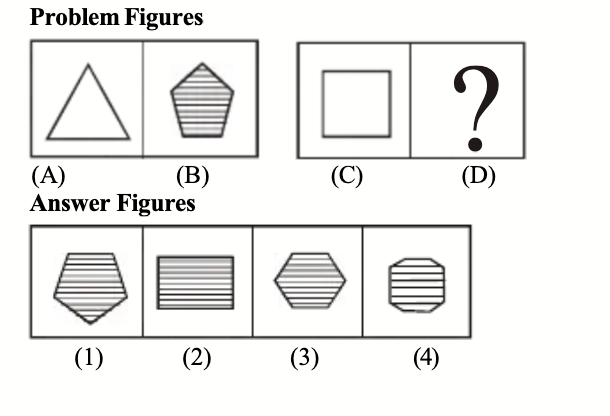
Pattern Identified: Increase in Number of Sides with Shading
🔍 Analysis
The triangle transforms into a striped pentagon. Applying the same increase in sides and shading pattern to the square gives the correct figure.
Correct Answer: Option (3)
Sample Question 7
Which circle should replace the question mark ?
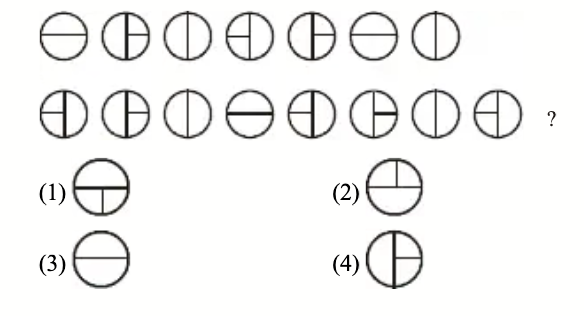
Pattern Identified: Leftmost Figure Shifting One Position Right in Successive Groups
🔍 Analysis
Divide the sequence into groups of four figures. In each successive group, the figure that originally appears at the far left shifts one place to the right.
The circle containing only a horizontal diameter appears in the 1st position of the first group and the 3rd position of the next group. Therefore, it should occupy the 4th position of the following group, which is the missing figure.
Correct Answer: Option (3)
Sample Question 8
DIRECTIONS (Qs. 8-9) : Each of the following questions consists of two sets of figures. Figures A, B, C and D constitute the problem set while figures 1, 2, 3, 4 and 5 constitute the answer set. There is a definite relationship between figures A and B. Establish a similar relationship between figures C and D and choose the one figure from answer set as alternative letter.
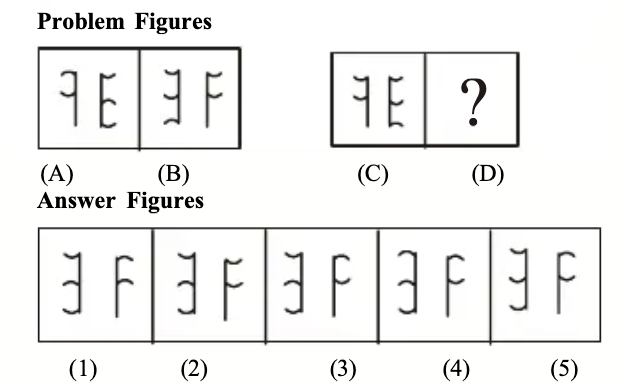
Pattern Identified: Vertical Reversal and Transfer of Arcs Between the Two Designs
🔍 Analysis
In Figure (A), the two lower arcs of the right-hand design are turned over vertically. The entire right-hand design then reverses horizontally and shifts to the left side in Figure (B).
The uppermost arc of the left-hand design reverses vertically and shifts to the right side. Applying the same transformation to Figure (C) produces the figure shown in Option (3).
Correct Answer: Option (3)
Sample Question 9
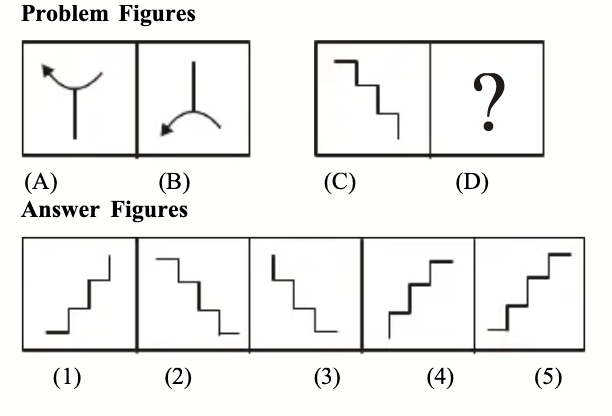
Pattern Identified: Vertical Reversal (Top-Bottom Reflection)
🔍 Analysis
From Figure (A) to Figure (B), the entire design is reversed vertically. The upper curved portion moves to the bottom, and the downward vertical line becomes upward.
Applying the same vertical reversal to Figure (C), the descending staircase transforms into the corresponding upward staircase shown in Option (1).
Correct Answer: Option (1)
Sample Question 10
DIRECTIONS (Qs. 10-11) : Figures A and B are related in a particular manner. Establish the same relationship between figures C and D by choosing a figure from amongst the five alternatives, which would replace the question mark in fig. (D)
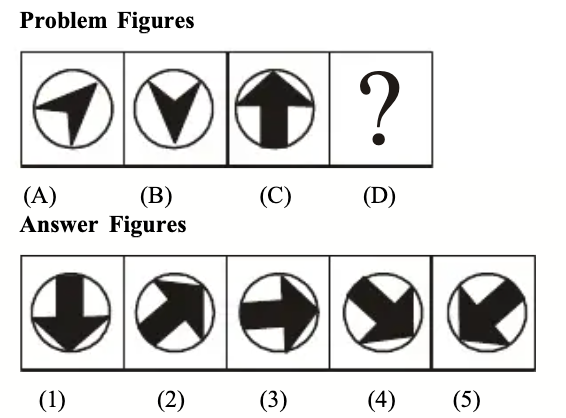
Pattern Identified: Rotation Through 135° Clockwise
🔍 Analysis
Figure (B) is obtained by rotating Figure (A) through 135° clockwise. The entire black figure along with the white cut-out portions rotates as a single unit.
Applying the same 135° clockwise rotation to Figure (C) produces a figure pointing toward the lower-right direction. The resulting figure matches Option (4).
Correct Answer: Option (4)
Sample Question 11
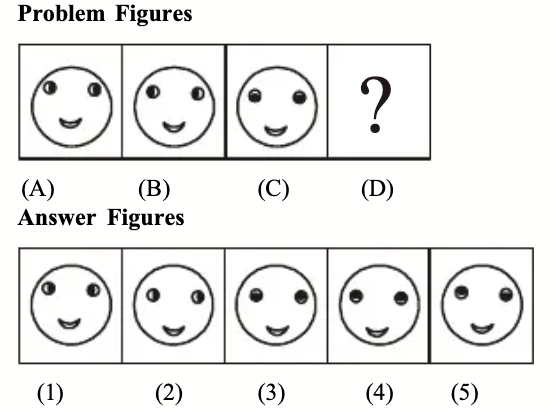
Pattern Identified: 180° Rotation of the Partially Shaded Eyes
🔍 Analysis
The partially shaded eyes rotate through 180° from one figure to the next. The white highlights move to the opposite side while the mouth remains unchanged.
Applying the same 180° rotation to the eyes in Figure (C) produces the arrangement shown in Option (4).
Correct Answer: Option (4)
Approach to Solve Sample Questions
Non Verbal Analogy questions become much easier when solved using a systematic approach. Instead of guessing based on appearance, candidates should focus on identifying the exact relationship between the figures.
- Observe the first pair of figures carefully.
- Identify the hidden relationship between them.
- Check for size, shape, position, or rotation changes.
- Look for addition or deletion of elements.
- Observe movement or rearrangement of symbols.
- Apply the same relationship to the second pair.
- Compare all answer options carefully.
- Select the figure that perfectly matches the relationship.
Important Concepts Covered in Sample Questions
| Concept | Application |
|---|---|
| Size Transformation | Large and small figures interchange sizes or proportions |
| Rotation of Figures | Figures rotate through fixed angles such as 90°, 135°, or 180° |
| Vertical & Horizontal Reflection | Figures reverse vertically, horizontally, or both |
| Position Interchange | Elements shift from top to bottom, left to right, or exchange positions |
| Shape Truncation | Upper, lower, left, or right portions of figures are removed |
| Progressive Figure Construction | New lines or components are added step-by-step to complete a figure |
| Internal Partition Transformation | Straight partitions, curved partitions, and sectional divisions are modified |
| Symbol Rearrangement | Symbols move according to a fixed cyclic or positional pattern |
| Colour Reversal | Black and white regions interchange while maintaining structure |
| Shape Enlargement & Reduction | Selected elements enlarge, shrink, or change relative importance |
| Arc & Curve Transformation | Curved portions rotate, reverse, or change orientation |
| Cyclic Movement Pattern | Elements move systematically in a repeating sequence |
| Pattern Recognition | Identifying hidden visual relationships between figure pairs |
| Logical Deduction | Applying the same visual relationship to a new figure pair |
| Visual Analysis | Careful comparison of shapes, symbols, positions, and orientations |
Common Mistakes Students Make
- Comparing figures instead of relationships.
- Ignoring rotation or directional changes.
- Overlooking symbol movement.
- Missing size transformation patterns.
- Ignoring addition or deletion of elements.
- Selecting visually similar options without analysis.
- Not checking all answer choices.
- Confusing mirror images with rotations.
- Focusing only on outer figures.
- Rushing without identifying the actual pattern.
Expert Tips for Solving Analogy Questions
- Always analyze the first pair completely before looking at the second pair.
- Check size transformation and rotation first.
- Observe movement of symbols individually.
- Count sides, lines, and elements whenever applicable.
- Use elimination method to remove incorrect options quickly.
- Check for mirror-image and reflection patterns.
- Focus on logical relationships rather than visual similarity.
- Practice different analogy patterns regularly.
- Develop observation speed through continuous practice.
- Verify the relationship before finalizing the answer.
Quick Learning Framework
Observe First Pair Carefully
↓
Identify Hidden Relationship
↓
Analyze Transformation Type
↓
Apply Same Logic to Second Pair
↓
Compare Answer Options
↓
Select the Correct Figure
Final Takeaway
The Sample Questions in Non Verbal Analogy demonstrate how different logical relationships are applied between figures. These relationships may involve size transformation, rotation, position interchange, symbol rearrangement, addition or deletion of elements, mirror reflection, or pattern progression.
Success in analogy questions depends on observation skills, logical deduction, visual intelligence, and pattern recognition ability. Candidates who practice a variety of analogy patterns regularly can solve questions faster and more accurately in competitive examinations.
Remember that the key to solving Non Verbal Analogy questions is not identifying similar figures, but identifying the relationship that connects them.